IN Brief:
- HELENA applies coherent beam combination to scalable high-energy laser-source configurations.
- QinetiQ is expanding development and manufacturing capacity at Farnborough and Malvern.
- The programme will support UK and allied directed-energy systems across land, maritime, and fixed installations.
QinetiQ is investing £20 million to develop and manufacture a scalable family of high-energy laser sources derived from technology created for the UK DragonFire directed-energy programme.
The HELENA product family uses coherent beam combination to bring several laser channels together into a higher-power output. Configurations are being developed for applications ranging from vehicle-mounted counter-drone systems to larger naval and fixed-site installations.
Development and production capacity will expand at QinetiQ’s Farnborough and Malvern sites, where the company works on laser sources, beam control, sensing, and associated defence technologies. Existing directed-energy activity supports approximately 150 jobs.
Separating the laser source from the wider DragonFire weapon architecture allows HELENA to be offered as a subsystem for UK and allied programmes. DragonFire itself is being developed by MBDA, Leonardo, and QinetiQ, with initial Royal Navy deployment planned from 2027.
Lower-power HELENA configurations are expected to begin around 30kW for counter-uncrewed-aircraft and short-range air-defence applications. Larger systems could reach 150kW or more for naval defence, counter-missile roles, and the protection of fixed infrastructure.
Coherent beam combination requires several optical channels to remain phase aligned so that their outputs reinforce one another. Sensors, control electronics, optical components, software, mechanical stability, and thermal management must operate together within narrow tolerances.
Electrical conversion presents an equally demanding system problem because a high-energy laser draws substantial input power while producing significant waste heat. Power supplies must deliver controlled energy under dynamic operating conditions without disturbing sensitive beam-control and sensing electronics.
As output rises, optical efficiency and cooling capacity determine how large the surrounding system becomes. Pumps, heat exchangers, filters, power converters, and energy storage can occupy more volume than the laser source itself, particularly on a compact land vehicle.
A naval platform provides more space and electrical capacity, yet integration still affects the ship’s generation, distribution, cooling, combat management, and maintenance architecture. Peak demand must be accommodated alongside propulsion, radar, communications, and other mission loads.
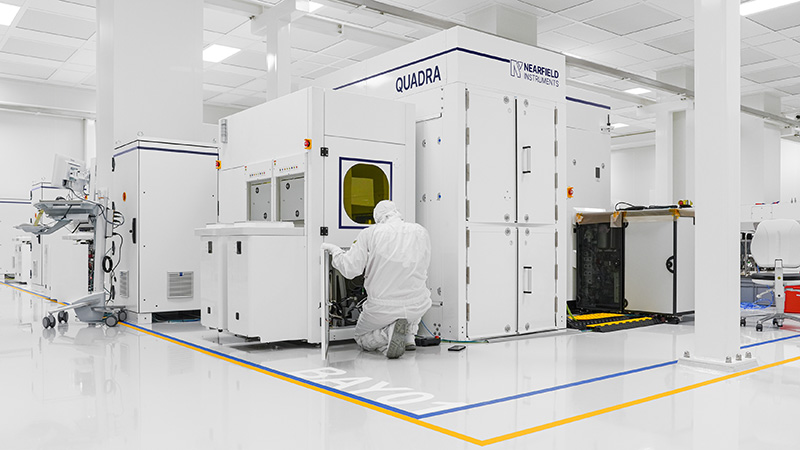
Scaling from a demonstrator into a product family changes the manufacturing task. A laboratory team can tune an individual assembly, whereas production requires repeatable optical alignment, controlled contamination, calibrated test equipment, traceable components, and suppliers capable of maintaining performance across successive units.
Fibre-laser technology draws from an industrial base established in cutting and welding, but a military source faces different duty cycles, environmental exposure, shock, vibration, storage conditions, and reliability requirements. Its components must also remain supportable throughout a programme that may operate for decades.
The operational attraction lies partly in magazine depth because each engagement consumes electrical energy rather than a separate missile. Available power and cooling still limit repeated firing, while atmospheric turbulence, rain, dust, line of sight, and the time required to hold energy on a target influence performance.
Directed energy will consequently sit alongside electronic warfare, guns, and missiles rather than replacing every conventional effector. Target type, range, weather, collateral constraints, and urgency will decide which layer of the defensive system is used.
Manufacturing capacity has become central as European demand for air defence rises and conventional interceptor stocks require lengthy replenishment. A common laser-source family could support greater production volume than several unrelated bespoke designs, provided interfaces and variants remain tightly controlled.
Repeated customer-specific changes to power conversion, cooling, software, optics, and mechanical packaging would erode those economies. Modular source units, qualified subassemblies, and defined electrical and thermal interfaces will therefore shape the achievable production rate.
The same industrial pressure is visible across GCAP’s movement from programme funding into engineering and factory preparation. Directed-energy production draws on many of the same scarce capabilities, including photonics, secure software, power electronics, thermal design, and precision manufacturing.
HELENA moves QinetiQ’s laser work from a programme-specific contribution towards a separately manufactured subsystem. The investment now has to convert difficult optical and electrical engineering into repeatable hardware that can be delivered, maintained, and upgraded at operational scale.