IN Brief:
- IAAPS and GKN Aerospace tested a TRL4 energy storage system and an integrated fuel-cell power generation system under the H2GEAR programme.
- Testing required gaseous hydrogen supply, high-power battery emulation and cryogenic helium cooling, alongside electrical measurement facilities.
- GKN announced completion of H2GEAR in July 2026; the 20 October technical account does not establish a new test-completion date.
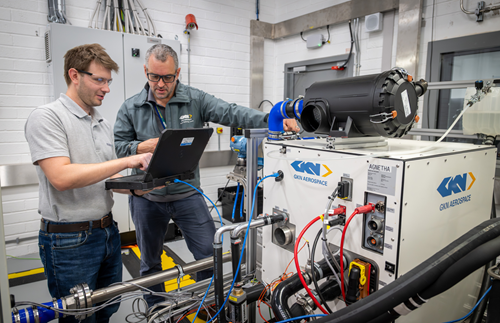
IAAPS has detailed its hydrogen-electric propulsion testing with GKN Aerospace, describing the infrastructure and procedures used to validate an energy storage system and integrated fuel-cell power generation hardware. The work formed part of the £54 million H2GEAR programme and involved specialised hydrogen supply, high-power electrical testing and cryogenic cooling capabilities at the Bristol and Bath Science Park.
A technical account published on 20 October 2026 identifies the equipment tested and the facilities developed for the collaboration. GKN Aerospace had already announced completion of H2GEAR on 19 July, however, and the later account does not establish that the individual tests were completed during October. The disclosed results concern the earlier programme rather than a verified new test campaign.
H2GEAR investigated technologies for hydrogen-electric aircraft propulsion, including electrical power generation, energy storage, high-power distribution and cryogenic drive systems. In the proposed arrangement, hydrogen supplies a fuel-cell system that produces electrical energy, which is then conditioned and delivered to the equipment needed to propel an aircraft.
Fuel-cell generation differs from a conventional combustion engine because electrochemical reactions are used to produce electricity. A proton exchange membrane fuel cell combines hydrogen and oxygen through an electrochemical process, producing an electrical output alongside water and heat. The complete power generation assembly also requires supporting equipment to manage reactant supply, operating conditions and heat removal.
Aircraft applications place demanding constraints on these systems because installed mass and volume influence the energy and performance available for flight. Generation hardware must also operate with suitable reliability while responding to changes in electrical demand. The characteristics of the fuel-cell stack, its supporting equipment and the downstream electrical network consequently need to be assessed together.
The collaboration between IAAPS and GKN included tests of a technology readiness level four energy storage system and an integrated fuel-cell power generation system. TRL4 denotes validation at an early stage of technology development, generally under controlled laboratory conditions. It does not establish that a propulsion architecture is ready for installation on an operational aircraft.
Electrical storage can support a fuel-cell propulsion architecture by responding to power requirements that change more rapidly than the generation system can comfortably accommodate. During a transient, the storage system may absorb or supply energy while control equipment manages the relationship between generation, distribution and the connected electrical loads.
A propulsion motor may demand increased current during acceleration or changes in operating conditions. The power network must deliver that energy without allowing voltage or current to move beyond the permissible limits of connected equipment. The storage system, generator and associated power converters must therefore operate under coordinated control rather than being assessed solely as independent components.
IAAPS established high-power battery emulation capability for the test programme. A battery emulator uses controlled electrical equipment to reproduce selected characteristics of an energy storage source without requiring a physical battery pack for every test condition. It can impose defined voltage and current behaviour, allowing connected equipment to be evaluated against repeatable operating scenarios.
Such emulation is useful when investigating fault responses, transient loading and system-control behaviour, but its fidelity depends on the electrical model and the capabilities of the emulator. A laboratory power system that reproduces selected voltage and current characteristics does not automatically reproduce every thermal, chemical or ageing process occurring inside a real battery.
The programme also required gaseous hydrogen supply arrangements. Hydrogen handling introduces safety and engineering requirements involving storage, pressure control, ventilation, detection and suitable equipment for the operating environment. Test facilities need to manage these hazards alongside the electrical risks associated with high-power propulsion hardware.
The work involved cryogenic helium cooling infrastructure, another capability established through the collaboration. Cryogenic systems operate at temperatures far below ordinary ambient conditions and require carefully selected materials, thermal insulation and suitable control of heat entering the system.
Cooling can influence the performance of electrical conductors, machines and associated components. The useful benefit depends on the hardware being cooled, the target temperature and the energy required to operate the cooling equipment. A reduction in electrical losses within one component does not independently establish improved efficiency for the complete propulsion system.
Hydrogen-electric aircraft designs may also involve liquid hydrogen storage, introducing additional cryogenic requirements. The facilities described in the October account supported relevant test work, but no complete operating dataset establishes that every element of a liquid-hydrogen propulsion system was demonstrated simultaneously under flight-representative conditions.
Electrical testing requires careful measurement of both steady operating conditions and changing loads. Voltage, current, delivered power and component temperatures may need to be recorded while the equipment responds to commanded operating changes. The measurement system must have sufficient bandwidth and accuracy to capture the behaviour relevant to the design being assessed.
Integration testing is more demanding than confirming that separate pieces of equipment operate correctly. Interactions between generation, storage, controllers and power converters may create oscillations, unexpected transients or thermal loads not apparent during isolated tests. The control architecture must also respond predictably when one subsystem approaches an operating limit.
Hydrogen and cryogenic equipment introduce constraints on the test sequence itself. Operating conditions must be established safely before particular electrical measurements can begin, while shutdown procedures need to account for both the energy remaining in electrical storage and the behaviour of hydrogen supply and cooling systems.
IAAPS and GKN report successful validation work at TRL4, but the October account does not provide a full test matrix, measured conversion efficiencies, power output ratings or transient-response data for the integrated system. Those omissions prevent a detailed comparison with alternative propulsion architectures or an independent assessment of the performance achieved.
GKN’s July completion announcement described H2GEAR achievements in aircraft-level design studies, cryogenic electrical systems and fuel-cell propulsion integration. It also identified subsequent technology programmes intended to continue development of selected elements, including H2FlyGHT and ICEFLIGHT.
The October account refers to future work on cryogenically cooled power distribution conduits and high-power electrical drive systems. These are areas identified for further development, not evidence that a new October contract, completed experimental campaign or certified propulsion installation has been established.
Further testing will need to investigate electrical losses, cooling demand, fault containment and reliability under conditions representative of the intended aircraft application. The complete system must eventually satisfy the relevant aviation safety and certification requirements, extending substantially beyond the laboratory validation reported for H2GEAR.
The IAAPS test infrastructure provides a basis for that continuing engineering work. Its hydrogen supply, battery emulation and cryogenic capabilities supported H2GEAR’s earlier validation activities, while the precise timing of the individual tests and any separate subsequent milestones remain undocumented in the October account.