IN Brief:
- QPS201 scanners will be installed at passenger checkpoints across five Airports of Thailand sites.
- The fully electronic system operates from 70GHz to 80GHz and uses multistatic millimetre-wave imaging.
- Rohde & Schwarz says more than 2,000 QPS systems are already deployed at airports worldwide.
Rohde & Schwarz will supply QPS201 millimetre-wave security scanners to passenger checkpoints at five Airports of Thailand sites, including Bangkok Suvarnabhumi Airport.
The award puts the German company’s advanced imaging technology into a network that includes one of Asia’s busiest aviation hubs. Rohde & Schwarz says the QPS201 systems supplied to Airports of Thailand are certified to European Civil Aviation Conference and US Transportation Security Administration requirements, with more than 2,000 QPS systems already deployed at airports worldwide.
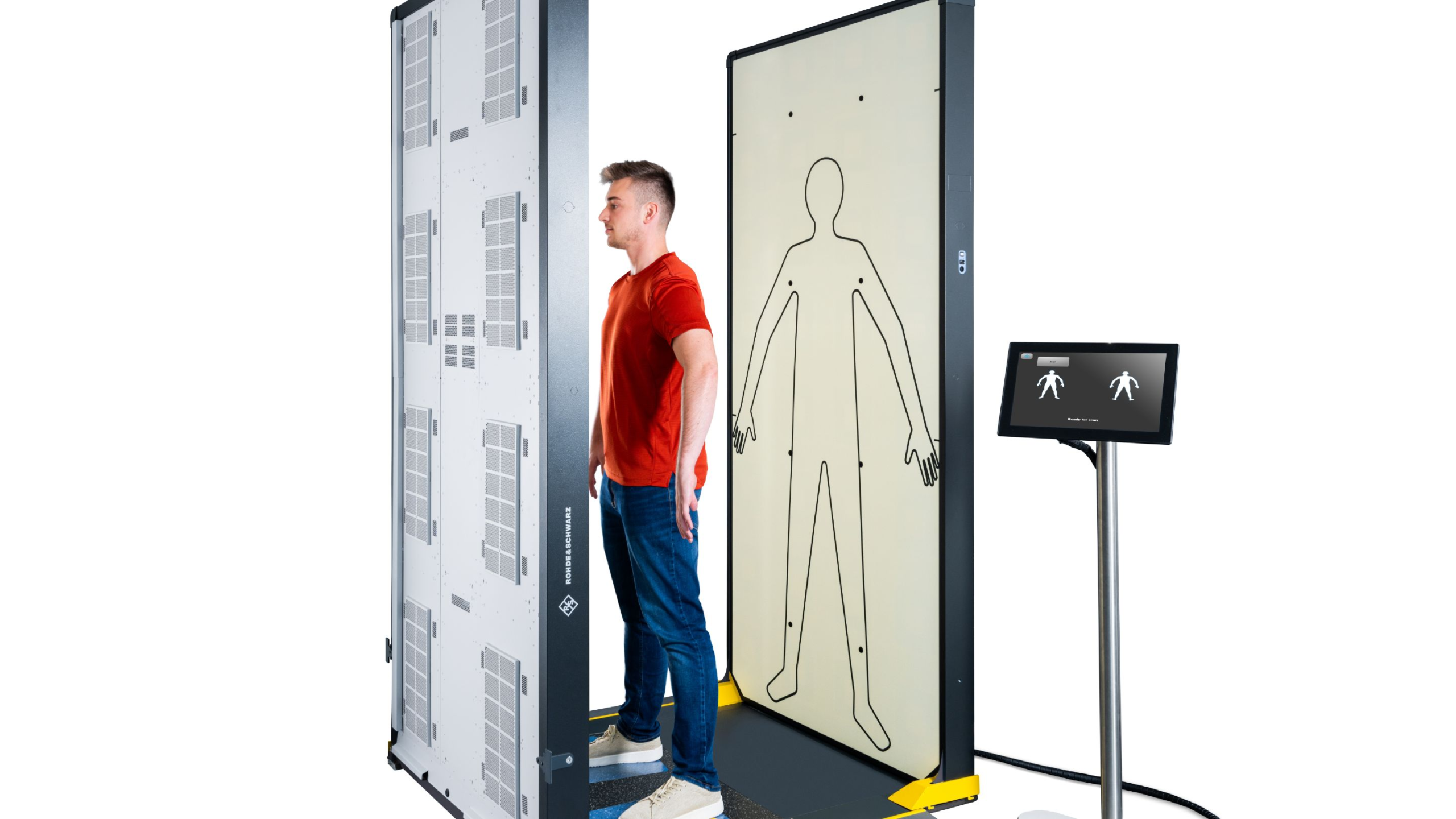
QPS201 operates from 70GHz to 80GHz and uses a multistatic architecture with thousands of transmitter and receiver antennas in each panel. Rohde & Schwarz specifies approximately 1mW transmit power and a data-acquisition time of around 24ms per panel. The scanner is fully electronic, with no moving scanning mechanism.
The passenger adopts a hands-down pose between the two open panels while the system collects reflected millimetre-wave data. Automated detection algorithms identify anomalies associated with concealed metallic and non-metallic objects, and alarm locations are shown on a standardised digital avatar rather than an image revealing personal attributes.
Unlike X-ray screening, the system uses non-ionising radiation. The 70GHz to 80GHz band also provides a short wavelength for high-resolution imaging of objects carried on the body or concealed in clothing. Rohde & Schwarz states that its QPS architecture collects more than a billion measurements during a complete scan, although the operational time at a checkpoint also includes processing, passenger movement, and any alarm resolution.
That distinction is important in a large airport installation. A short acquisition time does not automatically determine passenger throughput because the scanner sits inside a wider process involving document checks, tray handling, baggage screening, staffing, and secondary searches. Hardware performance still needs to translate into repeatable operation across different terminals and passenger flows.
The absence of mechanically scanned parts removes one source of wear from the equipment. Rohde & Schwarz also offers automated screening functions and centralised fleet monitoring, allowing operators to manage multiple systems and review performance across a wider installation rather than treating each scanner as an isolated unit.
Certification carries similar weight. Airport security equipment is deployed under national and international regulatory regimes, so qualification against established ECAC and TSA requirements gives Airports of Thailand a platform already assessed for aviation passenger screening. It also provides a common technical baseline for a deployment spanning five airports rather than a single demonstration lane.
The five-airport scope also changes the support requirement. A single checkpoint installation can be managed around local staff and spare parts; a distributed estate needs consistent software configuration, maintenance procedures, operator training, and fault reporting. Centralised monitoring is therefore more useful when the same scanner type is spread across several terminals and airports.
The Thai award extends QPS201 beyond the company’s existing airport installed base and into another multi-site operating environment. Suvarnabhumi handles around 60 million passengers a year, which places the equipment in a setting where availability, false-alarm performance, operator training, and maintenance will be tested continuously rather than during limited trials.
Millimetre-wave scanners are also used in correctional facilities, critical infrastructure, and employee-screening applications, but aviation remains one of the more demanding environments because throughput and regulatory compliance have to coexist. Small increases in alarm resolution time can accumulate quickly when thousands of passengers pass through a checkpoint.
For Airports of Thailand, the installation is therefore a systems deployment rather than simply a purchase of RF hardware. The 70GHz to 80GHz electronics provide the sensing layer, but the success of the rollout will depend on how consistently the scanners integrate with checkpoint procedures and how effectively their automated detection handles real passenger traffic across five separate airports.