IN Brief:
- Four Aetina variants use Jetson Orin NX or Orin Nano modules with performance spanning 34 to 100 TOPS.
- Each system provides four Fakra-Z GMSL2 camera connections in a 136.3 × 132 × 63mm enclosure.
- MIL-STD-810H testing, E-Mark certification, 9–36V input, and ignition control target vehicles, AMRs, and industrial machinery.
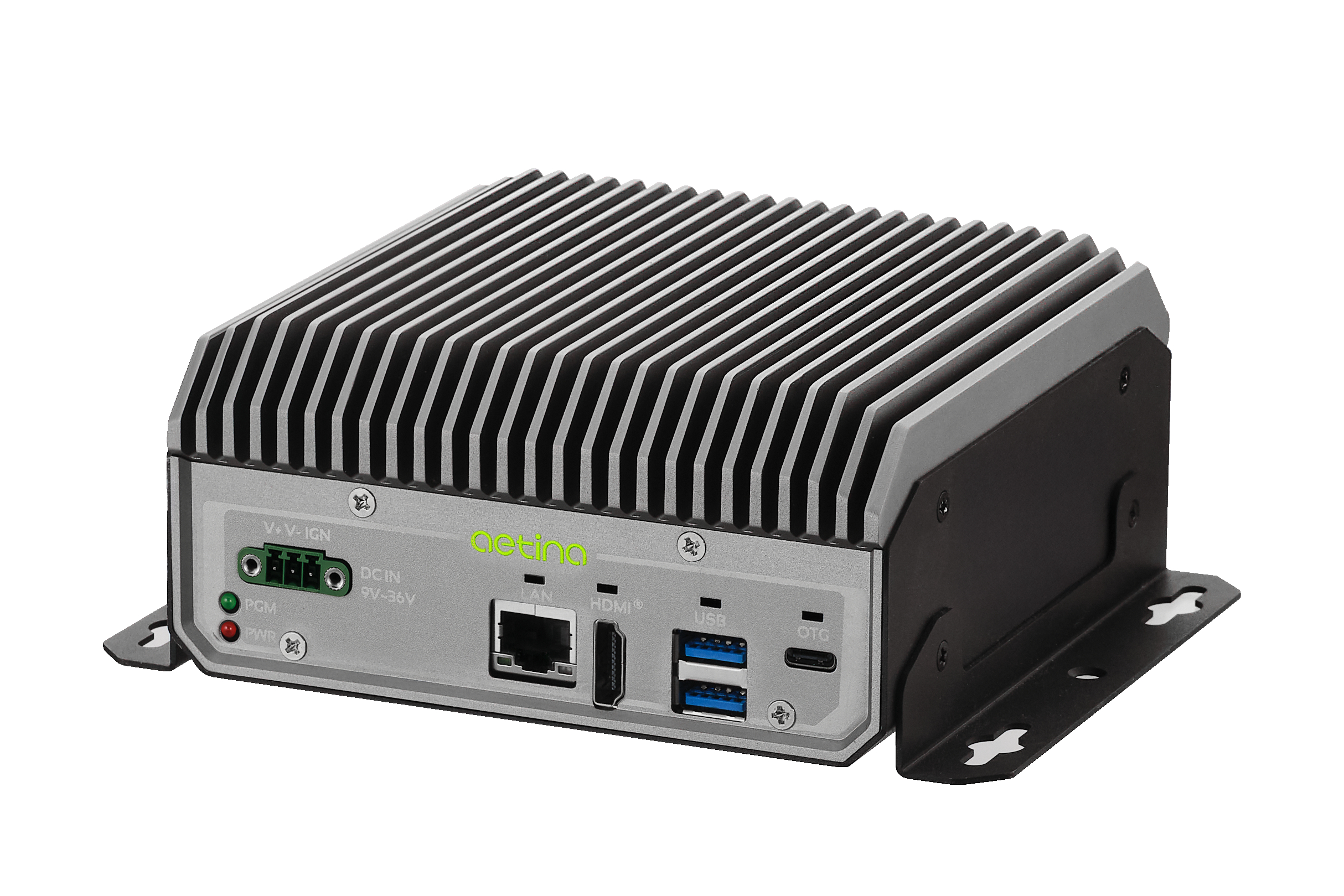
Aetina has launched four palm-sized edge AI systems combining NVIDIA Jetson Orin compute with four GMSL2 camera interfaces, fanless cooling, and vehicle-oriented power management. The DeviceEdge AIE-VN34/44 and AIE-VO24/34 are intended for transportation, autonomous mobile robots, and industrial automation where multi-camera inference has to fit inside a compact, rugged enclosure.
The AIE-VN44 uses a Jetson Orin NX 16GB module and delivers up to 100 TOPS, while the AIE-VN34 combines an Orin NX 8GB module with up to 70 TOPS. The Orin Nano-based AIE-VO34 and AIE-VO24 provide up to 67 TOPS and 34 TOPS respectively, allowing integrators to select compute performance without changing the basic mechanical and camera architecture.
All four systems measure 136.3 × 132 × 63mm and provide four GMSL2 camera ports using Fakra-Z connectors. That interface is well suited to distributed machine-vision systems because cameras can be located away from the processor while retaining a high-bandwidth serial connection through locking connectors designed for mobile environments.
Aetina is supporting the computers with validated GMSL2 adapter boards and camera modules, while the launch material specifies image transmission over distances of up to 15 metres. The combination is aimed at shortening the integration work needed to connect several cameras to a Jetson platform for surround monitoring, blind-spot detection, obstacle avoidance, industrial inspection, and similar workloads.
The mechanical design reflects mobile and factory deployment rather than laboratory use. Aetina says the systems have passed MIL-STD-810H shock and vibration testing and carry E-Mark E24 certification, while the specified operating range extends from -25°C to +55°C. Fanless cooling removes a moving component and reduces maintenance requirements in environments where dust, vibration, or restricted airflow can make conventional small fans troublesome.
The power architecture is similarly tailored to vehicles and industrial equipment. The units accept 9–36V DC and include ignition power control so startup and shutdown can follow the host vehicle or machine. That gives the embedded computer a controlled response to supply changes rather than treating it as permanently powered IT hardware attached to an unstable electrical source.
Interfaces beyond the cameras include Gigabit Ethernet, USB 3.2, HDMI, isolated CAN FD, configurable GPIO or RS-232, M.2 storage, and an M.2 E-Key expansion position for wireless connectivity. The combination allows the system to connect vision sensors, vehicle networks, controllers, storage, and local displays without requiring a separate computer for each interface domain.
Multi-camera processing is where the compact form factor becomes most relevant. A vehicle or AMR may need several camera views for local perception, while a production machine can use multiple inspection angles to detect defects or track material without sending continuous raw video to a remote server. Local inference reduces network dependence, although camera calibration, model accuracy, latency, thermal limits, and safety requirements remain system-level responsibilities.
The four models also show the trade-off between compute headroom and deployment constraints. The 100 TOPS configuration provides more capacity for concurrent vision networks, but power consumption, model optimisation, storage bandwidth, and thermal design still determine how much of that headline performance can be used continuously inside a sealed or confined installation.
Aetina’s product page lists MIL-STD-810H vibration and shock tests, E-Mark certification, CE, FCC Class A, and UKCA, giving integrators a clearer starting point for vehicle and industrial approvals. Those certifications do not qualify the finished application, but they remove part of the environmental and electromagnetic compliance work associated with selecting an untested development platform.
The systems support Linux with NVIDIA JetPack 6.2 and above, while the supplied announcement states that JetPack 7.2 support is planned. Aetina is also positioning the hardware as ready for mass production, which moves the emphasis from prototype capability towards lifecycle support, peripheral validation, and the consistency of the board-support package over deployed fleets.
Compact edge AI computers are increasingly defined by the interfaces and environmental controls around the accelerator rather than by TOPS alone. Aetina’s new platform packages camera connectivity, power conditioning, ruggedisation, and Jetson compute into one enclosure; deployments will show whether that integration reduces enough engineering work to outweigh the reduced flexibility of building each subsystem separately.