IN Brief:
- KTR has added FR3 evaluation capability to its existing 4G and 5G testing environment using Anritsu's MT8000A.
- The platform supports research, technical verification, automated testing, and future 6G signalling work as FR3 specifications develop.
- Building certification-oriented test capability before standards are final gives KTR a base that can evolve alongside eventual 6G requirements.
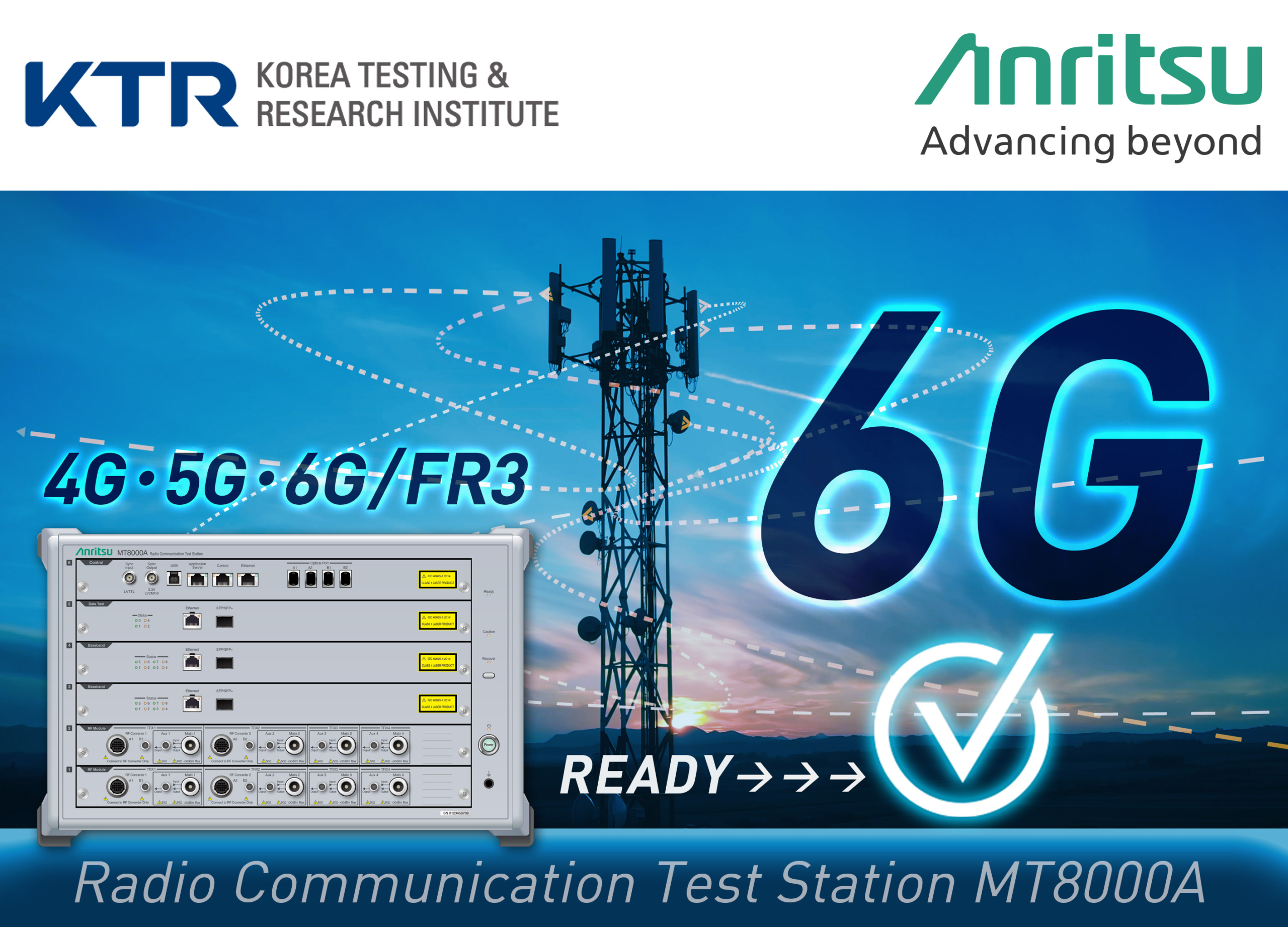
Anritsu is supplying its MT8000A Radio Communication Test Station to Korea Testing & Research Institute, giving KTR an FR3 evaluation environment alongside its existing 4G and 5G testing capability. The institute plans to use the platform for 6G research, technical verification, standardisation work, and the development of future certification procedures.
FR3 is being considered for next-generation mobile systems because it sits between the frequencies used extensively by current sub-6GHz networks and the higher millimetre-wave bands explored for very high-capacity links. Anritsu’s current MT8000A configuration supports the 7.125GHz to 16GHz portion of the broader FR3 spectrum, giving researchers access to a band in which 6G radio architectures are already being evaluated.
KTR’s installation extends an established cellular test environment rather than creating an isolated research bench. That is significant for work that will eventually have to bridge experimental radio techniques and repeatable conformance testing, because equipment developed around candidate 6G bands will need to be assessed against common procedures once standards begin to stabilise.
The MT8000A is already used for 5G signalling and radio testing, and Anritsu has expanded the platform with FR3-capable RF hardware. KTR can therefore work with a common test architecture across several mobile generations while developing new procedures around candidate 6G frequencies, rather than maintaining a separate experimental platform with no route into later certification activity.
Automated testing is also part of the planned environment. KTR intends to combine the MT8000A with Anritsu software to increase the efficiency and repeatability of FR3 evaluation, with future applications including 6G signalling tests. Automation becomes increasingly useful when engineers have to sweep large combinations of frequency, bandwidth, modulation, power, and channel conditions while preserving results that can be compared between laboratories.
FR3 still presents a substantial RF design challenge. Moving above the bands used by much current mobile equipment affects antenna dimensions, front-end design, propagation, device losses, power consumption, and measurement methodology. The higher frequencies offer access to wider bandwidth, but they also require engineers to characterise performance under conditions that sit between familiar sub-6GHz behaviour and the more severe propagation constraints of millimetre wave.
That places test equipment suppliers close to the standardisation process. Instrumentation has to support research before every parameter has been fixed, then evolve as candidate techniques become formal requirements. A platform designed only around a finished standard would arrive too late for developers working on the radios and devices that help establish the standard in the first place.
KTR brings a certification perspective to that work. Research laboratories can demonstrate a radio technique under controlled conditions, but commercial interoperability eventually depends on measurements that different laboratories, manufacturers, and regulators can reproduce. Establishing the equipment and test methodology early gives the institute time to develop that repeatability while the underlying technology is still changing.
The process will remain iterative. Candidate spectrum allocations, waveform decisions, signalling procedures, RF performance limits, and certification requirements can all change before a commercial 6G specification emerges. KTR’s testbed therefore provides an adaptable engineering environment rather than a finished 6G certification system.
Anritsu’s role is to keep the test platform aligned with that progression. By extending the MT8000A from current 4G and 5G work into FR3, it can support customers that need to compare new radio techniques against existing cellular behaviour while avoiding a wholesale change of test architecture between research phases.
The value of the installation will become clearer as 6G standardisation moves from spectrum studies and experimental radio work towards formal signalling and conformance requirements. KTR now has an FR3 platform on which those procedures can be developed before certification demand arrives, rather than trying to assemble the necessary infrastructure after commercial hardware is already waiting to be tested.