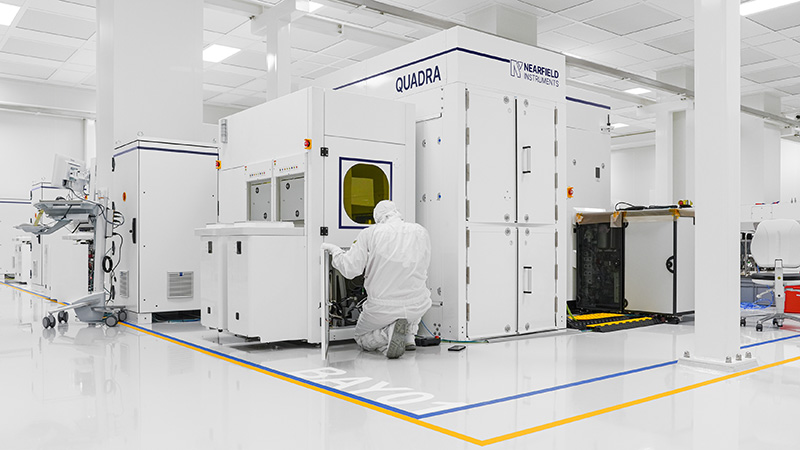
IN Brief:
- CACI has opened a 61,000ft² Manufacturing Center of Excellence for Defense Electronics in Greater Rochester.
- The facility increases CACI's manufacturing space by more than 300% and covers development, testing, assembly, delivery, and acceptance.
- TLS BCT Manpack production provides the initial programme base, with additional software-defined electronic warfare systems planned.
CACI International has opened a 61,000ft² Manufacturing Center of Excellence for Defense Electronics in the Greater Rochester area of New York, increasing its manufacturing space by more than 300% as production of software-defined electronic warfare equipment expands. The facility covers development, testing, assembly, delivery, training, customer acceptance, and onsite storage.
The immediate programme anchor is the US Army’s Terrestrial Layer System Brigade Combat Team Manpack, or TLS BCT Manpack, a portable signals-intelligence and electronic-warfare system for dismounted personnel. CACI describes TLS Manpack as a modular, low-size, weight, and power platform combining signal collection, processing, exploitation, and electronic effects in a software-defined architecture.
The Army increased the programme through a contract modification worth nearly $400 million in 2025, covering further procurement, training, and fielding. CACI subsequently described the wider TLS Manpack programme as having reached approximately half a billion dollars in value, creating a production requirement substantially larger than a conventional development or demonstration programme.
Rochester therefore has to support more than PCB assembly. Software-defined electronic warfare equipment combines RF receivers and transmitters, digital processing, embedded computing, power conversion, rugged packaging, firmware, software configuration, security controls, and system-level test, all of which have to remain consistent enough for fielded units to share a controlled hardware and software baseline.
That requirement becomes harder as production increases. A software-modifiable system can absorb new capabilities without replacing every physical module, but only if the manufacturer knows exactly which hardware, firmware, calibration data, and configuration are present in each unit. Component substitutions and design revisions that might be routine in commercial electronics can therefore require substantially more configuration control.
Acceptance testing is equally significant for electronic warfare hardware. A completed unit cannot be validated solely by checking that its processors boot and its software loads correctly. Receiver behaviour, RF paths, timing, thermal performance, power consumption, electromagnetic compatibility, and the interaction between digital processing and analogue radio functions can all influence whether the finished system meets its required performance.
CACI’s new centre puts those activities alongside production and customer acceptance rather than treating test as a remote downstream function. That can shorten the feedback loop when a manufacturing fault, configuration error, or test failure appears, provided engineering and production records are sufficiently detailed to trace the issue to its source.
The additional floor space also gives CACI room to extend the Rochester operation beyond TLS Manpack. The company says the centre is intended to manufacture other software-defined electronic warfare systems at scale, although it has not identified which programmes will follow or given a timetable for the next production line.
That expansion potential matters because electronic warfare systems are moving towards increasingly modular and updateable architectures. New signal environments can develop faster than traditional hardware procurement cycles, creating pressure for platforms in which algorithms and software can change while core RF, compute, power, and mechanical interfaces remain stable enough to avoid rebuilding the whole system.
Open and software-defined architectures do not remove the manufacturing burden; in some respects, they make discipline around the hardware baseline more important. A software release intended for a large fielded population has to behave consistently across units produced at different times, potentially containing components from different lots or approved substitute parts.
The Rochester operation also reaches into the regional electronics supply base. CACI says TLS Manpack production supports dozens of manufacturing and fabrication small businesses across Upstate New York, extending the programme into suppliers of mechanical parts, cabling, PCB assemblies, RF components, enclosures, and related production services.
That local supplier network can improve responsiveness, but it also creates another layer of qualification and traceability. Defence electronics manufacturers have to manage obsolescence, controlled component changes, cybersecurity requirements, and production documentation over programme lives that can stretch well beyond the commercial lifespan of individual electronic parts.
CACI has left room for further physical expansion at Rochester, so the 61,000ft² opening is unlikely to represent the final configuration if demand for its EW products continues to grow. The more useful measure will be production performance: stable acceptance rates, controlled hardware revisions, reliable deliveries, and the ability to insert new electronic capability without disrupting the systems already moving through the facility.