IN Brief:
- AI server power conversion is pushing intermediate buses towards higher switching frequencies and tighter thermal limits.
- EPC2370 combines 101A continuous current, 0.28mΩ typical on-resistance, and dual-sided cooling in a 3.3mm × 3.3mm package.
- Mass production gives designers a commercial Gen7 GaN option for 48V-to-6V and 800V-to-6V intermediate bus converters.
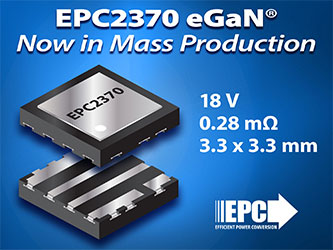
Efficient Power Conversion (EPC) has moved its EPC2370 18V enhancement-mode gallium nitride FET into mass production, giving power designers a production device for low-voltage, very high-current DC-DC stages in AI server systems. The transistor is built on EPC’s seventh-generation GaN platform and is specified for 101A continuous current, 0.28mΩ typical on-resistance, and 26nC total gate charge.
The EPC2370 carries an 18V continuous rating and a 22V transient rating, which EPC says allows it to replace silicon MOSFETs rated as high as 25V. It is supplied in a 3.3mm × 3.3mm thermally enhanced PQFN package designed for dual-sided cooling, combining a small board footprint with a short thermal path into the surrounding assembly.
EPC is positioning the device for centre-tapped synchronous rectification in high-density intermediate bus converters used in 48V-to-6V and 800V-to-6V architectures. The company is targeting switching frequencies of 1MHz and above, where lower gate charge and switching loss can translate into smaller magnetics and higher converter power density, provided the layout and thermal design preserve the device-level advantage.
The electrical trade-off is straightforward but unforgiving. At the currents involved in processor power delivery, conduction loss rises quickly with resistance, while increasing switching frequency to reduce passive-component size can simply move losses into the switching transitions. GaN is being pushed into this part of the power tree because it can combine low resistance with fast switching in a device whose parasitic capacitances and charge are lower than those of an equivalently rated silicon MOSFET.
AI racks are also changing the voltage hierarchy around the converter. Higher distribution voltages reduce current in cables and busbars, but processors and accelerators still require tightly regulated low-voltage rails at very high current. The resulting conversion chain stretches from hundreds of volts at rack level to single-digit volts close to the load, with semiconductor requirements changing sharply from one stage to the next.
The EPC2370 addresses the low-voltage end of that chain, while higher-voltage GaN is being developed further upstream. Power Integrations has demonstrated a 2200V GaN platform for higher-voltage conversion, illustrating how the material is spreading across a broader part of the power architecture rather than remaining confined to compact adapters and consumer chargers.
Packaging and cooling will determine how much of the EPC2370 specification survives in a real converter. A transistor carrying triple-digit current from a package only a few millimetres across cannot be evaluated from RDS(on) alone: copper spreading, package resistance, PCB stack-up, heatsinking, current sharing, and switching-loop inductance all influence efficiency and temperature once several phases are packed around a compute load.
Fast switching tightens the layout margin further. Parasitic inductance can create voltage overshoot and ringing, while measurement probes and test fixtures can distort the waveforms engineers are attempting to characterise. Multiphase designs add current-balancing and control requirements, making package geometry, gate drive, decoupling, and thermal symmetry part of device selection rather than post-layout housekeeping.
EPC is supporting development with the EPC90168 evaluation board, a 2in × 2in half-bridge design populated with two EPC2370 devices. The board provides probe points for waveform and efficiency measurements before the transistor is transferred into a custom multiphase converter, where mechanical and electrical parasitics will inevitably differ.
The company lists the transistor through distributors including DigiKey and Mouser at US$2.52 each in 1,000-piece quantities, with the evaluation board priced at US$260. Those availability details make the production step more useful than another device demonstration: engineers can now put the transistor through EMI, thermal, dead-time, efficiency, and manufacturability testing in the converter architecture that will determine whether Gen7 GaN earns its board area.