IN Brief:
- Skyloom has reached 84 optical communications terminal installations in low-Earth orbit.
- The latest units are aboard York Space Systems satellites launched from California on 16 July.
- The terminals support SDA's Transport Layer and are designed to interoperate with its OCT standards.
Skyloom has reached 84 optical communications terminals installed on orbit following a further deployment of its laser-link hardware aboard York Space Systems satellites for the US Space Development Agency.
The spacecraft form part of SDA’s Proliferated Warfighter Space Architecture, a large low-Earth-orbit network intended to provide resilient, low-latency communications and other defence capabilities. Skyloom is now an IonQ company and supplies optical communications technology for the PWSA Transport Layer.
The latest satellites carrying its terminals launched on 16 July aboard a SpaceX Falcon 9 from Vandenberg Space Force Base in California. They build on terminals flown during SDA’s first Tranche 1 mission in September 2025.
The resulting 84-unit footprint moves the engineering discussion beyond a one-off laser communications demonstration. Optical terminals for a proliferated constellation have to be manufactured, tested, launched, commissioned, and operated repeatedly while maintaining the interfaces required to communicate across a network of moving spacecraft.
Interoperability is central to SDA’s model. The agency defines Optical Communications Terminal standards so equipment supplied for the architecture can exchange data across common interfaces rather than restricting each satellite to proprietary links between identical terminal designs.
That requirement has consequences throughout the electronics and photonics system. A terminal must generate and detect the optical signal, control pointing and acquisition, process data, manage power and thermal conditions, and track another spacecraft accurately enough to maintain a narrow laser beam while both platforms move rapidly through orbit.
The precision required is markedly different from a conventional radio link. Radio-frequency systems can illuminate a wider region of space, whereas an optical terminal relies on a tightly directed beam whose pointing error can be enough to break the connection.
The narrow beam is also part of the attraction. Laser links can support high data rates with comparatively compact terminals and provide a more spatially confined transmission path, while optical crosslinks allow traffic to move between satellites without every transfer being routed through a ground station.
Skyloom describes its terminal technology as supporting links between low-Earth-orbit spacecraft as well as connections towards ground, airborne, and maritime platforms. The immediate 84-terminal milestone, however, is tied specifically to the SDA deployment rather than proving all of those link types in operational use.
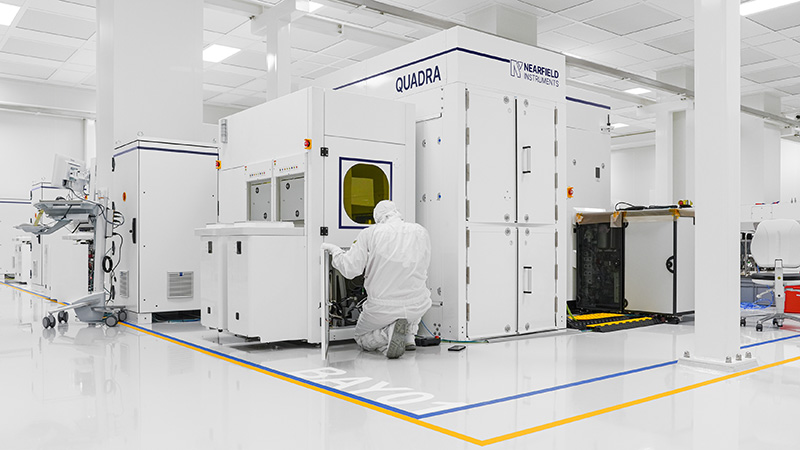
Manufacturing scale introduces another constraint. Space hardware has traditionally been associated with relatively low production quantities and extensive unit-level qualification, but proliferated constellations require suppliers to produce many flight units without allowing assembly variation or component substitutions to undermine reliability.
That pushes optical communications closer to a repeatable electronics-manufacturing problem. Precision optical alignment, detector and laser performance, digital processing, mechanical stability, thermal control, and acceptance testing all have to become sufficiently controlled for dozens of terminals rather than one laboratory instrument.
The York spacecraft support the PWSA Transport Layer, which is intended to create high-throughput communications paths across the constellation. Optical crosslinks allow a satellite that cannot see a suitable ground station to pass data through other spacecraft until it reaches a node with an available route.
A network built from many satellites also offers additional routing options when individual nodes are unavailable, although practical resilience depends on constellation geometry, operational spacecraft, link availability, and the software directing traffic between them.
The latest Skyloom announcement does not provide measured in-orbit throughput or link-availability data for the newly deployed units. Installation count should therefore not be confused with proof that every one of the 84 terminals is simultaneously carrying operational traffic.
It does provide a clear industrial milestone. A laser communications terminal design has now been manufactured and placed on orbit in numbers large enough for repeatability, interoperability, and fleet-level operation to matter at least as much as demonstrating the underlying photonics.
The next useful datapoints will come from commissioning and network operation. With 84 installations reached, the engineering question moves from whether the hardware can be launched at scale towards how consistently those terminals establish and maintain links once the surrounding Tranche 1 constellation is brought into service.