IN Brief:
- AEVA and AEVB aluminium electrolytic capacitors are rated to withstand vibration acceleration up to 30g.
- The surface-mount families operate to 125°C, with capacitance values reaching 4,700µF and endurance up to 5,000 hours.
- Plastic supports and enlarged soldering areas increase board-mounting strength for industrial power and control electronics.
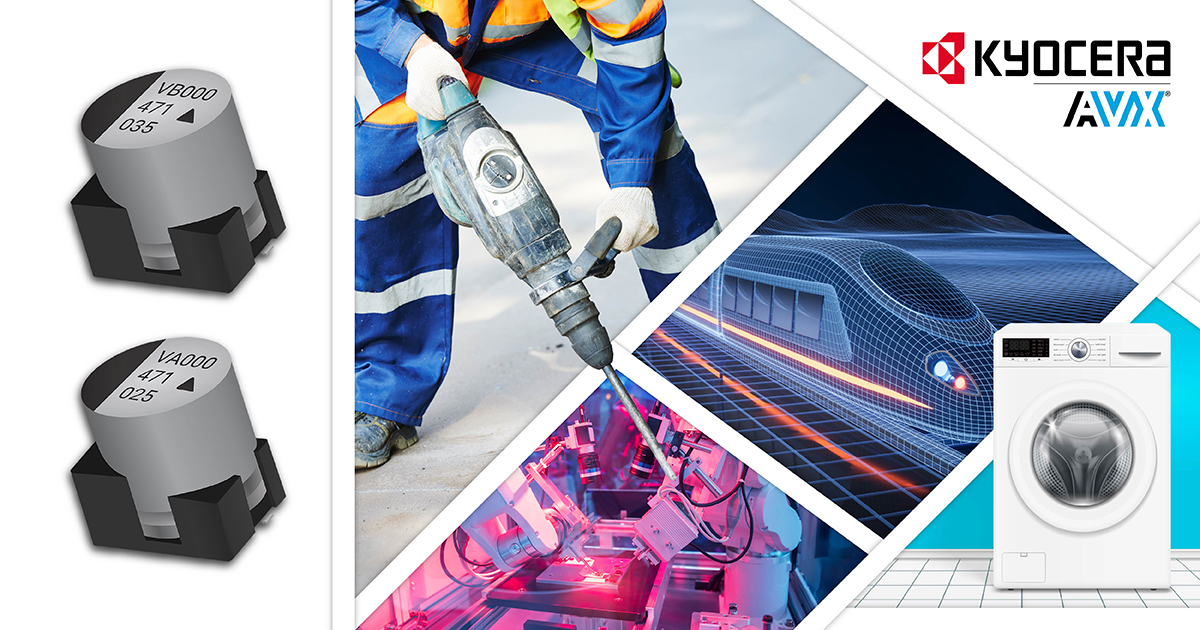
KYOCERA AVX has introduced two surface-mount aluminium electrolytic capacitor families designed for industrial electronics exposed to high vibration and temperatures up to 125°C. The AEVA and AEVB series use plastic supports and revised termination geometry to increase board-mounting strength, with both families rated to withstand acceleration up to 30g.
The AEVA range is available in five case sizes and covers rated voltages from 6.3V to 100V, with capacitance values from 10µF to 4,700µF. It operates from -55°C to 125°C and provides endurance of up to 4,000 hours at rated voltage and maximum temperature.
AEVB covers 16V to 50V and capacitance from 47µF to 2,200µF across four case sizes. Its operating range extends from -40°C to 125°C, with endurance reaching 5,000 hours at rated voltage and 125°C. Both series use liquid electrolyte, are compatible with reflow soldering, and are supplied for automated surface-mount assembly.
The 30g specification addresses a mechanical weakness that becomes more significant as electrolytic capacitors increase in size. A cylindrical aluminium capacitor carries considerably more mass above the PCB than most chip passives, so vibration produces greater loading at the solder joints and can allow the body of the component to move relative to the board.
KYOCERA AVX has addressed that loading through additional physical support around the can and terminations designed to increase soldering area. Strengthening the interface between the component and the PCB can reduce mechanical stress without forcing equipment manufacturers towards through-hole parts, secondary adhesives, or separate retention hardware.
That is particularly relevant to motor-driven and mobile industrial equipment. Robotics, embedded motor controllers, power tools, inverters, and converters may place large electrolytics on the same assembly as motors, pumps, fans, gearboxes, or other sources of continuous vibration. The capacitor has to tolerate that mechanical environment while also carrying ripple current and operating close to heat-generating semiconductors.
Thermal conditions remain equally important. Aluminium electrolytic lifetime depends strongly on operating temperature because electrolyte and internal materials age more quickly as temperature rises. A 125°C component therefore gives a designer additional environmental margin, although actual service life still depends on applied voltage, ripple current, local ambient conditions, and the equipment duty cycle.
The two families offer different electrical trade-offs. AEVA extends to 100V and 4,700µF, making it suitable for bulk filtering and power rails requiring relatively high stored charge. AEVB covers a narrower voltage and capacitance range but offers the longer maximum endurance rating, giving designers another option where sustained high-temperature operation carries greater weight.
Both ranges specify leakage current at no more than 0.01CV or 3µA, whichever is greater. KYOCERA AVX also describes the devices as low-ESR components, an important consideration where capacitors are carrying AC ripple current because equivalent series resistance contributes directly to internal heating and power loss.
The company lists photovoltaic inverters, DC/DC converters, uninterruptible power supplies, robotics, power tools, and embedded motor-control units among the intended applications. Those systems combine precisely the stresses addressed by the new parts: electrical ripple, elevated temperature, mechanical vibration, and pressure to keep assembly automated and compact.
Conventional aluminium electrolytics continue to occupy that part of the power-electronics market because they provide relatively high capacitance at practical cost and volume. Their liquid-electrolyte construction brings lifetime and mechanical considerations that are less prominent with ceramic or polymer devices, however, making package reinforcement useful where designers cannot simply substitute another capacitor technology.
Retaining compatibility with automated placement and reflow also matters at manufacturing level. A vibration-resistant component offers less benefit if fitting it introduces another manual production stage. The AEVA and AEVB designs instead build additional mechanical support into a familiar surface-mount assembly route.
For industrial designers, the resulting choice is not simply a 30g headline rating. Voltage, capacitance, ESR, expected ripple current, operating temperature, endurance, and case size still have to be balanced against the vibration environment. KYOCERA AVX has extended that design envelope by addressing the mechanical mounting problem without abandoning the production advantages of an SMD aluminium electrolytic.