IN Brief:
- Vishay has introduced four AEC-Q200 common-mode chokes for automotive power and communications electronics.
- The range provides current capability up to 14A, common-mode impedance to 11kΩ at 100MHz, and DCR down to 0.4mΩ.
- Applications include DC/DC converters, in-vehicle Ethernet, CAN, displays, lighting drivers, and other noise-sensitive vehicle electronics.
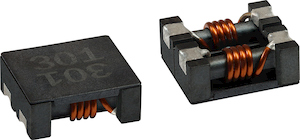
Vishay Intertechnology has expanded its automotive common-mode choke portfolio with four surface-mount devices combining low winding resistance with parts optimised for either high current or high common-mode impedance. The AEC-Q200-qualified components provide current capability up to 14A, impedance up to 11kΩ at 100MHz, and maximum DC resistance as low as 0.4mΩ.
The ICM5050-A and ICM6050-A are wirewound ferrite chokes intended for higher-current circuits. ICM5050-A supports heat-rating current up to 11A in a 12mm × 11mm × 6mm package, while ICM6050-A reaches 14A in a 15mm × 13mm × 6mm format. Depending on part value, maximum DCR extends down to 4mΩ and 3.5mΩ respectively.
Vishay’s smaller IFLN-1210BE-A and IFLN-1812CZ-A devices use precision winding and target higher impedance in compact footprints. The 1210 family provides as much as 11kΩ of common-mode impedance at 100MHz, while the 1812 parts reach 5.2kΩ. Maximum DCR can be as low as 0.4mΩ and 0.6mΩ respectively.
A common-mode choke suppresses unwanted current travelling in the same direction on two conductors while presenting much less impedance to the intended differential signal or supply current. Its coupled windings are arranged so that the magnetic effects created by normal differential current largely cancel, whereas common-mode interference reinforces flux in the core and encounters higher impedance.
That principle becomes increasingly useful as vehicles combine fast-switching power converters with high-speed communications. DC/DC stages, displays, lighting drivers, control units, and network interfaces can generate or receive conducted noise across shared wiring, while faster semiconductor switching edges push interference further into frequency ranges where PCB traces and cables become more effective radiators.
The filtering component then has to solve two competing problems. Higher impedance helps block common-mode noise, but resistance in the winding adds loss to the useful current passing through it. At 14A, even a small increase in series resistance can create appreciable I²R heating, so lowering DCR reduces both power loss and the thermal load around the choke.
Vishay compares the new surface-mount parts with larger toroidal common-mode chokes that may exhibit around 23mΩ DCR. The ICM devices occupy substantially smaller packages while providing higher-current options, giving power-system designers a route to reduce board area without simply accepting additional conduction loss.
The high-impedance IFLN parts address another part of the EMC problem. Their 1210 and 1812 footprints suit compact communications and control interfaces where current is lower but noise attenuation at tens or hundreds of megahertz is more important. Vishay lists CAN, LAN, and automotive DC/DC converter applications alongside in-vehicle Ethernet.
Temperature capability also differs between the families. The ICM5050-A and ICM6050-A are specified from -40°C to 125°C, while the IFLN-1210BE-A and IFLN-1812CZ-A extend from -55°C to 150°C. Designers still have to account for current derating and self-heating within those ranges rather than treating the maximum temperature as an unrestricted operating point.
All four devices are AEC-Q200 qualified, halogen-free, suitable for reflow soldering, and compatible with automated pick-and-place assembly. AEC-Q200 provides a component-level qualification framework for passive devices used in automotive environments, although finished vehicle electronics still require application-specific electrical, thermal, and EMC validation.
Samples and production quantities are available, with Vishay quoting lead times of 10 to 12 weeks. That makes the announcement a production component release rather than a technology preview, giving designers defined case sizes, impedance ranges, current ratings, and temperature limits against which to evaluate the parts immediately.
The devices address a relatively prosaic element of automotive electronics, but EMC failures are frequently discovered only once boards, harnesses, and enclosures are tested together. Providing lower-resistance and smaller filtering options gives designers more scope to include common-mode suppression early without consuming excessive power or PCB area.
As switching frequencies and in-vehicle data rates continue to rise, that design margin becomes more valuable. The choke may remain one of the quieter components on the board, but its job is precisely to keep the rest of the electronics quiet enough to coexist.