IN Brief:
- ARK and SiMa.ai have combined Modalix MLSoC modules with US-manufactured drone carrier boards in two hardware bundles.
- Modalix is specified at 50 TOPS below 10W and is pin-compatible with Jetson Orin NX and Nano.
- Pin compatibility does not mean complete interface equivalence, with ARK documenting differences across CAN, UART, PCIe, HDMI, and USB.
SiMa.ai and ARK Electronics have launched two embedded AI computing bundles for unmanned aircraft and robotics, combining SiMa.ai’s Modalix MLSoC system-on-module with ARK carrier hardware intended to simplify deployment of onboard vision, sensor-processing, and autonomous workloads.
The companies describe the ARK-SiMa.ai Modalix bundles as production-ready hardware rather than standalone development boards. Modalix is specified at 50 TOPS of AI processing while operating below 10W, putting the emphasis on performance per watt in systems where compute shares a constrained electrical and thermal budget with propulsion, communications, sensors, navigation, and payload equipment.
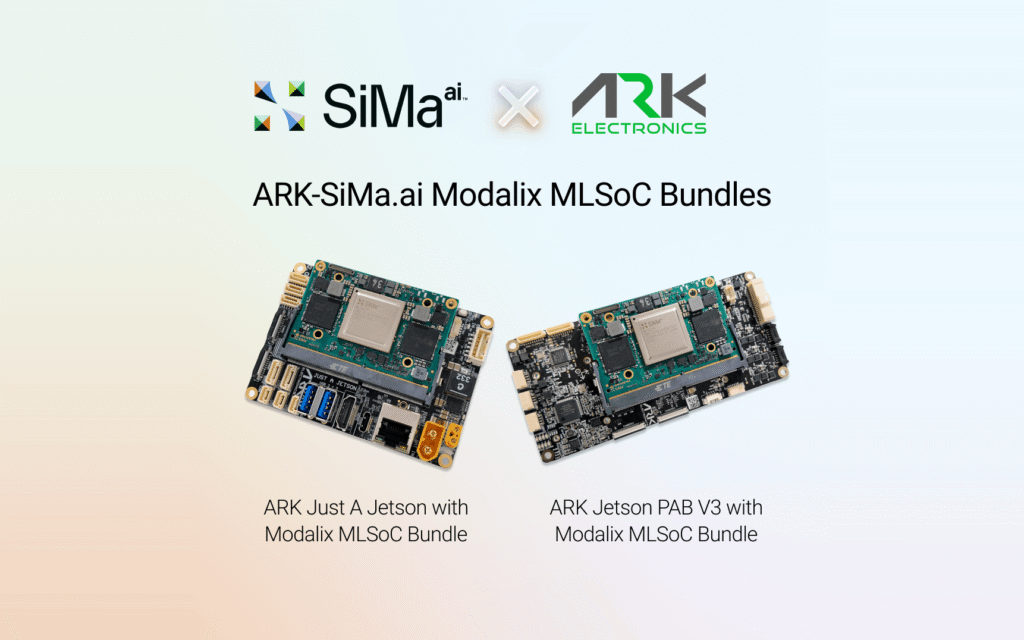
Two configurations are being offered. The smaller Just A Jetson bundle combines ARK’s carrier board with a Modalix system-on-module, heatsink, and fan. A second Jetson PAB V3 bundle integrates the Modalix hardware into ARK’s wider drone electronics architecture, providing a route to combine AI computing and flight-control hardware within an established UAS stack.
The Modalix system-on-module is pin-compatible with carrier boards designed around NVIDIA Jetson Orin NX and Nano modules. That gives equipment developers the option to evaluate a different accelerator architecture without immediately redesigning the entire carrier board, mechanical envelope, power system, and connector layout.
Pin compatibility does not make the modules electrically interchangeable in every respect, however. ARK’s own integration documentation lists a number of interface differences on its Just A Jetson carrier. There is no CAN interface in the Modalix configuration, UART2 acts as a console, UART0 operates without flow control, and UART1 does not operate. HDMI depends on the selected Modalix option, while PCIe2 is unavailable when HDMI is used.
ARK also states that the M.2 Key E connector does not carry PCIe in this configuration, while the USB-C 3.0 interface operates as a host and the USB 2.0 connection is routed to an FTDI console on the system-on-module. Those details make the platform closer to a mechanically compatible migration path than a completely transparent substitute for every Jetson-based design.
The Modalix module includes onboard eMMC storage, with an optional 480GB NVMe SSD available from ARK. The carrier and module combination measures roughly 100mm by 72mm by 37mm in the Just A Jetson configuration and weighs around 198.5g without the optional SSD, giving airframe designers a more concrete starting point than an accelerator specification alone.
The attraction of local AI processing in unmanned systems is largely about latency, bandwidth, and availability. Vision processing, object detection, navigation, sensor fusion, and other autonomous workloads can require decisions faster than a remote or cloud connection can reliably provide. Radio links may also be bandwidth-limited, unavailable, or unsuitable for continuously transporting high-rate sensor data.
Moving more inference onto the aircraft avoids some of those constraints, but transfers the engineering burden into size, weight, power, and cooling. A theoretical accelerator rating is useful only if the processor can sustain the required model while the aircraft remains inside its endurance and thermal limits. Memory traffic, sensor interfaces, utilisation, software efficiency, and cooling overhead can therefore matter as much as the nominal TOPS figure.
SiMa.ai supplies its Palette Neat software environment alongside the hardware, intended to support deployment of AI models onto its MLSoC architecture. That software layer will be important for engineering teams moving from another accelerator ecosystem because carrier-board compatibility has limited value if model conversion, runtime support, drivers, or debugging consume the time saved by retaining the mechanical platform.
ARK manufactures drone and robotics electronics in the US and already supplies flight controllers, GPS modules, sensors, and embedded computing products into commercial and defence programmes. Its involvement moves Modalix closer to a complete airframe electronics stack rather than leaving SiMa.ai’s processor as an isolated module requiring a customer-specific carrier.
The bundles are available to qualified drone OEMs and system integrators, although individual aircraft will still require their own environmental, EMC, thermal, flight-safety, and mission qualification. The useful comparison will therefore take place at system level: whether a 50-TOPS, sub-10W module can run the required workload with enough interface support and integration stability to justify replacing or supplementing an established compute platform.
By publishing both the compatibility claims and the interface differences, ARK has at least made that engineering trade-off visible. The result is more useful than another edge-AI benchmark because designers can now evaluate the processor as part of a real carrier-board and drone-electronics architecture.