IN Brief:
- Anritsu and MediaTek verified 3GPP Release 17 NR Coverage Enhancement test cases using the MediaTek M60 UE.
- The work covers Msg3 repetition, enhanced PUSCH Repetition Type A, and Transport Block processing over Multiple Slots.
- Testing used Anritsu's ME7834NR platform, registered as Test Platform 251 with GCF and PTCRB.
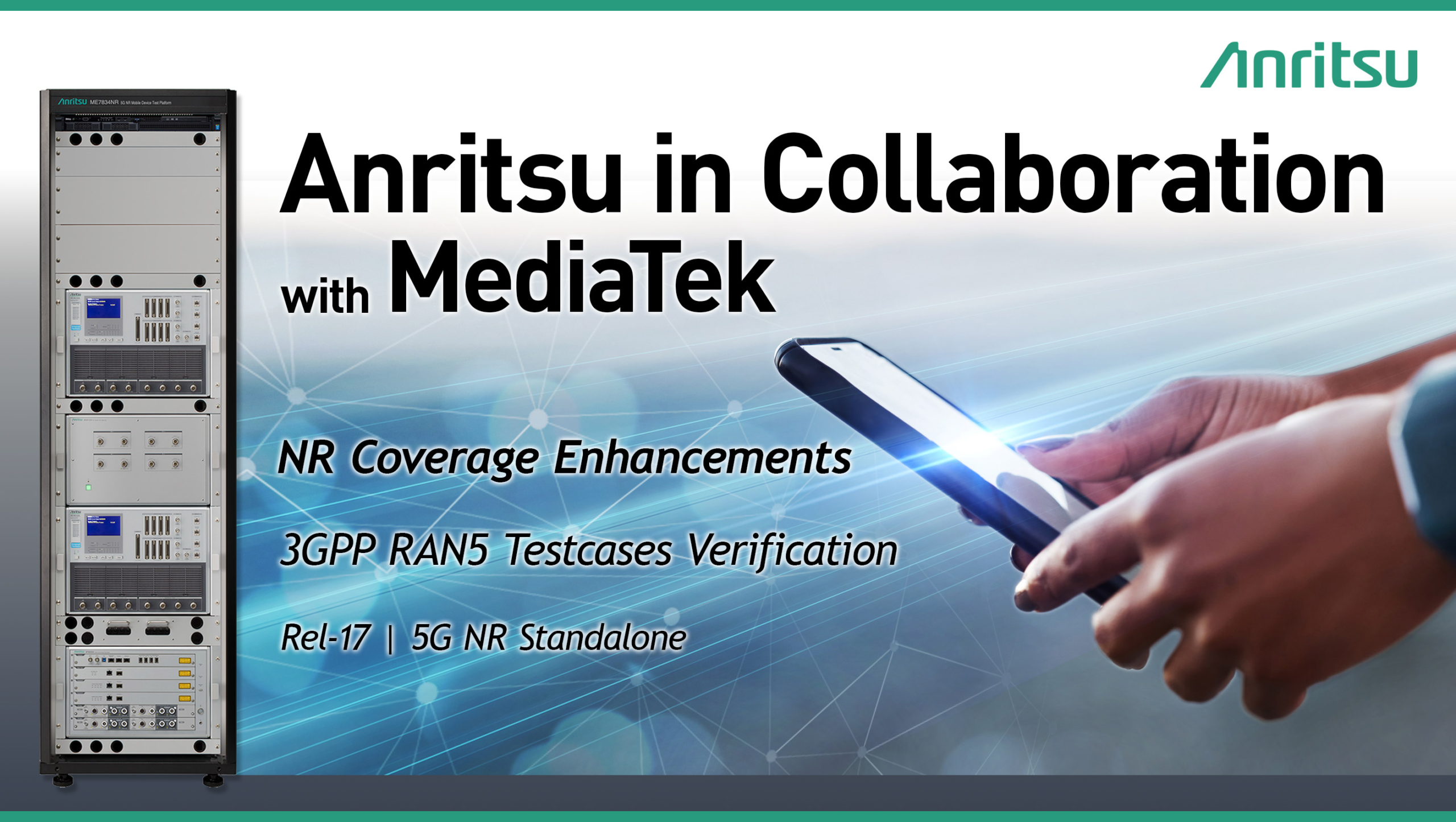
Anritsu and MediaTek have verified 3GPP Release 17 New Radio Coverage Enhancement conformance test cases using MediaTek’s M60 user-equipment platform and Anritsu’s ME7834NR mobile-device test system.
The work addresses radio conditions in which uplink coverage becomes the limiting part of the connection. Release 17 introduced several mechanisms intended to improve a device’s ability to establish and maintain communication at the cell edge, deep inside buildings, and in other weak-signal environments without simply increasing transmit power or adding network infrastructure.
Anritsu and MediaTek have exercised test cases covering Msg3 repetition, enhanced Physical Uplink Shared Channel Repetition Type A, and Transport Block processing over Multiple Slots, or TBoMS. The conformance tests are defined in 3GPP TS 38.523-1 and have been submitted by Anritsu to 3GPP’s Radio Access Network Working Group 5.
The mechanisms address different stages of the uplink. Msg3 forms part of the random-access procedure used when a device is establishing communication with the network. Repeating the message gives the receiver additional opportunities to recover the information where propagation conditions make a single transmission unreliable.
PUSCH repetition extends the same broad principle to uplink user data. Multiple transmissions can improve decoding probability in poor radio conditions, although every repetition also consumes time and radio resources, meaning improved robustness has to be balanced against capacity and latency.
TBoMS allows a transport block to be processed across several slots, providing another method of extending uplink operation under difficult conditions. Rather than treating coverage improvement as a question of brute-force transmit power, Release 17 gives the air interface additional ways to use time and repeated information to improve the probability of successful reception.
That is useful because uplink and downlink coverage are not symmetrical. A base station has considerably greater transmit resources than a mobile or embedded device, so a terminal can reach a point where it still receives the network adequately but struggles to deliver its own transmission back with the same reliability.
Coverage Enhancement is intended to extend useful operation into more of those cases. Cell-edge mobility and deep-indoor coverage are obvious applications, but the same problem can affect devices installed in buildings, industrial sites, and other locations where propagation loss makes the terminal’s uplink the weaker side of the connection.
Yokoo Daizaburo, general manager of Anritsu’s Mobile Solutions Division, said the work enables “accurate verification of coverage-oriented functionality” as operators and device suppliers implement newer 5G features.
The important step is conformance verification rather than the existence of the feature in the specification. A Release 17 mechanism becomes commercially useful only when modem implementations can be exercised against formal test cases and demonstrate the expected behaviour under controlled conditions.
Anritsu carried out the work with its ME7834NR 5G NR Mobile Device Test Platform. The system is registered as Test Platform 251 with both the Global Certification Forum and PTCRB, giving it an established role in device protocol-conformance and carrier-acceptance testing.
The platform supports Standalone and Non-Standalone 5G NR alongside LTE, LTE-Advanced, LTE-A Pro, W-CDMA, and non-terrestrial-network functions. When combined with Anritsu’s MA8171A over-the-air RF chamber and suitable RF converters, it can also test sub-6GHz and millimetre-wave 5G NR operation.
That breadth matters because commercial devices rarely operate against one radio technology in isolation. A modem platform can move between 5G SA, NSA, and older technologies according to network availability and operator configuration, while newer Release 17 features have to coexist with the rest of that protocol stack.
Coverage-enhancement mechanisms introduce additional interactions with scheduling, power consumption, latency, and resource use. More repetitions can improve reliability, but they are not free capacity; a standards-compliant implementation has to apply them under the correct conditions and integrate them with the broader radio-resource strategy.
The verification does not establish a universal field-coverage improvement for devices using the M60. Real-world results will still vary with spectrum, network configuration, interference, antenna design, propagation, base-station deployment, terminal implementation, and the particular Release 17 features enabled by the operator.
Its significance is narrower: specific Coverage Enhancement functions have moved into formal conformance testing between a commercial MediaTek UE platform and an established test system. That gives device developers another defined route for demonstrating that their implementation follows the 3GPP behaviour expected by certification and network programmes.
As Standalone 5G deployments mature, this type of validation determines which standards features progress from specification tables into dependable terminal behaviour. Radio coverage has always been less impressed by feature lists than by whether the uplink actually arrives.