IN Brief:
- Beckhoff EtherCAT IP supports 10, 100 and 1,000 Mbps on PolarFire FPGA and FPGA SoC platforms.
- Microchip provides TSN IP for deterministic 1 Gbps Ethernet on PolarFire FPGA SoCs using IEEE 802.1 standards.
- Libero SoC tools, Ethernet evaluation hardware and PolarFire platform security features support system development.
Microchip Technology has expanded industrial Ethernet support on its PolarFire programmable devices with Beckhoff EtherCAT intellectual property and its own Time-Sensitive Networking (TSN) implementation. EtherCAT IP is compatible with PolarFire FPGAs and FPGA SoCs, while the TSN IP is supported on PolarFire FPGA SoCs. The additions give embedded equipment developers two deterministic networking options within the power-efficient PolarFire hardware family.
Beckhoff’s EtherCAT IP supports 10, 100 and 1,000 Mbps connectivity on the applicable devices. Microchip’s TSN implementation enables deterministic 1 Gbps Ethernet using IEEE 802.1 standards. Link rates determine the nominal data capacity, while the timing of control traffic is set by the selected network method, device configuration and connected equipment. The distinction between FPGA and SoC device support also affects hardware selection before board design begins.
EtherCAT provides a means of exchanging cyclic control data between industrial controllers, drives, remote I/O and sensors. Network frames can pass through participating nodes while their assigned data is processed, supporting coordinated communication across a machine. Effective motion control also relies on synchronisation, the controller’s scan cycle and the timing of the physical plant, which must be established together for a specific application.
TSN applies scheduling, time synchronisation and traffic management mechanisms to Ethernet networks. Depending on the standards and profiles implemented, switches and endpoints can prioritise or reserve transmission opportunities for traffic with defined timing requirements. A PolarFire SoC using TSN IP can become part of that architecture when connected to compatible network equipment and configured according to the required schedule and service guarantees.
Programmable logic allows interface handling and data processing to run in parallel hardware paths. That is useful where an industrial camera or robotic controller must collect information locally while exchanging control or status data over a network. PolarFire FPGA SoCs add processor resources for software-driven functions, creating a design route in which control interfaces and application processing share a platform but can be assigned different execution resources.
The PolarFire platform uses non-volatile FPGA technology and supports instant-on operation alongside hardware security capabilities such as secure boot and anti-tamper protection. Those features can help establish a trusted starting point for networking equipment, provided the wider design includes suitable credential handling, protected updates and management access. Network security still requires choices beyond the FPGA fabric, including authentication and access rules for communicating devices.
Microchip supplies design and evaluation resources for the new networking options through its Libero SoC tools, IP cores and reference designs. The Dual-Port Gigabit Ethernet FMC card (ETH-DC-DUALGBE) provides physical Ethernet connections for prototyping, while the PolarFire SoC Video Kit (MPFS250-VIDEO-KIT) supports evaluation of designs combining embedded processing and image data. Together these resources support configuration and functional testing before a custom industrial board is built.
In an embedded vision installation, image capture and processing may consume local compute resources while a separate communications path carries trigger signals, results and equipment status. The FPGA fabric can allocate parallel functions to those tasks, reducing dependence on a single sequential software execution path. System timing still needs to include sensor exposure, processing delay, network transmission and any actuator response in the overall cycle budget.
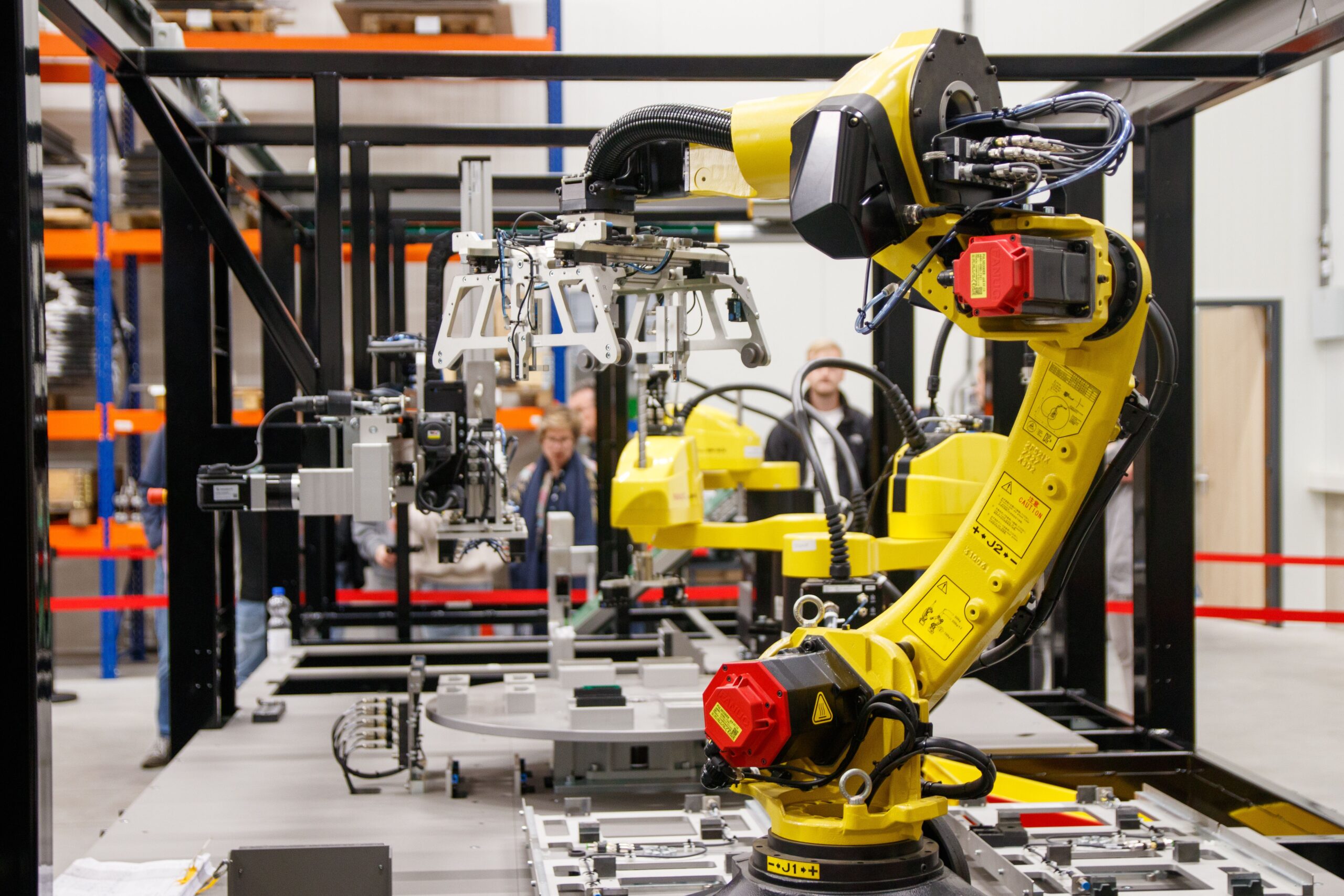
Industrial robots introduce another combination of network demands: motion updates require predictable timing, while diagnostics and higher volume data streams can follow different traffic rules. EtherCAT and TSN address parts of that communications problem through distinct architectures. Engineers selecting either option will need to test it against actual endpoints, switches and controller software rather than derive machine latency directly from the 1 Gbps link specification.
With the IP available for the supported PolarFire devices, development teams can use evaluation hardware to validate network integration before committing to a production design. EtherCAT coverage across FPGAs and SoCs and the SoC-specific TSN support provide clear device selection boundaries as automation systems combine local processing with scheduled industrial communications.