IN Brief:
- Litavis provides continuous 256 × 256 photon-counting imaging alongside timing output from a 64 × 64 macropixel grid.
- In-pixel processing supports simultaneous intensity, timing, histogramming, programmable gating, and multiple photon timing modes.
- Applications include machine vision, robotics, spectroscopy, medical imaging, quantum sensing, depth measurement, and industrial automation.
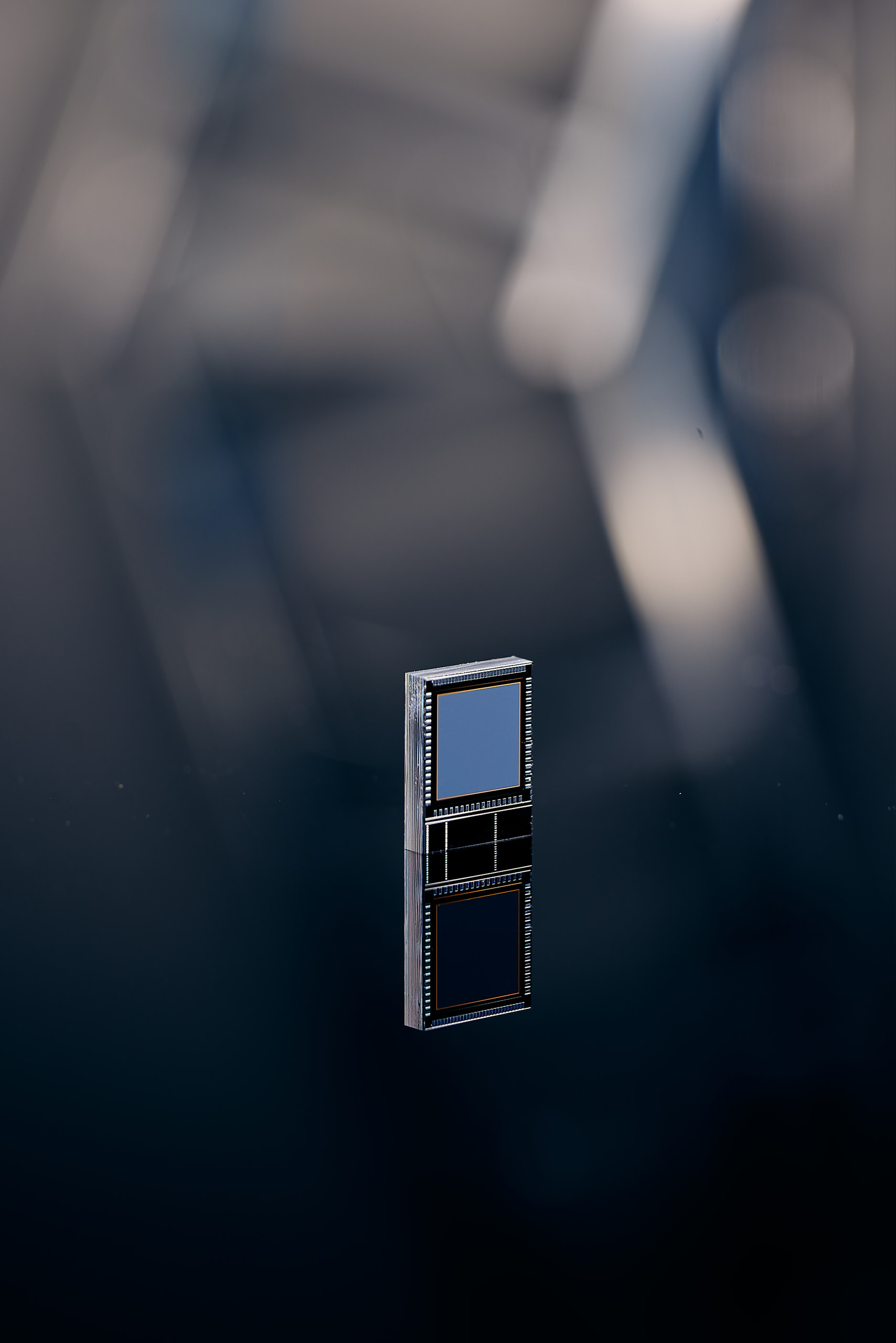
Singular Photonics has launched Litavis, a software-configurable SPAD image sensor that combines photon-counting imaging, timing, histogramming, and photon statistics on the same chip.
The Edinburgh semiconductor company has designed the device to perform several measurement functions simultaneously rather than optimising the array around a single sensing mode. Litavis provides continuous 256 × 256-pixel photon-counting imaging while generating time-stamped events through a 64 × 64 macropixel timing grid.
Single-photon avalanche diodes operate above their breakdown voltage, allowing the arrival of an individual photon to trigger a measurable electrical avalanche. That sensitivity makes SPAD arrays useful in low-light imaging and in measurements where photon arrival time carries information that conventional intensity imaging cannot provide.
Large SPAD arrays can also create a substantial data-handling problem. Recording individual events and their timing information can produce streams that require high-bandwidth interfaces, external FPGAs, memory, and additional processors before useful measurements emerge.
Litavis moves more of that processing into the pixel array. Singular says the architecture supports multiple time-correlated single-photon counting and time-to-digital converter configurations, high-dynamic-range photon counting, programmable time gating, coincidence detection, timestamping, and in-pixel histogramming.
The full-resolution array continues to provide photon-counting images while timing information is generated at the lower 64 × 64 macropixel resolution. Singular specifies picosecond-resolution photon timing and support for multiple detected photons within an excitation cycle, allowing separate events to be assigned to time bins.
Combining those functions on the sensor can reduce the amount of raw event data that has to leave the device. External processors can receive measurements that have already undergone part of the required timing or statistical treatment, reducing interface loading and shifting some computation away from the rest of the camera system.
That architecture opens several different measurement routes from the same hardware. Fluorescence lifetime imaging depends on the decay time of emitted photons rather than image brightness alone, while time-of-flight systems use arrival times to derive distance. Spectroscopy and quantum measurements can also exploit photon statistics, coincidence events, and precise temporal information.
Machine vision and robotics present a different integration problem. Cameras in autonomous equipment need to operate within finite processing and power budgets, and sending every detected event to a separate processor adds bandwidth and latency. On-sensor processing gives system designers another point at which to reduce or interpret the data before it reaches the main compute platform.
Litavis is being offered for machine vision, robotics, physical AI, depth sensing, spectroscopy, scientific and medical imaging, quantum technologies, and industrial automation. The common requirement is not a particular market but the need to obtain spatial and temporal information from photon events using a compact sensing architecture.
The device follows Singular Photonics’ Andarta and Sirona sensors, extending the company’s SPAD portfolio towards a more configurable multimodal architecture. Singular says it has already received pre-orders from companies and institutions, although customer names and volumes have not been disclosed.
The launch also follows a £1.6 million funding round announced in August, when the company said it was preparing the next stage of commercialisation for its single-photon sensor technology.
Greater processing capability inside the sensor does not eliminate downstream electronics. Calibration, application algorithms, system control, storage, communications, and more computationally intensive analysis still have to be handled somewhere in the architecture. It does, however, change how much raw photon-event data must reach those stages.
For Litavis, the commercial test will be whether its combination of imaging, timing, and configurable on-chip processing can simplify complete systems sufficiently to outweigh the added complexity inside the sensor itself. The 256 × 256 array and 64 × 64 timing grid provide the hardware framework; application developers now have to establish which processing functions are most useful at the focal plane and which remain better suited to external compute.