IN Brief:
- Singular Photonics has closed an oversubscribed $2.15m funding round led by ACF Investors.
- The Edinburgh company develops SPAD image sensors with on-chip computation for scientific, medical, and industrial applications.
- New capital will expand engineering capacity and accelerate development of the company's next sensor generation.
Singular Photonics has closed an oversubscribed $2.15 million funding round, approximately £1.6 million, to expand engineering capacity and accelerate development of its next generation of single-photon avalanche diode image sensors. The Edinburgh fabless semiconductor company is targeting machine vision, industrial automation, scientific instrumentation, medical imaging, and physical AI as it broadens its product roadmap.
The round was led by ACF Investors, with participation from Wren Capital, Cambridge Angels, Scottish Enterprise, Quantum Exponential, and Old College Capital. Singular says sales in 2026 to date have already doubled the total achieved across full-year 2025, while former Arm chief technology officer Dipesh Patel has joined the board.
Singular’s sensors are based on SPADs, semiconductor detectors operated so that a single photon can trigger a measurable avalanche event. That allows the devices to detect very low light levels and, importantly, measure photon arrival time rather than recording only aggregate image intensity, opening applications in time-of-flight, spectroscopy, fluorescence imaging, correlation measurements, and quantum sensing.
The company combines those detectors with digital processing in or close to the pixel array so some analysis happens on the sensor before large volumes of raw data move elsewhere. That can reduce data transfer and latency in systems that need time-resolved information, although it also makes the sensor a more complex combination of photodetection, digital logic, timing, firmware, and application-specific processing.
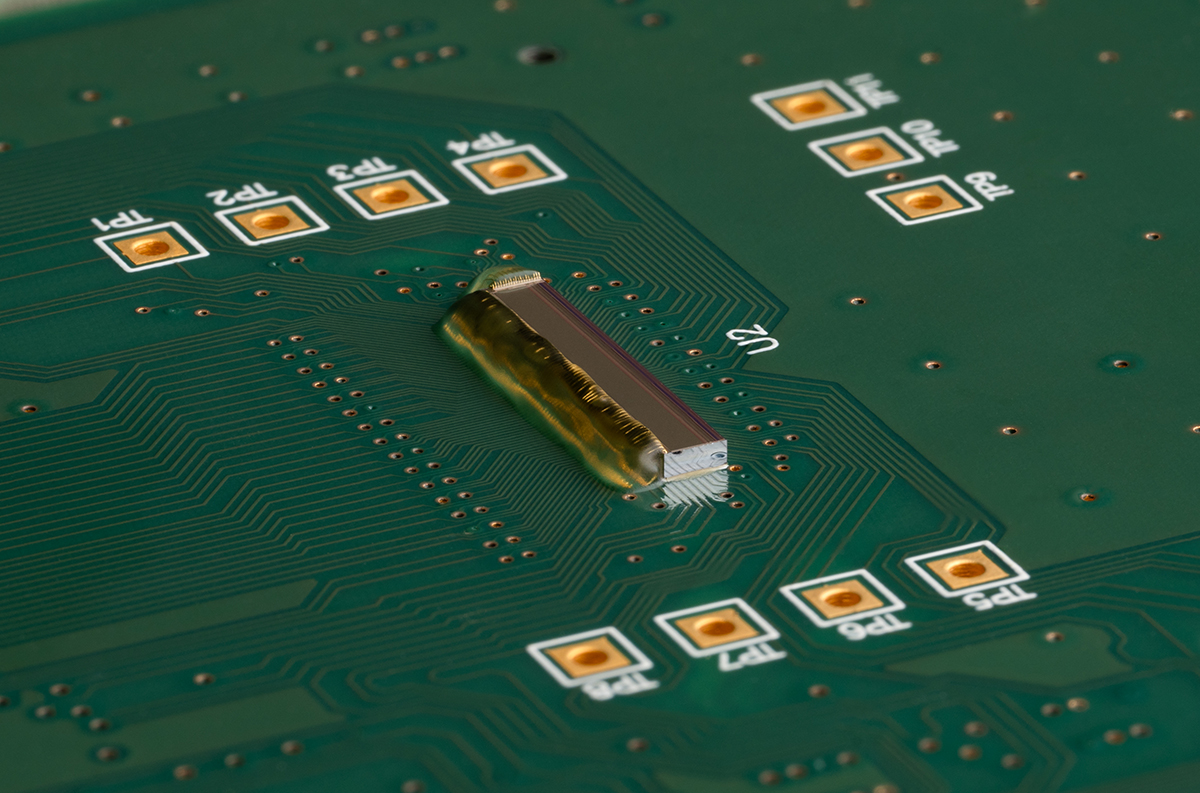
Its existing portfolio illustrates two different approaches. Andarta is a compact SPAD sensor intended for applications including fluorescence lifetime imaging, diffuse correlation spectroscopy, burst imaging, and other photon-counting techniques, while Sirona is a 512-pixel line sensor aimed at time-resolved multispectral imaging, Raman spectroscopy, fluorescence lifetime imaging, time-of-flight measurements, and quantum sensing.
Those markets do not demand the same device characteristics. Industrial machine vision may prioritise timing, low-light performance, and rapid event capture; biomedical systems can need accurate photon statistics and compact power budgets; spectroscopy depends on timing and spectral behaviour; and quantum applications can place greater emphasis on single-photon sensitivity and noise.
A broader sensor roadmap therefore gives Singular scope to optimise architectures around specific workloads rather than forcing every application through one general-purpose imager. The new funding is intended to increase the engineering resources available for that work and shorten the route from customer requirements to new silicon.
Singular emerged from the University of Edinburgh CMOS Sensors and Systems group and has been converting that research base into commercial products. Its sensors are already being integrated into instrumentation, including work with Renishaw around Raman spectroscopy, giving the company application feedback that can feed into the specifications of later devices.
For a fabless sensor company, however, extending the roadmap carries the same execution demands faced by larger semiconductor suppliers. New products must move through architecture, circuit design, physical implementation, foundry manufacture, packaging, electrical and optical characterisation, software support, reliability work, and customer qualification before engineering interest becomes repeatable revenue.
SPAD devices add their own manufacturing and test questions because photon-detection efficiency, dark-count rate, timing resolution, pixel uniformity, optical stack behaviour, and packaging can matter as much as conventional digital specifications. A design that performs well in laboratory characterisation still has to be reproducible across wafers, lots, packages, and application environments.
The £1.6 million round gives Singular more capacity to address that work, but it is modest by semiconductor-development standards and places a premium on disciplined product selection. The company’s growing sales base and existing customer collaborations should help determine which sensor variants justify the cost of tape-out and qualification rather than expanding the roadmap faster than engineering resources allow.
The next measure of progress will be how quickly new devices move from customer-led requirements into working, qualified hardware. Singular has already established that SPAD sensors can support specialised imaging tasks; the commercial challenge is to make those devices repeatable, integrable, and supportable across enough applications to sustain a fabless semiconductor business beyond individual research and instrumentation projects.