IN Brief:
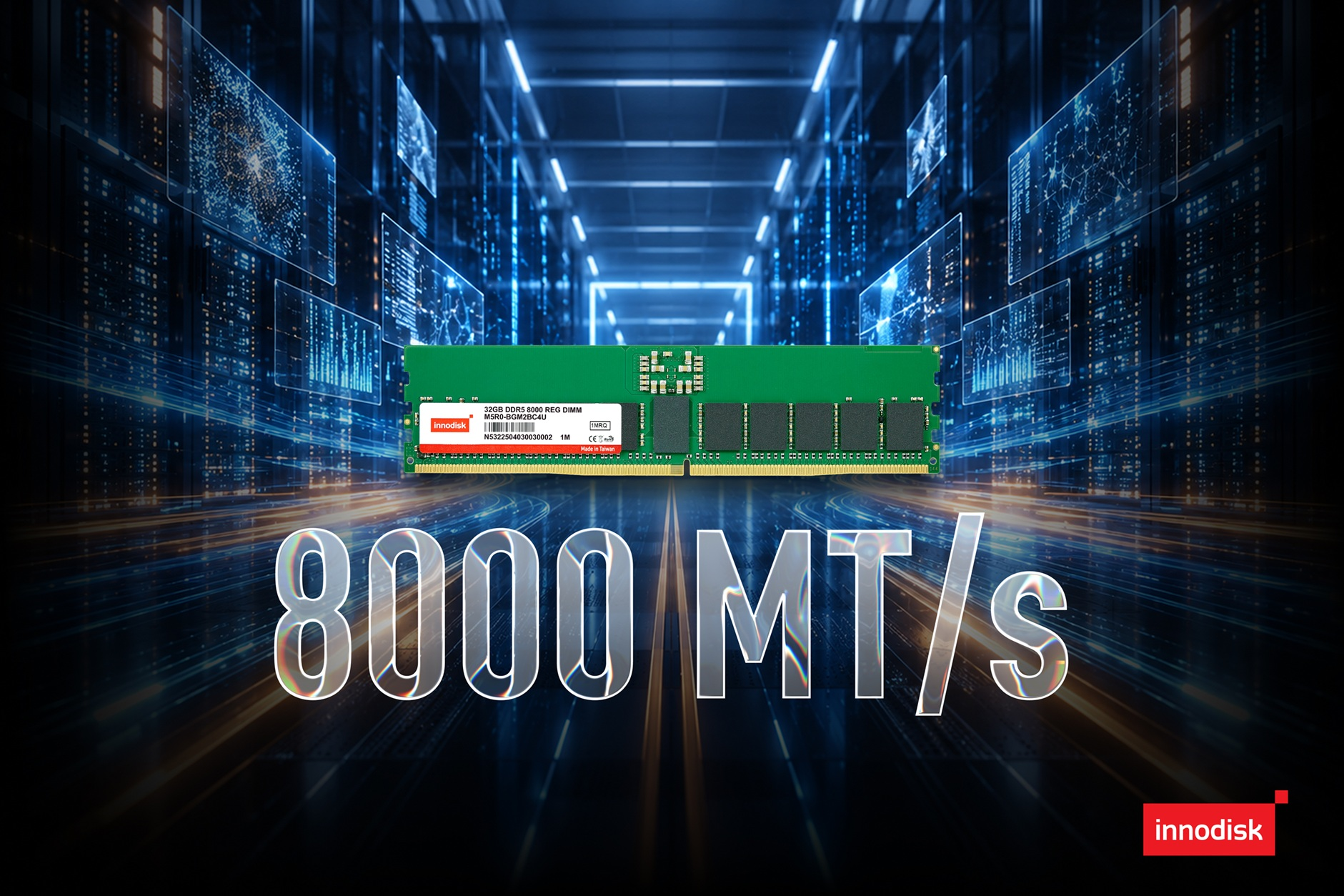
- The 288-pin RDIMM operates at 8000 MT/s and is available in 16GB, 24GB, 32GB, 48GB and 64GB capacities.
- Registered ECC is combined with TVS diode and eFuse protection, 30μin gold contacts and anti-sulfuration protection.
- Innodisk is extending its wider DDR5 8000 family across additional DIMM formats for different system architectures.
Innodisk has launched an industrial DDR5 8000 RDIMM aimed at edge AI and enterprise computing, combining an 8000 MT/s data rate with registered ECC and additional electrical protection intended for systems expected to operate continuously under demanding workloads.
The 288-pin module is offered in 16GB, 24GB, 32GB, 48GB and 64GB capacities. Innodisk specifies an x80 bus, 1.1V operation and a case temperature range of 0°C to 95°C, positioning the product as a high bandwidth registered memory option within its industrial DDR5 range.
The move to 8000 MT/s matters because processor and accelerator performance increasingly depends on how quickly data can move through the memory subsystem. Large AI models, digital twins and image processing workloads can place sustained pressure on memory even when the available compute resources are substantial.
A higher nominal memory rate does not guarantee a proportional application gain. Processor memory controllers, channel population, memory access patterns and software behaviour all affect usable bandwidth, and a workload that already fits comfortably within the existing memory subsystem may see little benefit from the faster module.
The RDIMM architecture is designed for systems where signal integrity and capacity are priorities. Registered memory buffers command, address and control signals between the processor and DRAM devices, reducing the electrical loading presented to the memory controller as module capacity and operating speed increase.
Innodisk also specifies ECC support. Error correction provides another layer of resilience for systems where memory faults can corrupt long running calculations or create difficult to reproduce failures, although the complete server or embedded platform still has to support the relevant registered ECC memory architecture.
Electrical protection is a second part of the design. Transient Voltage Suppressor diodes are included to clamp voltage spikes, while an eFuse is intended to interrupt the circuit when abnormal electrical conditions exceed its protection threshold. These functions address physical module protection rather than the data errors handled by ECC.
The company has also retained mechanical and environmental features more commonly associated with industrial memory than performance-oriented consumer modules. The DDR5 8000 RDIMM uses 30μin gold contacts and anti-sulfuration protection intended to improve contact durability and reduce corrosion risks during extended deployment.
That industrial positioning should not be confused with wide temperature operation. The live product specification lists a 0°C to 95°C case temperature range for this RDIMM, so applications requiring operation below freezing still need to be matched against Innodisk’s separate wide temperature memory options.
Bandwidth is particularly relevant at the edge when AI processing has to remain local. Moving inference closer to cameras, sensors or industrial equipment can reduce network dependency and latency, but it transfers memory and compute requirements into systems with tighter limits on power, cooling and physical size.
The RDIMM format points towards the larger end of that edge spectrum. Registered modules are more likely to appear in server and workstation-derived platforms than in compact fanless controllers, making the product relevant to edge servers, local AI appliances and enterprise systems rather than every embedded endpoint.
Innodisk identifies large language models, generative AI, digital twins, telehealth and image recognition among the target workloads. Those applications vary widely, but all can benefit when frequently accessed data remains close to the processor and the memory subsystem can sustain the required transfer rate.
The company’s wider DDR5 portfolio also includes higher bandwidth MRDIMM products, which use a different memory architecture and should not be treated as directly interchangeable with a conventional RDIMM. The 8000 MT/s launch instead raises the ceiling within the familiar registered DIMM format for platforms designed to support it.
System compatibility remains the practical boundary. A motherboard has to support the correct DDR5 RDIMM architecture, speed grade and capacity, while signal integrity and firmware validation become more demanding as data rates increase. Qualified memory populations therefore matter more than the headline number on an isolated module.
Innodisk says further DDR5 8000 module formats are being added across CUDIMM, CSODIMM and ECC configurations. Its current product material already groups those form factors within the wider DDR5 8000 family, so designers should confirm the precise availability of the required module before fixing a production configuration.
For the new RDIMM, the specification is straightforward: 8000 MT/s, capacities to 64GB, registered ECC and added electrical and contact protection. Its usefulness will depend on whether the host platform and workload are genuinely constrained by memory bandwidth, but AI systems make that constraint increasingly difficult to ignore.