IN Brief:
- LAN8679 provides a compact 10BASE-T1S PMD transceiver using the OPEN Alliance 3-Pin interface in an eight-pin VDFN package.
- LAN8680 adds system basis chip functions including power management, wake and sleep control and watchdog supervision.
- LAN866x Remote Control Protocol endpoints extend Ethernet into control, lighting and audio nodes without requiring the same local software architecture at each endpoint.
Microchip Technology has expanded its 10BASE-T1S Single Pair Ethernet portfolio with new PMD transceivers and integrated endpoint devices, targeting automotive, industrial and robotics systems moving towards more centralised Ethernet-based network architectures.
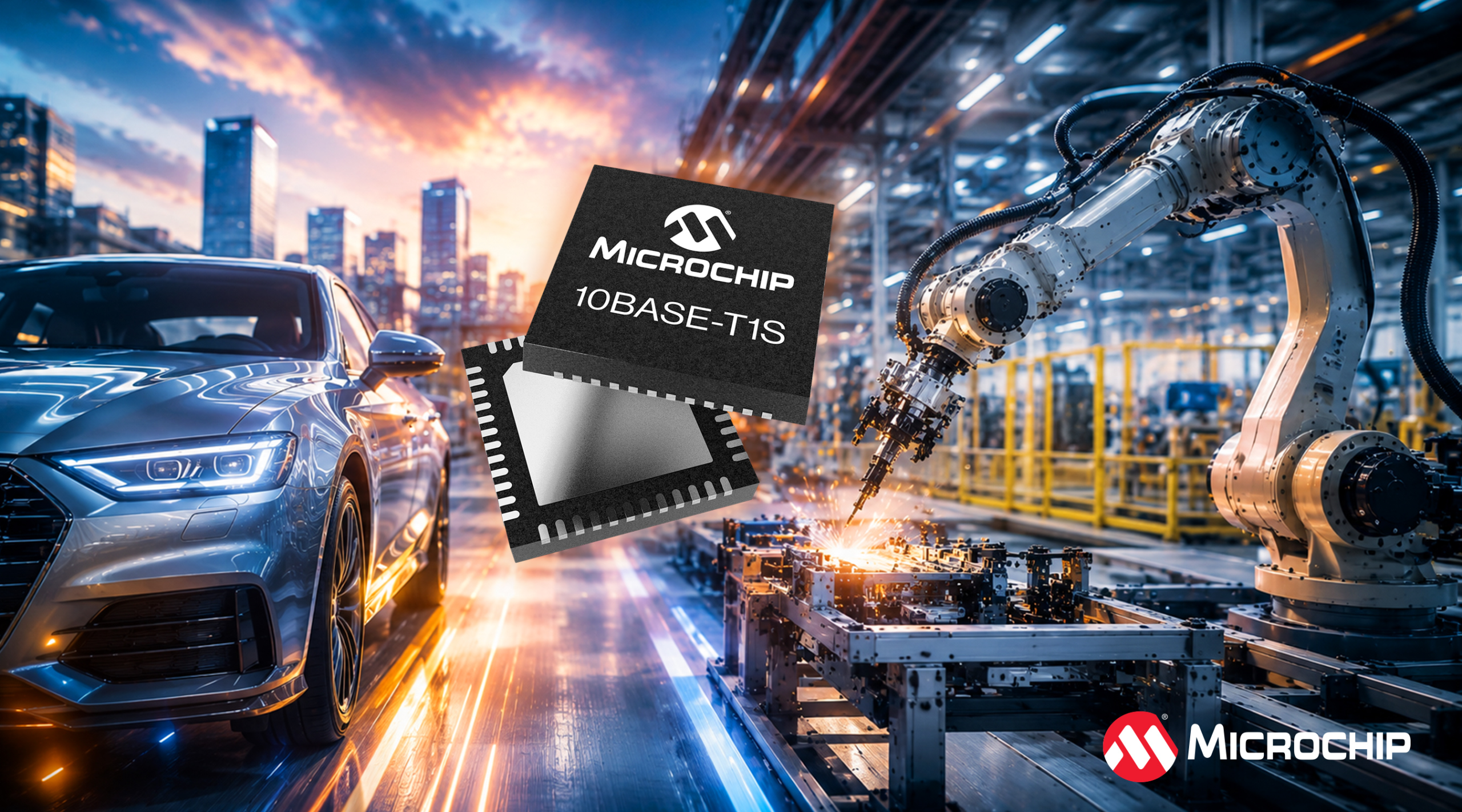
The launch introduces the LAN8679 and LAN8680 PMD transceivers alongside LAN8660X, LAN8661X and LAN8662X endpoint variants identified in the company’s announcement. The devices are intended to extend standard Ethernet closer to low speed sensors, actuators, lighting and control nodes while reducing the circuitry required at the network edge.
10BASE-T1S operates at 10Mbps over a single balanced pair and supports multidrop operation, allowing several nodes to share the same bus. That makes it different from higher speed automotive Ethernet links normally used between controllers, cameras or central compute systems.
For low bandwidth devices, the attraction is architectural rather than raw data rate. A shared single pair can reduce wiring and connector requirements while retaining an Ethernet-based communication model, which can simplify the boundary between central compute and physical edge nodes.
The LAN8679 provides the physical media dependent function through the OPEN Alliance 3-Pin interface in an eight-pin VDFN package. Microchip is positioning the device for nodes where package size and pin count matter and where the wider Ethernet control architecture is implemented elsewhere in the system.
LAN8680 adds system basis chip functions around the 10BASE-T1S PMD. The launch material identifies integrated power management, system wake and sleep control and watchdog supervision, reducing the number of separate support functions that have to be implemented around the Ethernet connection.
Microchip’s current automotive Ethernet catalogue lists LAN8679 and LAN8680 as 10BASE-T1S PMD devices with AEC-Q100 Grade 1 and ASIL B positioning. The catalogue currently directs customers to contact Microchip for the parts, so availability should be treated according to the company’s current ordering information rather than assumed from the announcement alone.
The endpoint side of the portfolio addresses a different layer of the zonal architecture. Microchip’s LAN866x family uses Remote Control Protocol to bridge Ethernet traffic towards local device interfaces, allowing selected edge functions to operate without a dedicated application microcontroller and separately maintained software image at every node.
That approach is already being applied to control, lighting and audio applications. A central compute module can send commands across the Ethernet network to an endpoint that exposes local peripheral functions, reducing protocol translation and moving more software ownership away from individual edge nodes.
The model suits zonal vehicle architectures because nodes are grouped by physical location rather than only by function. A zone controller can aggregate nearby devices and link them into the central vehicle network, while 10BASE-T1S provides a lower bandwidth connection for endpoints that do not justify a separate high speed Ethernet link.
Multidrop operation contributes to the wiring argument. Several nodes can share one bus rather than each requiring a dedicated point-to-point connection, although the allowable topology still has to meet electrical limits around cable length, stubs, termination and node count.
Shared media also require deterministic access. 10BASE-T1S uses Physical Layer Collision Avoidance to allocate transmission opportunities across participating nodes, helping control access to the bus rather than allowing uncontrolled contention between endpoints.
For industrial automation and robotics, the same principle can extend Ethernet further into a machine. Many sensors and actuators exchange relatively small amounts of data but still need predictable communication, diagnostics and integration with higher level control systems. Single Pair Ethernet provides a path towards that network model without bringing conventional four-pair cabling to each device.
The design trade-off is between distributed intelligence and central control. A microcontroller at every endpoint provides local autonomy and application flexibility, but it increases component count, software ownership and update complexity. A remotely controlled endpoint can be smaller and simpler, but it depends more heavily on the network and central controller.
Microchip is widening the choices between those extremes. A designer can use LAN8679 where only the compact PMD interface is needed, LAN8680 where additional system management functions should be integrated, or an RCP-enabled endpoint where the objective is to reduce local processing and software.
The portfolio also sits alongside Microchip’s faster 100BASE-T1 and 1000BASE-T1 devices rather than replacing them. Zonal systems can use different Ethernet physical layers according to the bandwidth and control requirements of each connection, reserving faster links for cameras and controllers while using 10BASE-T1S for simpler edge nodes.
The result is a more granular route towards an all-Ethernet architecture. The new devices do not remove the electrical and software engineering required at the edge, but they give designers more control over where that complexity lives and how much hardware has to be repeated across large populations of relatively simple nodes.