IN Brief:
- ALT1350 supports LTE-M/NB-IoT and the ALT1550 targets 5G eRedCap device designs.
- The companies plan terrestrial and Iridium NTN Direct functionality on compatible chipset platforms.
- The agreement describes a forthcoming integration, not completed customer deployments or universal coverage guarantees.
Altair Semiconductor is integrating Iridium NTN Direct connectivity into its ALT1350 and ALT1550 cellular IoT platforms. The announced work is designed to allow equipment manufacturers to combine terrestrial and satellite communications through a compatible chipset, avoiding the need for a separate satellite modem in supported products. Iridium has not named a completed customer implementation using these specific integrations or confirmed a universal product availability date.
The ALT1350 is associated with LTE-M and narrowband IoT applications, where equipment often exchanges relatively small quantities of information and must operate within a limited energy budget. The ALT1550 is a newer platform supporting 5G enhanced reduced capability, or eRedCap, aimed at device classes that do not require the full complexity of a high-performance 5G modem. Adding satellite capability to both offers a potential path for different types of connected equipment to operate outside ordinary cellular coverage.
Iridium NTN Direct uses the operator’s low Earth orbit satellite network and coordinated L-band spectrum. It is intended to provide standards-based non-terrestrial communications using compatible 3GPP technologies. The approach differs from an arrangement in which the device incorporates an unrelated satellite subsystem with its own proprietary modem and control software. Standards compatibility, however, does not establish that a finished device is automatically approved or interoperable on every network.
Industrial systems often have intermittent terrestrial connectivity. Assets move between regions, utility installations are located far from built-up areas, and agricultural equipment may operate beyond dependable mobile coverage. A satellite connection could provide another means of reporting equipment status or an important alarm. The amount of data transmitted and the reporting interval will need to reflect the capabilities and cost of the selected service.
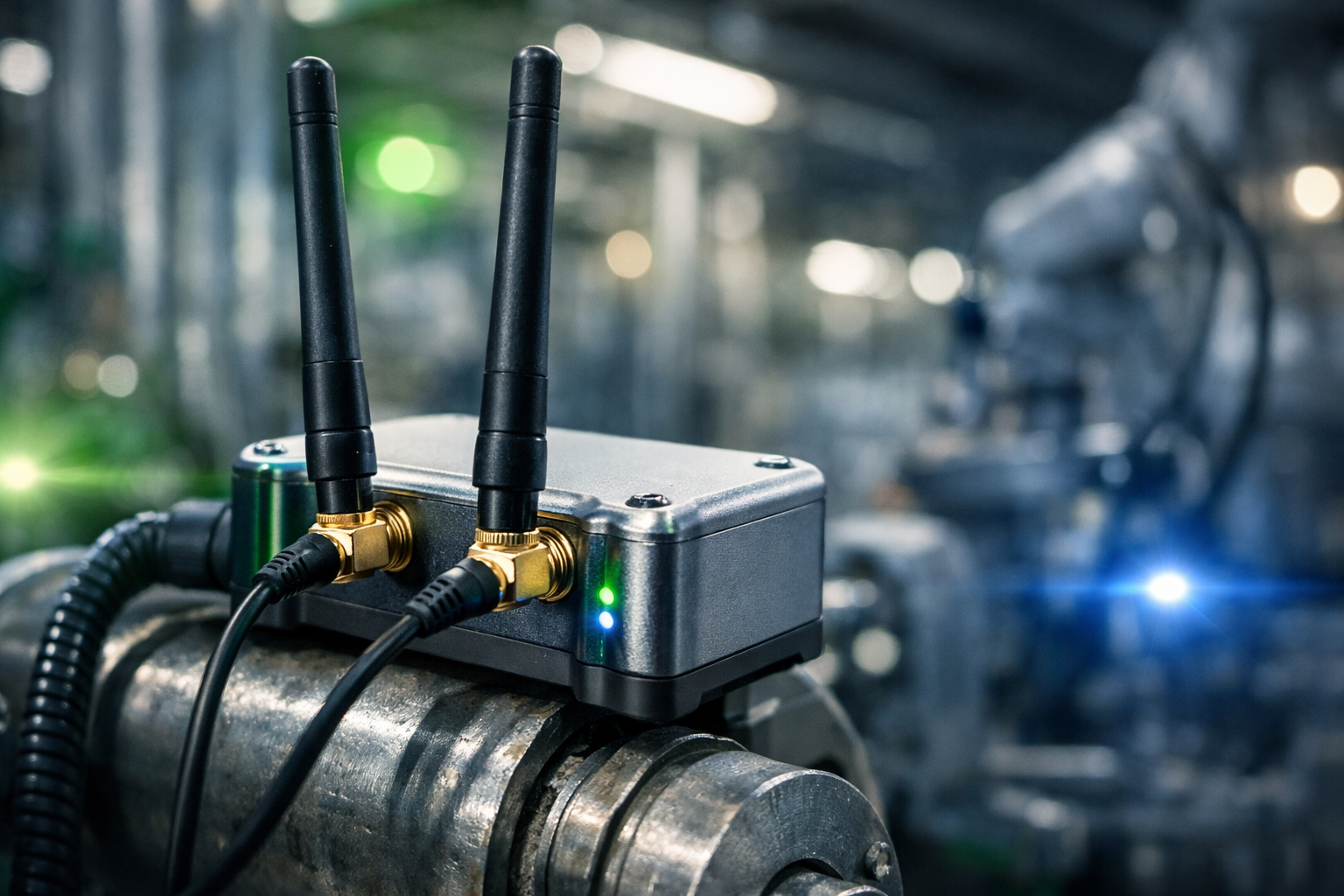
The integrated approach can reduce hardware complexity by sharing some of the chipset’s processing and communications functions. A separate modem would otherwise introduce additional components, electrical interfaces and potential power-management requirements. The completed device still needs an antenna arrangement suited to the frequencies involved, appropriate RF filtering and protection, and software that can select and manage communications paths.
Satellite and terrestrial links operate under different propagation conditions. Low Earth orbit satellites move relative to the ground, while buildings, terrain and equipment enclosures can obstruct or attenuate the received signal. The supported data throughput, connection timing and power use of a particular device cannot be inferred from the chipset partnership alone. Such characteristics require measurements under the relevant operating and installation conditions.
Battery-operated devices present an additional challenge. Energy consumption depends on the radio’s transmission mode, the duration and frequency of connections, processor activity and the amount of stored data. Even where a cellular chipset is designed for low-power operation, the addition of a satellite path does not guarantee identical battery endurance. Designers must budget for the full operating cycle, including periods when the selected network is unavailable.
A monitoring device could collect local measurements and use cellular service for routine transmissions, reserving satellite communications for exceptional events or areas outside normal coverage. This division of responsibilities requires application software and sensible decisions about which data can be buffered. A failed transmission must be distinguished from the absence of an event, particularly in safety-related monitoring systems.
The collaboration is therefore a chipset integration announcement rather than an operational satellite device launch. Altair and Iridium will need to establish the final radio implementation, software interfaces, qualifications and service availability before manufacturers can evaluate complete designs. Its immediate engineering significance is the possibility of combining two communications paths without adding a wholly separate satellite modem architecture.
Network selection is another integration consideration. Application software must recognise when a terrestrial link has failed or become uneconomic, determine whether the satellite service is available and handle repeated connection attempts without exhausting energy reserves. Data integrity may require local queuing, acknowledgement and retransmission. These measures depend on the device software and service implementation, not simply on the presence of two radio capabilities in the same semiconductor platform.