IN Brief:
- The new hybrid variants use two rated 16A power contacts alongside two, four or six 3A signal contacts.
- Bulgin states IP66 and IP68 protection when compatible connectors are correctly mated and assembled.
- Inline and panel-mount variants provide different cable and enclosure connection arrangements.
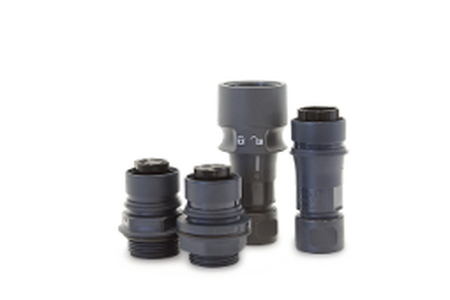
Bulgin has added hybrid power and signal configurations to its 6000 Series Buccaneer circular connector range. Each version brings two power contacts rated at 16A together with a choice of two, four or six signal contacts rated at 3A. The design allows equipment requiring both power delivery and lower-current electrical connections to use one connector housing rather than separate interfaces for the two functions.
The ratings apply to the specified contact types: the 16A figure describes each designated power contact, not the signal positions or a universal rating for every circuit through the connector. Current-carrying capability in a finished cable assembly also depends on conductor size, termination quality, ambient conditions and the applicable derating information. Designers should verify the relevant part number and operating conditions rather than treating a nominal contact rating as an unrestricted system limit.
A hybrid interface can simplify compact industrial equipment that has limited space for cable glands and panel cut-outs. A control enclosure, for example, may need to supply an actuator or powered instrument while receiving status signals from the same assembly. Placing these paths in one circular interface can reduce connector count and external cable routing, although internal wiring and circuit separation must still be designed for the application.
Electrical proximity introduces considerations as well as packaging benefits. Rapid changes in current flowing through power contacts can generate conducted or coupled interference affecting nearby signals, particularly when the connected load includes switching electronics. Signal type, cable construction, earthing, filtering and the internal separation provided by the connector all contribute to the finished installation’s compatibility. Bulgin’s announcement does not claim that combining contacts removes these requirements.
The hybrid products use the existing Buccaneer mechanical platform, including the series’ push-and-twist connection and 30-degree locking movement. Inline cable versions and front-panel mounting options are available, with mating configurations selected to suit the enclosure and cable arrangement. Contacts and fitting tools may be provided separately for particular versions, so the complete bill of materials must be checked before assembly.
Bulgin specifies IP66 and IP68 ingress protection when the relevant parts are correctly mated with compatible counterparts. Its published product-family pages make this condition explicit. The ingress ratings should not be applied to an exposed connector half, an incorrectly fitted cable gland or a mismatched mating pair. Suitable sealing accessories are available for some unmated configurations, but their use and installation conditions must follow the selected product specification.
The manufacturer also describes an IP68 qualification involving immersion at ten metres for two weeks. This is a stated test condition, not an assurance that every equipment installation may remain submerged indefinitely or resist every liquid and cleaning chemical. Sealing performance can be influenced by cable diameter, assembly torque, contact installation and mechanical wear, as well as the environment to which the connection is exposed.
Bulgin’s inline PXP6071 family includes several cable entry sizes, while the PXP6074 panel versions accommodate different enclosure interfaces. The choice of a plug or socket and the mating component must be determined by the wiring arrangement and access requirements. A connector that is compact on the panel may still need sufficient clearance for installation, cable bending and servicing.
Maintenance procedures also change when several circuits share one disconnect point. Removing a hybrid connector may interrupt both power and monitoring signals simultaneously, which can be desirable for a controlled equipment exchange but unsuitable for circuits requiring independent isolation. The system design needs to define safe disconnection, contact protection and the consequences of losing each connection.
The addition extends Bulgin’s established rugged connector range with new contact layouts. Its engineering contribution is the combination of specifically rated circuits inside a compatible sealed assembly; the electrical suitability and ingress protection of the completed equipment remain dependent on correct selection and integration.