IN Brief:
- The ADD607 combines reception across 9MHz to 20GHz in one vertically polarised antenna assembly.
- Its active/passive operating modes allow a monitoring system to respond to different signal-strength environments.
- Rohde & Schwarz lists a typical system direction-finding accuracy of 2° RMS under specified conditions.
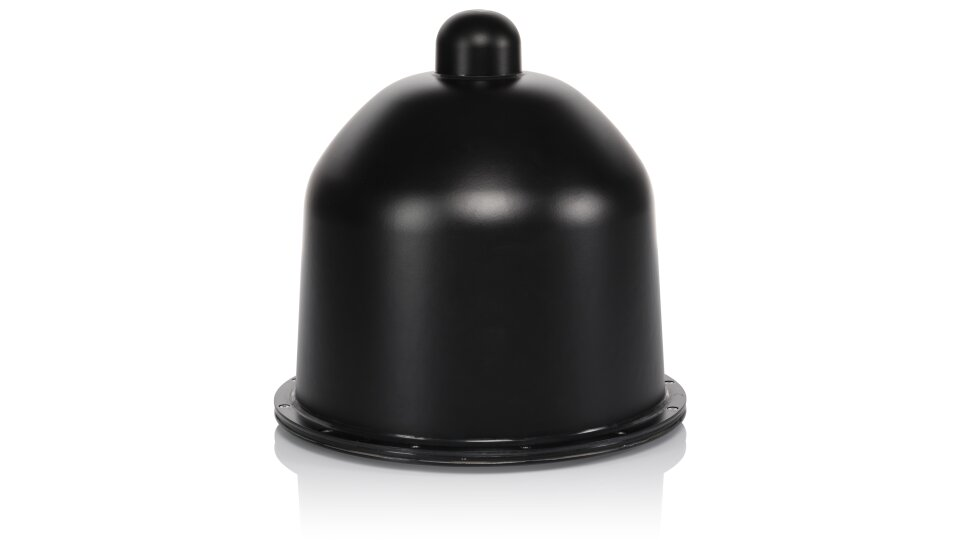
Rohde & Schwarz has launched the ADD607, a compact direction-finding antenna covering 9MHz to 20GHz for mobile spectrum monitoring and radio-location equipment. The product combines active and passive antenna operation within a single assembly, allowing the receiving system to accommodate changing radio-frequency conditions without requiring several different antennas for the specified bands. The announcement targets spectrum regulators, military monitoring organisations and transportable measurement systems.
Direction finding establishes a bearing to a radio transmitter by analysing the signal received at an antenna arrangement. Its accuracy is influenced by the electrical response of the antenna, the receiving equipment, calibration and the propagation environment. Buildings, terrain and nearby metallic structures can produce reflections that alter the apparent arrival direction. Covering a wide frequency range reduces the need for separate hardware, but does not remove these underlying measurement constraints.
The ADD607 supports vertically polarised signals. Rohde & Schwarz specifies a typical system direction-finding accuracy of 2° RMS, a figure associated with its stated system conditions rather than a guaranteed error for every deployment. The company has not established a universal detection distance or minimum detectable transmitter power applicable across the entire frequency range. Those quantities depend on the source signal, noise environment, antenna installation and connected receiver.
A notable feature is the integrated active/passive switching arrangement. Active receiving components can support weak-signal monitoring, but strong transmissions in the local environment may overload active circuitry or the receiver. Overload can cause distortion and unwanted responses, obscuring other signals. Passive operation bypasses the active antenna components, providing an alternative configuration where high signal levels make the additional gain undesirable.
Switching modes changes the available receiving configuration; it cannot guarantee that a weak source will be detected in the presence of every nearby transmitter. The usable dynamic range, signal discrimination and final bearing still depend on the complete monitoring system. Engineers planning an installation must consider intermodulation, receiver filtering, local sources of interference and the interaction between the antenna and its mounting structure.
Rohde & Schwarz has incorporated a compass and GPS functionality to support orientation and location reporting in transportable systems. Position and heading data are valuable when bearings acquired at several locations are brought together to estimate a transmitter location. Those measurements must be consistent and accurately referenced to the vehicle or antenna orientation. A compass reading taken close to ferromagnetic vehicle parts may also require installation-specific calibration.
The antenna can be deployed on mobile platforms and temporary supports. Its compact form is intended to simplify field installation compared with assembling separate antennas for several frequency bands, although mechanical compatibility, cable routing and electromagnetic clearance remain application-specific matters. The manufacturer identifies a magnetic vehicle mounting option for appropriate installations.
Compatibility is listed with Rohde & Schwarz monitoring equipment including the PR200, PR300, EM200, UMS400 and ESMW, allowing the ADD607 to be evaluated as a component of a broader radio monitoring arrangement. Signal analysis, recording and operational presentation remain functions of the connected system rather than of the antenna alone. The new unit therefore consolidates reception hardware and operating modes, while leaving detection performance to be established through the full equipment configuration and field conditions.
Frequency coverage also influences the design of the connected receiver and the measurement plan. Signals occupying distant bands can have very different modulation formats, instantaneous bandwidths and power levels. A direction-finding antenna may support reception across the full specified range, but the receiver must still be capable of tuning, digitising and interpreting the transmission of interest. Bearing estimates gathered in a moving vehicle may further require time synchronisation and reliable positional records if they are to be compared with measurements from other sites or vehicles.