IN Brief:
- Rockwell says the new controller occupies 43% less space than comparable CompactLogix 5380 configurations.
- The range supports local PointMax I/O, integrated safety, and security capabilities aligned with IEC 62443-4-2.
- The product is listed for availability in the fourth quarter of calendar 2026, with configuration-dependent capabilities.
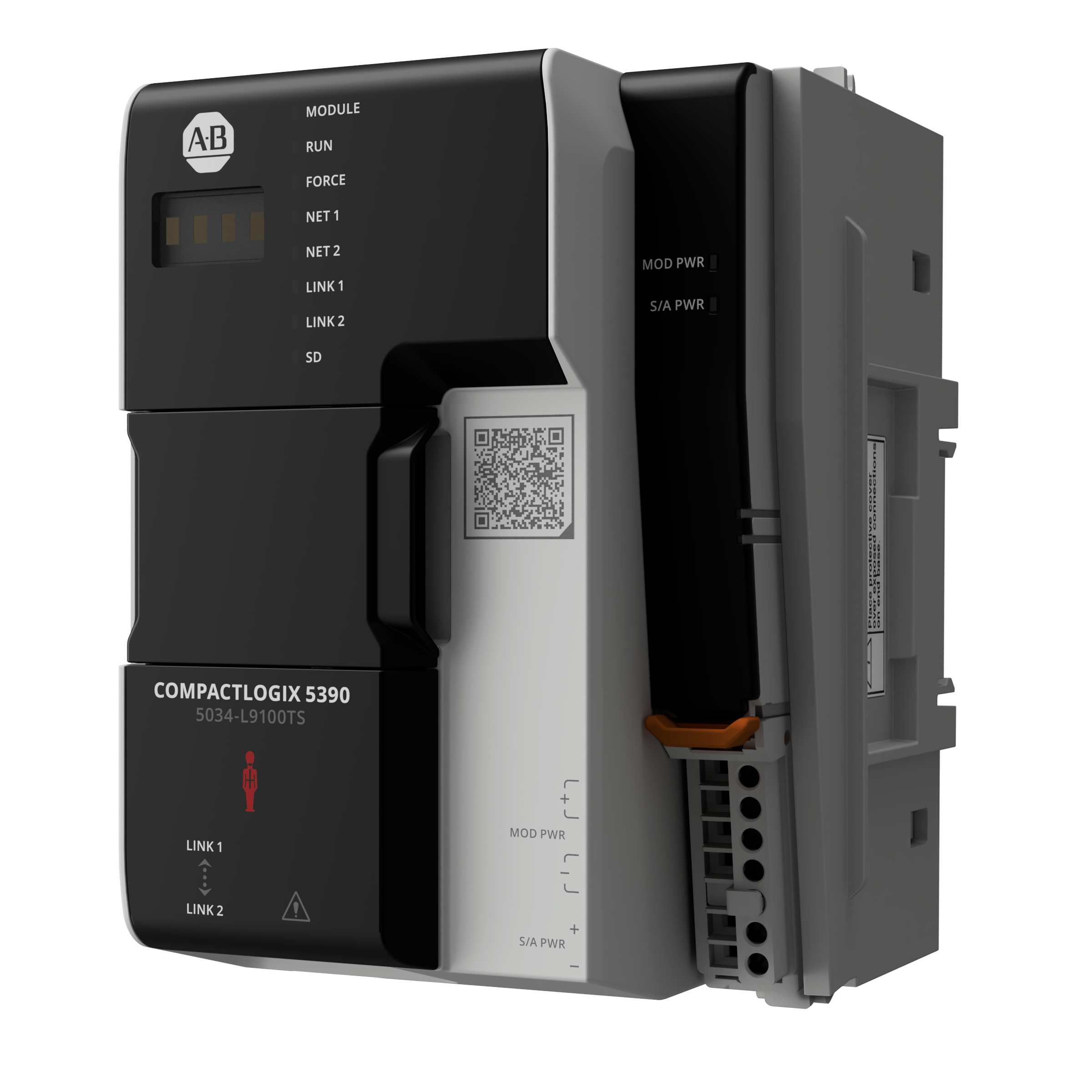
Rockwell Automation has introduced the CompactLogix 5390 programmable controller with local PointMax I/O support, integrated safety functions and embedded cybersecurity capabilities. The latest member of the company’s Integrated Architecture range is intended for machine-control applications requiring coordinated logic, I/O and associated automation equipment. Rockwell says the controller occupies 43% less space than the previous CompactLogix 5380, with customer availability planned for the fourth quarter of 2026.
The smaller arrangement is intended to reduce the amount of cabinet space needed for control equipment, while accommodating local PointMax input and output modules. These modules connect field signals and actuators to the controller, allowing a machine design to be divided into a central control section and the required mix of nearby interfaces. The advantage depends on the size and position of the complete installed module assembly, rather than the controller body alone.
A programmable controller reads field inputs, executes application logic and produces outputs according to its configured execution sequence. More sophisticated equipment must coordinate this cycle with motion systems, drives, diagnostics and communication traffic, placing demands on processing resources and deterministic behaviour. Rockwell describes increased performance and scalability for the 5390, but the announcement does not provide a like-for-like benchmark covering programme scan times or motion throughput against the older family.
The product range supports configurations with differing application memory and connection capacity. Rockwell’s published overview lists user memory options from 400KB to 10MB, separate safety memory specifications, 10–30V DC module and sensor-actuator power supplies, and a USB-C interface. Those figures describe available specifications across the range, not the features of every individual catalogue number. The appropriate configuration must be established against the required I/O quantity, programme size and control functions.
Integrated safety means safety-related control functions can be engineered within an associated controller and I/O architecture, rather than requiring an entirely separate set of general control hardware for every task. It does not remove the need for an application-specific risk assessment, correct selection of safety devices and validation of stopping behaviour. Rockwell lists an individual 5390 safety variant with SIL2/PLd capability, illustrating why the safety performance of a complete machine should not be inferred from the family name alone.
Rockwell says the 5390 includes security capabilities aligned with IEC 62443-4-2 and is intended to assist preparation for the European Union Cyber Resilience Act. IEC 62443-4-2 concerns technical security requirements for industrial automation and control system components. Alignment with those requirements is not equivalent to proof of certification or confirmation that a complete machine meets every obligation under the Act. System integration, account management, network segmentation, maintenance and secure update processes still require attention.
The controller is designed to operate within the company’s established automation portfolio, including Kinetix motion equipment, PowerFlex drives, Stratix networking products and FactoryTalk Design Studio engineering software. Reusing familiar control and configuration tools can simplify development across related machine models, particularly where motion, process variables and operator functions need to be coordinated. The engineering benefits depend on supported firmware, device revisions and the software used for a particular installation.
A reduction in controller enclosure space may permit a smaller panel or provide room for other devices, but the final machine layout still needs clearance for wiring, heat dissipation, power supplies and service access. Rockwell’s online specifications list a one-inch clearance on all sides for the controller, and include variants suited to defined corrosive-atmosphere conditions. Those environmental and installation limits are as relevant to industrial design as a percentage reduction in the controller footprint.
Rockwell plans to make the 5390 range available during the fourth quarter of 2026. Its stated footprint reduction and catalogue specifications can inform a control-cabinet design, but the completed machine will still require validation of its chosen I/O, safety functions, networking and application software. No comparative figures for finished cabinet cost or installation time have been published.