IN Brief:
- PositionSense combines a six-axis MEMS inertial sensor with a three-axis tunnel magnetoresistance magnetometer.
- Four configurations use ICM-45608 or ICM-45689 with ICT-15312 or ICT-15318, offering different motion ranges and interface voltages.
- Worldwide distribution is now announced; the underlying PositionSense platform was introduced in January 2025.
TDK has announced worldwide distribution of its PositionSense nine-axis sensing platform, providing four defined combinations of inertial and magnetic sensors for embedded navigation and orientation systems. The solution pairs a six-axis MEMS inertial measurement unit with a three-axis tunnel magnetoresistance magnetometer and runs sensor fusion and calibration software on the device. The development concerns broader commercial availability: TDK introduced PositionSense in January 2025 and had previously offered samples by direct enquiry.
Three accelerometer axes measure linear acceleration, while three gyroscope axes track angular velocity. The additional magnetic axes provide a reference for heading relative to the surrounding magnetic field. Combining these measurements gives a system more information about its orientation than either an inertial sensor or electronic compass alone, although the final accuracy depends on the calibration and operating environment.
The gyroscope can respond quickly to rotation but accumulates error when angular velocity is integrated over time. Accelerometers can help constrain pitch and roll through the direction of gravity during suitable motion conditions, while magnetic sensing supplies information about heading. Fusion software balances these signals and updates its estimates using a common timing reference, reducing the consequences of relying on any individual sensor.
TDK emphasises on-chip sensor fusion, precise time synchronisation, gyro-assisted calibration and automatic recovery following magnetic shocks. These functions are intended to shorten the period during which a compass indication is unreliable after power-up or a local disturbance. A magnetometer is nevertheless sensitive to ferrous structures, motors and current-carrying conductors. Calibration and fusion can improve resilience, but the announcement does not establish that the system will be unaffected by all industrial magnetic interference.
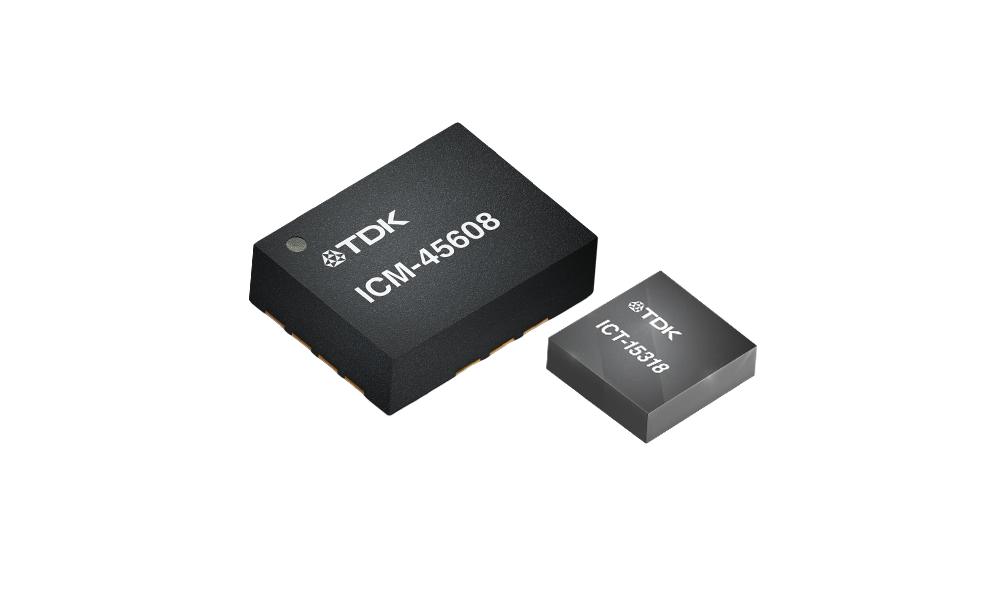
Two of the configurations use the ICM-45608 inertial sensor with either the ICT-15318 or ICT-15312 magnetometer. The ICM-45608 supports accelerometer measurement to ±16g and gyro measurement to ±2,000 degrees per second. With the ICT-15318, the digital interface operates at 1.8V and supports I²C, SPI and I3C. Pairing the same IMU with the ICT-15312 provides a 1.2V interface using I²C or SPI, addressing designs with a lower-voltage digital supply.
The other two combinations substitute the ICM-45689, extending the accelerometer range to ±32g and the gyro range to ±4,000 degrees per second. They retain the same magnetometer options: ICT-15318 for the 1.8V I²C, SPI or I3C arrangement, and ICT-15312 for the 1.2V I²C or SPI alternative. The higher full-scale ranges provide additional headroom for rapid motion, although developers must still consider measurement noise and resolution when choosing a device for slower movements.
The 1.2V and 1.8V interface choices affect the host processor connection, while bus bandwidth and interrupt or sampling arrangements need to be matched to the chosen sensing rate and power management scheme. On-device fusion can reduce the amount of raw sensor processing needed by a host, but it does not remove the need to characterise the full application’s timing, mechanical mounting and power consumption. TDK has not supplied a universal navigation error figure for the four configurations.
The platform is being offered for robotics, drones, industrial IoT equipment and wearable devices. Heading estimation is especially useful when satellite navigation is intermittent, but orientation alone cannot determine an absolute geographical position. A robot attempting to localise itself inside a warehouse will ordinarily require additional information from wheel odometry, cameras, ranging sensors or mapped features if it is to control positional drift over a journey.
TDK describes the solution as suitable for always-on sensing, including operation while higher-power processing functions sleep. That capability can support designs in which motion triggers further sensing or processor activity. Actual battery life will still depend on the selected mode, sensor update rate and host duty cycle, none of which can be reduced to a single figure from the distribution announcement.
Worldwide distribution makes the four device pairings more directly accessible for integration and evaluation, following the initial PositionSense introduction in 2025. Design teams can now compare the motion range, interface voltage and calibration behaviour of each pairing against a defined application requirement. TDK has not announced customer qualification results for industrial robots or quantified positioning accuracy across the environments described in its release.