IN Brief:
- The demonstrator integrates VisIC D³GaN power modules with AVL drivetrain controls and NXP electronics.
- Earlier dynamometer testing reached 99.67% inverter efficiency at 10kHz and more than 99.8% at 5kHz.
- Vehicle-level efficiency, durability and production readiness have not yet been quantified publicly.
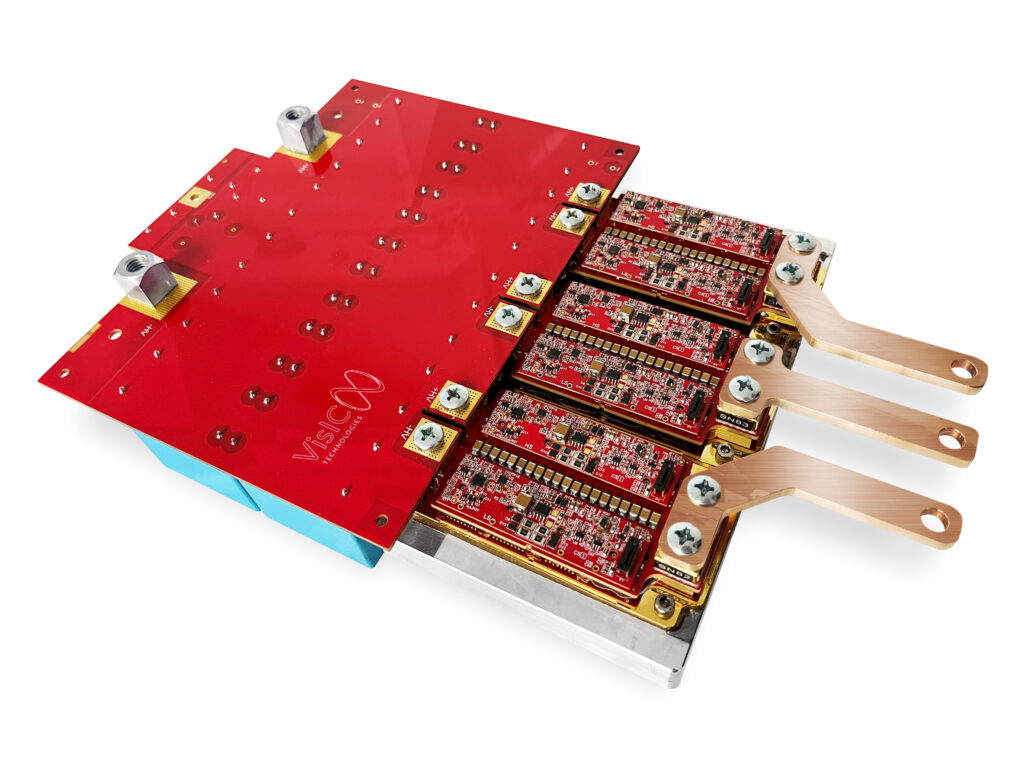
VisIC Technologies has integrated its gallium nitride power modules into an electric vehicle demonstrator developed by Austrian engineering company AVL, extending a joint traction inverter programme from controlled test facilities into a complete drivetrain. The vehicle combines a high-speed electric axle, power electronics and vehicle control systems, with NXP Semiconductors contributing driver electronics to the inverter development.
The integration follows earlier work at AVL’s facilities in Germany, where the companies measured an inverter efficiency of 99.67% at a switching frequency of 10kHz and more than 99.8% at 5kHz. These figures were recorded during dynamometer testing, rather than during on-road operation. The newly announced vehicle configuration provides a means to examine how the GaN system behaves alongside the electrical, thermal and control functions of an operating powertrain.
A traction inverter converts the battery’s direct-current supply into the controlled alternating-current waveforms required by an electric motor. Its semiconductor switches must repeatedly commutate substantial currents while responding to changing torque demand. Every switching event introduces a potential energy loss, while current flowing through an on-state device produces conduction losses. Their balance depends on the drive cycle, switching frequency, device characteristics and the surrounding circuit.
VisIC’s D³GaN technology uses gallium nitride grown on silicon and is intended to limit those losses while supporting the current levels needed in automotive applications. The inverter work uses the company’s power module technology alongside NXP gate-drive electronics, AVL’s PI850e development platform and AVL control software. Proper gate control is especially important with fast-switching devices, where transients, dead time, electromagnetic interference and short-circuit behaviour affect both performance and protection design.
During the earlier testing, the partners reported that inverter energy losses were more than 60% below those of a comparable silicon carbide system under the stated conditions. That comparison should not be read as a universal improvement across every vehicle operating point: the absolute efficiency difference, loading conditions and switching frequency all influence the result. The bench figures establish a useful technical reference, but the new announcement provides no equivalent measured energy-consumption or range result for the complete demonstrator vehicle.
The transition to vehicle integration adds questions that a dynamometer test alone cannot settle. The inverter must remain controllable through rapid acceleration and regenerative braking, tolerate the thermal environment around the electric axle and operate alongside other high-voltage equipment. Wiring and mechanical integration introduce parasitic inductance and packaging constraints, while the cooling system must manage the heat generated during sustained loads and repeated transients. AVL’s demonstrator enables these interactions to be investigated in a more representative configuration.
Mathias Deiml, technical lead for GaN inverter development at AVL Software and Functions, described the vehicle integration as an important step in understanding the opportunities and challenges of bringing this technology into future automotive applications
. That work brings transient behaviour, cooling, protection and control coordination into the same test environment; the earlier headline efficiency results still refer to dynamometer testing.
The companies began their collaboration in 2024 and have since used the same semiconductor platform to explore high-power automotive inverter requirements. VisIC identifies its VM030 D³GaN half-bridge module as a building block for the demonstration. The company’s published module information describes a 650V device family, while separate development work is examining higher-voltage architectures. An automotive installation does not in itself demonstrate that a future 800V module has completed qualification.
GaN competes with silicon carbide and established silicon devices in different parts of the power conversion system. Higher switching speed can reduce the size of some passive components and improve part-load conversion efficiency, but device cost, thermal cycling, short-circuit robustness and the behaviour of the complete inverter remain important selection criteria. Existing motor and cooling designs may also limit how much of a device-level gain can be translated into a production vehicle.
The programme now has a functioning vehicle platform on which to evaluate those trade-offs. Neither a production vehicle adoption timetable nor a verified vehicle-level range improvement has been disclosed, leaving further operating data and qualification work to determine how readily the demonstrated inverter can move into series manufacturing.