IN Brief:
- The partners have demonstrated a working prototype of a solid-state breaker for 800V DC distribution.
- InnoMux-2 derives isolated gate-drive, control and sensing supplies from the high-voltage DC bus.
- B-TRAN provides the bidirectional semiconductor switching element; no clearing-time or product launch data is supplied.
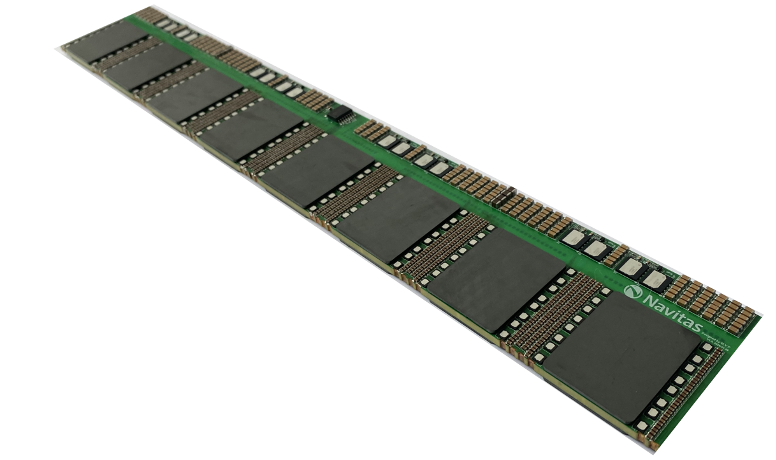
Power Integrations and Ideal Power have demonstrated a working prototype of an 800V DC solid-state circuit breaker using a 1700V InnoMux-2 power conversion device and B-TRAN semiconductor switching. The companies are developing a reference design for protection of power distribution circuits serving AI computing racks. The collaboration has not yet produced an announced commercial product or a published timetable for availability.
The two chips have different roles in the proposed architecture. Ideal Power’s B-TRAN forms the semiconductor switching element in the 800V power path, while the InnoMux-2 device draws from that bus to produce isolated supplies for control, sensing and gate-drive functions. The intended arrangement avoids the need for a separate external auxiliary supply, although it still requires a fully engineered insulation system and protection control strategy.
Interrupting DC current presents a different problem from opening contacts in an AC circuit. Alternating current passes through zero periodically, which helps extinguish an arc; a DC bus has no equivalent natural zero crossing. Fault energy can also be stored in bus capacitors and magnetic components. The protective system must detect the fault, interrupt the semiconductor path and manage the resulting electrical transients without exceeding the limits of the connected equipment.
Semiconductor breakers can respond electronically rather than waiting for mechanical contacts to move, but device speed alone does not determine protective performance. Sensing delay, controller response, current rating, switching energy and the coordination of upstream and downstream protection all influence the fault-clearing result. The companies describe their prototype as a basis for fast isolation without publishing a measured trip time, full fault-current qualification or independently verified protection curve.
In normal operation the power-path switch conducts continuously, so even a modest voltage drop can create substantial heat at high currents. Ideal Power is positioning B-TRAN as a bidirectional device with low conduction loss for this duty. No test data for the complete breaker has been published that would establish its efficiency relative to a particular mechanical or electronic alternative; loss depends on current, temperature, gate drive and the overall circuit topology.
InnoMux-2 addresses the other part of the problem by deriving several independently regulated, isolated supply outputs from an 800V DC input. Power Integrations says its 1700V PowiGaN device technology provides voltage headroom, allowing the breaker’s measurement, control and switching circuitry to operate without a chain of additional post-regulators. Individual rail ratings and conversion performance must nevertheless be evaluated against the actual control electronics and fault conditions.
The 1700V rating describes the power conversion device technology, not the nominal voltage of the finished breaker. Its target network operates at 800V DC, with electrical margin still required for transients, insulation coordination and abnormal conditions. The partners have not released a complete equipment-level surge rating, creepage specification or certification report for the prototype.
A breaker must also work alongside inrush control and the converters supplying processors. Hot-swap electronics may limit charging current as a rack is attached to the bus, whereas selective circuit protection aims to isolate a fault without needlessly disconnecting healthy loads. The sensing thresholds, trip sequence and permissible fault energy depend on the distribution topology. A controller designed to manage start-up is therefore not automatically a replacement for a protection device.
Recent work on 800V rack conversion circuitry addresses how electrical energy is transformed into the low voltages consumed by computing hardware. This collaboration concerns the protective path upstream of those converters. The installed system still needs coordinated bus conductors, isolation, maintenance procedures and fault handling across the whole electrical chain.
The partners are developing a reference design around the prototype’s semiconductor switch and isolated supply arrangement. Equipment builders will need to evaluate the gate-drive layout, sensing circuits, thermal path and coordination with upstream and downstream protection. A commercial release date, final continuous current rating and tested clearing-time specification have not been provided.
Representative bus-fault tests, measured conduction losses and complete equipment insulation testing remain necessary to establish the operating limits of a production 800V DC breaker.