IN Brief:
- The Switchtec PCIe 6.0 low-lane-count switch provides up to 64 lanes, 32 ports and configurable x2 to x16 port widths.
- An enhanced Flashtec NVMe 5016 controller supports CNSA 2.0, dual-port operation and quality-of-service controls.
- SmartRAID 4300 additions include RAID 6 and RAID 60, self-encrypting drive key management and persistent event logs.
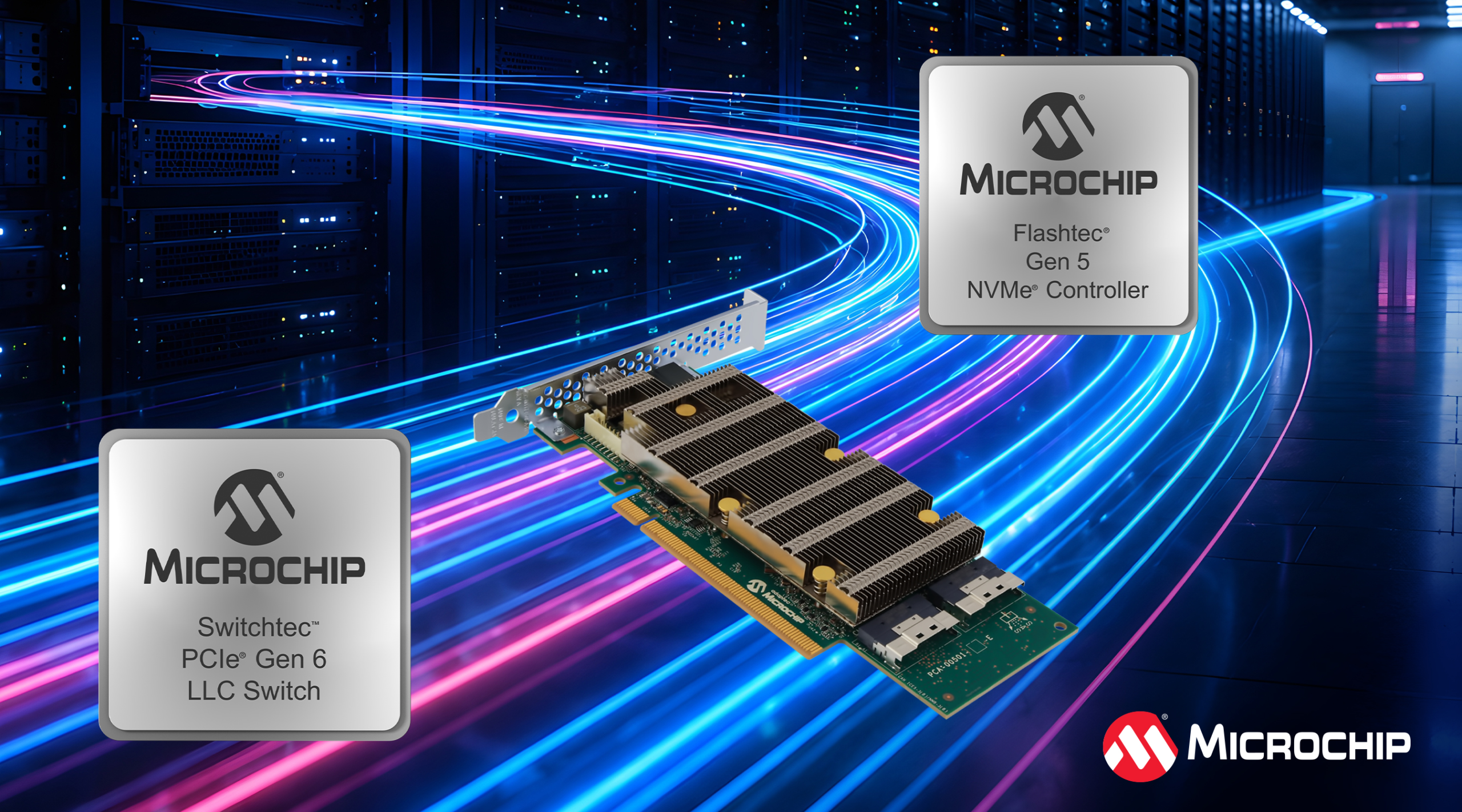
Microchip Technology has expanded its data centre component portfolio with a PCIe 6.0 switch and further capabilities for Flashtec NVMe SSD controllers and Adaptec SmartRAID accelerators. The devices address three distinct functions within computing and storage equipment: connecting endpoints, controlling solid-state drives and managing data protection at the system level.
The new Switchtec PCIe 6.0 Low-Lane-Count (LLC) switch provides up to 64 PCIe Gen 6 lanes and 32 ports, with x2, x4, x8 and x16 bifurcation options. Those widths allow the available interface lanes to be assigned to different numbers of devices, rather than locking a board to a single topology. The company targets systems constrained by board area and power more than those using its largest PCIe switches, although specific wattage and footprint comparisons have not been published.
An integrated direct memory access engine supports peer-to-peer movement between connected devices with less intervention from the host CPU. Whether that path can be used depends on endpoint capabilities, address translation, access permissions and host software. The switch also includes PCIe Multicast and partitioning, which can distribute selected traffic to multiple recipients or separate groups of endpoints within a supported configuration. Neither function should be read as a universal substitute for software-level data management.
Security provisions include a hardware root of trust and secure boot, intended to protect the integrity of the switch’s start-up process. These measures help establish that trusted firmware is loaded before normal operation; they do not certify the security of attached devices or the complete system. The new component is also distinct from Microchip’s previously announced PCIe 6.0 and CXL 3.1 retimers. A retimer restores signal quality across demanding links, whereas a switch controls connectivity between endpoints.
In the storage controller range, Microchip is updating its PCIe Gen 5 Flashtec NVMe 5016 with support for Commercial National Security Algorithm Suite 2.0 (CNSA 2.0). The company describes the feature as preparation for post-quantum security requirements. Support for the suite does not establish independent cryptographic certification for a finished SSD, nor does it demonstrate that every storage function uses post-quantum algorithms.
Flashtec is also gaining dual-port operation, redundant data paths and load balancing. Two ports can give separate host paths access to the same SSD, allowing a suitably designed storage platform to maintain connectivity if one route fails. The controller cannot remove every single point of failure, because host adapters, cabling, power supplies, firmware and the drive itself still have to be considered. Virtualisation, quality-of-service management and programmability are also supported in the updated controller.
Microchip’s Adaptec SmartRAID 4300 line receives enhancements to security and administration rather than an entirely new accelerator architecture. Support for self-encrypting drives now includes local and remote key management, alongside RAID 6 and RAID 60 options. RAID 6 distributes dual parity across a drive group to tolerate two drive failures, while RAID 60 combines multiple RAID 6 groups through striping. Either configuration needs suitable capacity planning, monitoring and rebuild procedures, and RAID does not replace independent backups.
Further SmartRAID changes include dynamic NVMe configuration during service, persistent event logging and peer-to-peer rebuild support that can reduce CPU involvement. Microchip has also expanded support for Linux environments including Debian and Ubuntu, and for Windows 11. These features concern management and host compatibility; availability in any particular deployment still depends on the software and firmware versions supplied for the chosen accelerator.
The StorageCore API provides an interface for third-party management software, either through in-band applications on the host or customised out-of-band connections using a baseboard management controller (BMC). Such integration can bring storage monitoring into existing administration systems, although the application must implement the API and the chosen platform must expose the required management functions. Microchip lists ChipLink for PCIe configuration, diagnostic telemetry and debugging, as well as separate utilities for Flashtec and Adaptec products.
Pricing and availability differ among the new and enhanced devices. Microchip directs customers to its sales teams and distributors for device-specific ordering information, which will determine when individual switches, controllers and accelerator functions can enter hardware builds.