IN Brief:
- Squadron scales to 16 eight-server SquadRacks and up to 1,024 Corsair inference XPUs.
- The company reports an internal Arizona deployment and shipments to priority customers, with smaller configurations generally available.
- A heterogeneous GPU–Corsair demonstration processed 64 concurrent requests at a reported 20,415 tokens per second.
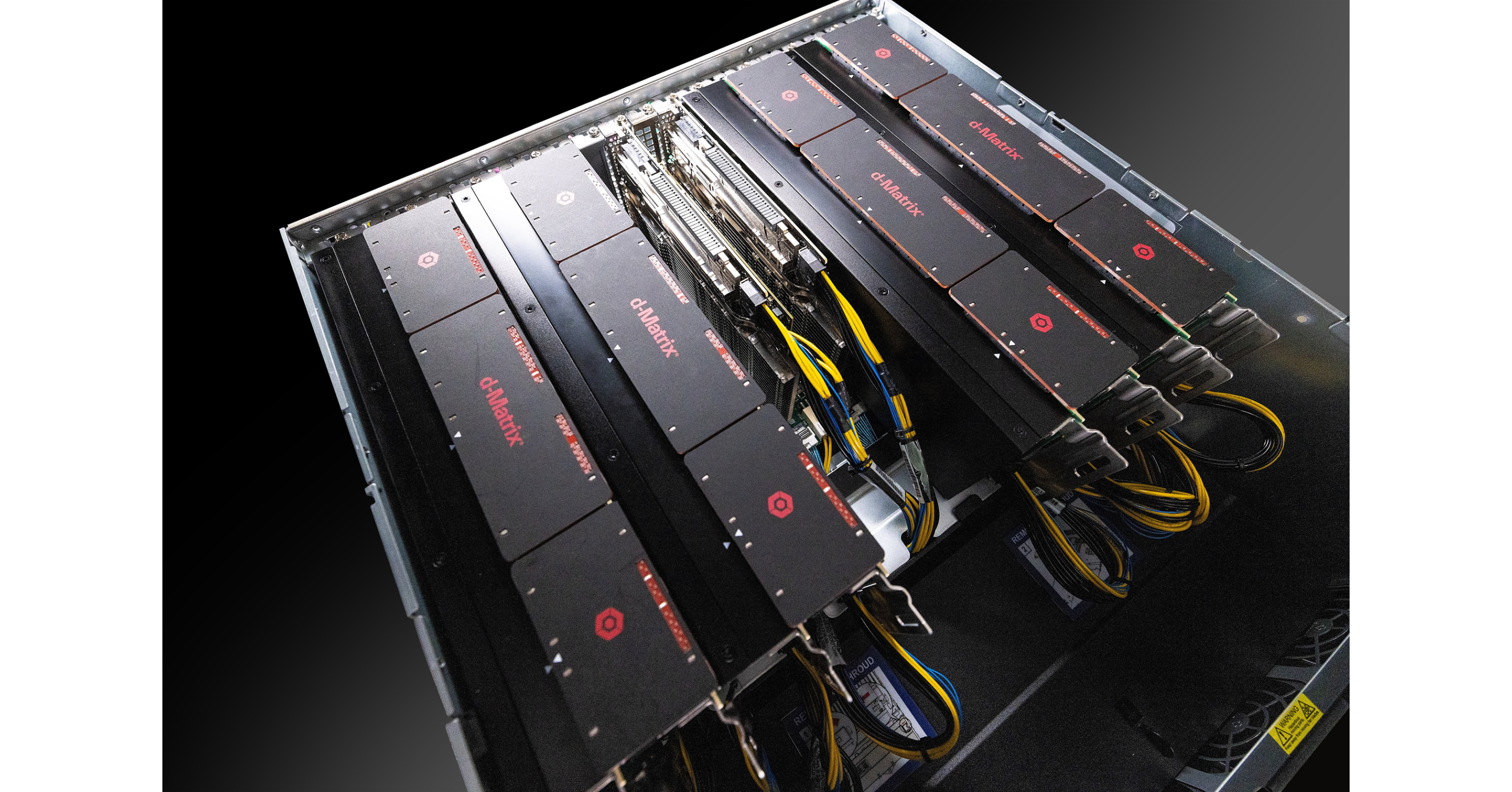
d-Matrix has begun shipping its Squadron multi-rack inference computing system to priority customers, expanding its Corsair accelerator hardware into configurable data centre clusters. A full installation can connect up to 16 SquadRacks containing a total of 1,024 Corsair XPUs, with networking through the company’s JetStream interface technology and deployment software supplied through Aviator. Smaller Corsair servers and eight-server SquadRack configurations are also being offered, while the complete Squadron system has already been deployed in the company’s Arizona research facility.
Squadron packages the existing Corsair processor within new server, networking and management hardware, enabling the devices to operate together across racks. d-Matrix put the accelerator platform into production earlier in 2026 and separately announced plans to use NVIDIA NVLink Fusion with its future Raptor design. Squadron is based on Corsair, and its shipping status should not be taken as confirmation that Raptor-based NVLink rack systems have entered production.
Corsair uses a memory-centric architecture that places relatively large amounts of fast static RAM close to the arithmetic units handling model inference. This can reduce the repeated movement of model weights between off-chip memory and processing logic, a significant source of delay in some language-model workloads. The approach is particularly relevant when the same fixed weights must be accessed frequently, although available on-chip capacity, model structure and batching determine how effectively it can be used.
Each SquadRack houses eight Corsair servers, with eight XPUs per server in the maximum stated configuration. Sixteen such racks therefore account for the quoted ceiling of 1,024 accelerators. The product is described as air cooled and designed around conventional data centre arrangements, avoiding a requirement for direct liquid cooling at the accelerator. That statement does not mean the rest of a site can dispense with cooling infrastructure or that every existing room has enough available power and airflow for a multi-rack installation.
JetStream network interface cards provide connections between the compute elements, while Aviator is intended to configure and operate the systems across deployment sizes. Once workloads are distributed over several racks, the speed and predictability of data exchange can become as important as the performance of any single processor. Network congestion, scheduling overhead and failures between components can all affect model latency, particularly when operations within a transformer layer depend on results from another device.
Alongside the hardware launch, d-Matrix has demonstrated attention–feed-forward-network disaggregation using Corsair processors and NVIDIA H100 GPUs. The test assigns attention operations and the growing key-value cache to the GPU, while the Corsair hardware processes the feed-forward expert computations in a mixture-of-experts model. Rather than repeating all operations on one device, the systems exchange intermediate representations through JetStream connections as the model advances through its layers.
The company’s technical account specifies GPT-OSS-20B, with 19.12 billion expert parameters held at four-bit precision across eight Corsair cards for the experiment. The benchmark combines H100 GPUs with Corsair accelerators and reports up to 845 output tokens per second for a single user, and approximately 20,415 tokens per second in total for 64 concurrent requests. Those measurements describe a particular model, precision, batch size and hardware allocation, not a general performance result for every Squadron installation.
Offloading feed-forward calculation does introduce communication between processing devices. d-Matrix says overlapping the data exchange with other GPU operations helps limit the delay exposed to the application. Whether the technique improves a different model depends on the proportion of computation in attention and expert layers, the size of its weights and the latency of the interconnect. A wider deployment also requires appropriate performance, power and reliability measurements beyond the demonstration workload.
Developed with Arista, Broadcom and Supermicro, Squadron is shipping to priority customers while individual Corsair servers and SquadRacks are generally available. The published attention–feed-forward demonstration gives a workload-specific performance reference, but d-Matrix has not disclosed independent full-cluster energy-per-token results or a broader customer deployment list.