IN Brief:
- Nu-Link3-Pro combines six-channel digital signal capture, protocol decoding and programming for compatible NuMicro development targets.
- The specified 110MHz capability applies to supported ETM instruction tracing, not the CPU clock or logic-analyser sampling rate.
- Secure provisioning is a configurable service assessed for particular chips and projects rather than universally available protection.
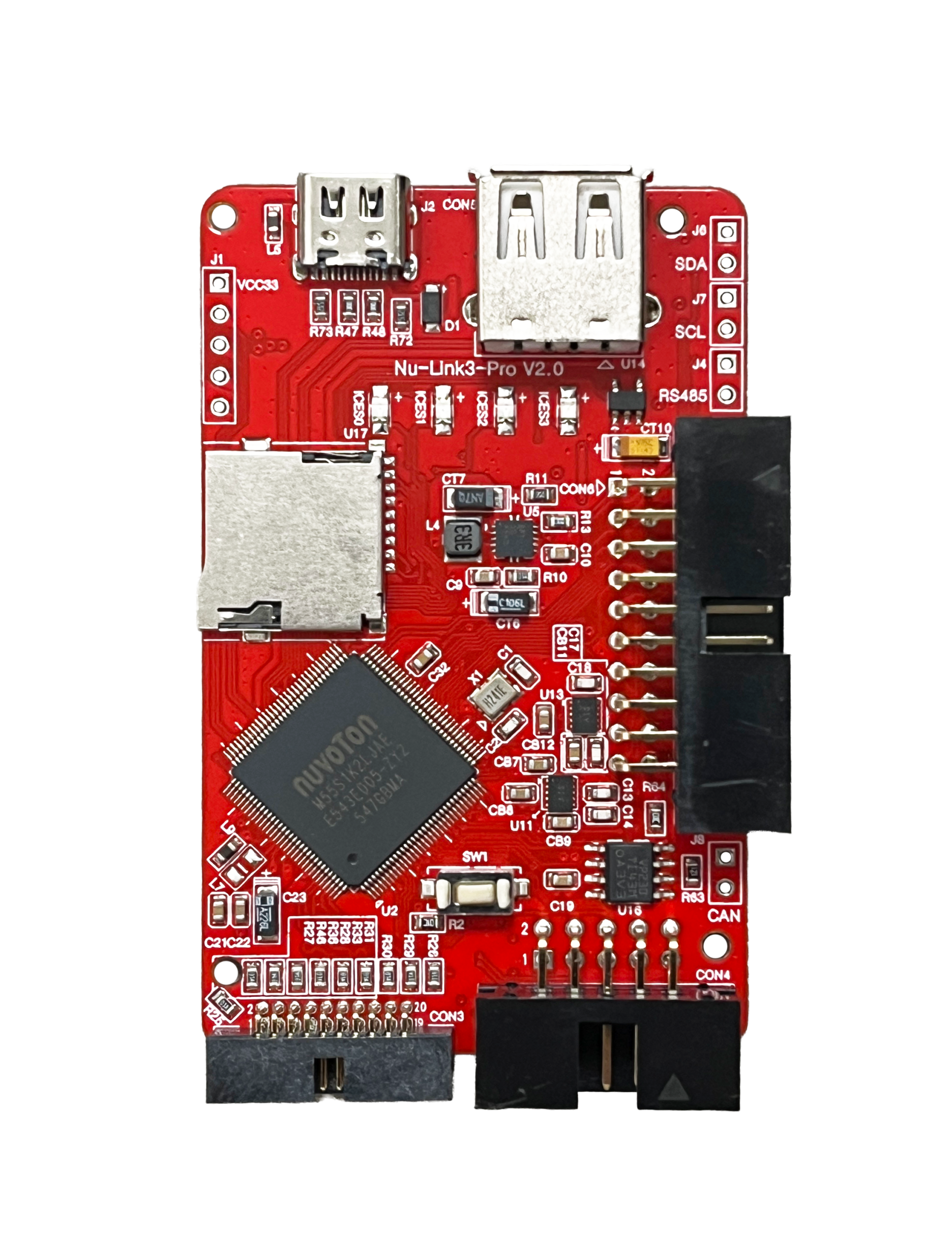
Nuvoton Technology has introduced Nu-Link3-Pro, a combined debugger, programmer and digital logic analyser intended for its NuMicro microcontroller range. Announced on 15 October, the unit brings several functions used during embedded hardware and firmware development into one USB-C-connected instrument. Alongside on-chip debugging and device programming, it provides six-channel signal analysis and expanded support for industrial communication protocols.
The adapter extends Nuvoton’s Nu-Link2-Pro programming and debugging functions and remains tied to the supported NuMicro toolchain. Development work commonly moves between software execution traces, external bus observations and repeated firmware flashing. Each measurement answers a different question: instruction tracing shows execution flow, a logic analyser records changes on external digital pins, and programming tools place an executable image into the target. Consolidating these functions can reduce the number of interfaces on a bench, but it does not make the forms of evidence interchangeable.
Nuvoton specifies Embedded Trace Macrocell (ETM) instruction tracing at up to 110MHz when used with compatible NuMicro controllers. That rating concerns the supported tracing function; it is neither the microcontroller’s CPU clock rating nor the sampling frequency of the separate logic analyser. Available trace capabilities also depend on the target’s trace implementation, connections and debug settings, so the adapter cannot provide a full instruction trace on every microcontroller.
The six-channel logic analysis function works with PulseView and the sigrok software framework on supported target connections. It allows developers to capture digital transitions and inspect supported protocol exchanges while diagnosing firmware behaviour. Correlating a bus transaction with a software event can be useful when investigating missed interrupts, unexpected peripheral responses or an intermittent state change. Accurate interpretation still depends on sufficient sampling settings, electrical signal compatibility and the timing information available from the particular capture.
For compatible development setups, the tool supports analysis or interaction with SPI, I²C, UART and RS-485, and adds I3C and CAN FD capabilities. I3C expands the range of serial sensor and peripheral communication that can be examined, while CAN FD accommodates a transport widely used in vehicle and industrial controller networks. Protocol decoding can identify frames and transactions, but it cannot by itself establish analogue signal margins, cable quality or electromagnetic compatibility. A mixed-signal oscilloscope or physical-layer test instrument may still be required when the failure concerns edge integrity rather than digital content.
Supported NuMicro targets can use serial-wire debugging and the in-circuit or in-system programming functions documented for the chosen device. The adapter also supports target voltage levels of 1.8, 2.5, 3.3 and 5V. These voltage options help accommodate different boards, but electrical compatibility must still be checked for the interface and pin configuration used. Neither multiple voltage support nor a USB-C connector makes the instrument a universal programmer for unrelated microcontrollers.
A MicroPython environment provides the main addition for automated production or laboratory procedures. A MAIN.PY script on a microSD card can control offline programming sequences for supported targets without continuous operation from a host application. Such scripts can support repeated firmware downloads, parameter setting or a controlled fixture workflow where the required commands are supported. Automation improves consistency only if the script, target identification and pass criteria are themselves controlled.
Nuvoton offers an optional secure provisioning service that can generate a private key inside Nu-Link3-Pro, retain it in the device’s hardware key store and use an onboard cryptographic engine for specified credential operations. The vendor says the key need not leave the programmer within that configured workflow. This service is assessed and customised according to the target chip and project requirements; it is not a universal capability for all NuMicro devices or proof that a complete provisioning system is tamper-proof. Production teams must still define authorised access, audit records and recovery procedures.
The supplier positions Nu-Link3-Pro for development and manufacturing use, where the distinction between the two environments is particularly important. An engineer may want interactive breakpoints and flexible bus inspection; a production station requires deterministic sequencing, known firmware versions, secure handling of device identities and clear pass/fail records. A combined adapter can take part in both workflows, but suitable fixture design and manufacturing controls remain necessary for reliable repeatability.
Nu-Link3-Pro extends the NuMicro development toolchain rather than providing universal debugging and secure provisioning across embedded architectures. Each implementation must be checked against its supported controller, connection method, available ETM tracing and any project-specific provisioning arrangements before the device is placed into development or production use.