IN Brief:
- A $200,000 New Mexico award will support single-photon source characterisation and optical prototype development.
- UbiQD will use cadmium-, lead- and mercury-free I-III-VI semiconductor quantum dots, building on research with Los Alamos National Laboratory.
- Room-temperature operation and reliable fibre-coupled photon delivery remain development objectives, with no commercial device qualification announced.
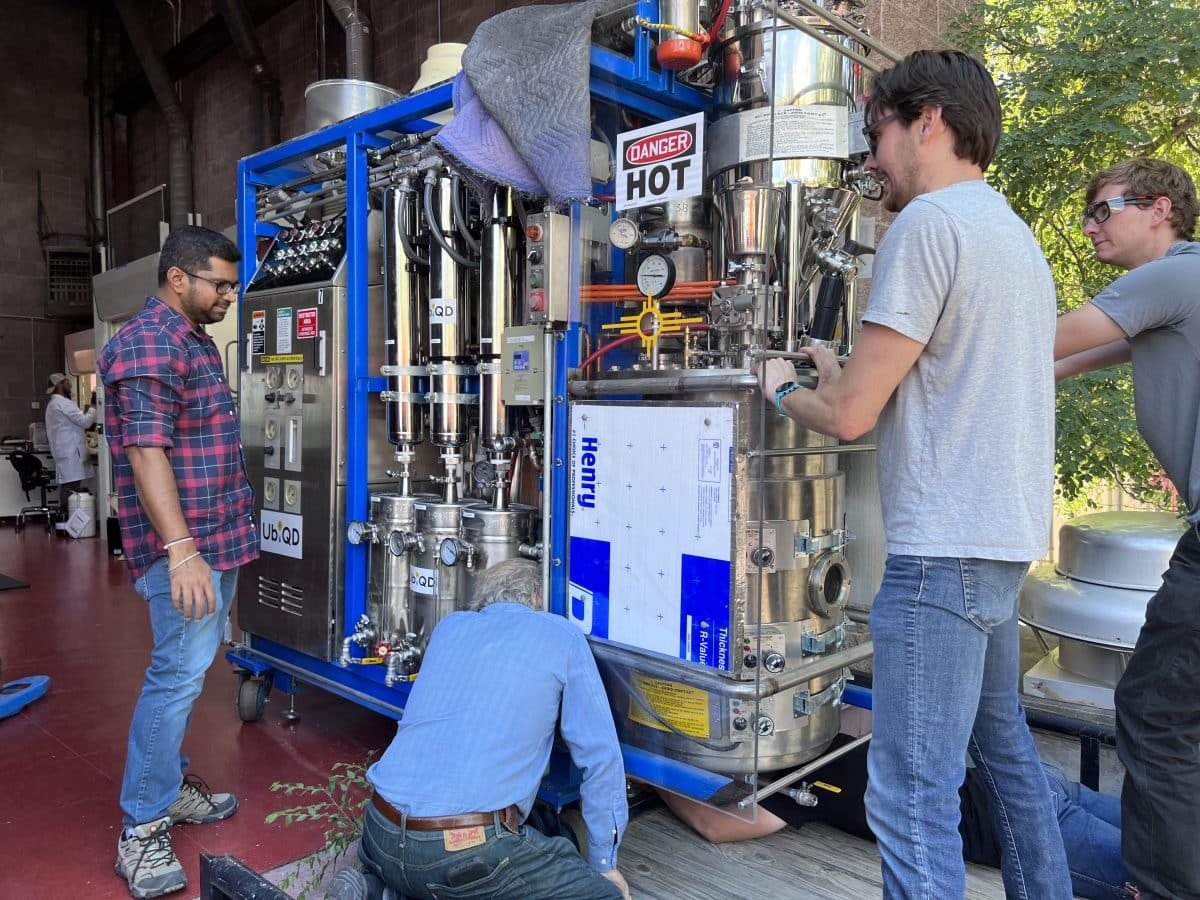
UbiQD has secured a $200,000 New Mexico grant to develop a fibre-coupled single-photon light source using its semiconductor quantum-dot materials. The award will finance optical equipment and device prototyping at the company’s Los Alamos headquarters, with work focused on emission reliability and the proposed operation of a practical source at room temperature.
The funding comes through the state’s Quantum Technologies Award programme. UbiQD plans to characterise how consistently its quantum dots emit individual photons, then refine the materials and optical assembly against performance requirements for quantum information systems. It has not disclosed a completed, qualified light-source module or a commercial shipment timetable.
The project uses the company’s I-III-VI semiconductor quantum dots, a material family manufactured without cadmium, lead or mercury. The emission characteristics of a quantum dot depend on its semiconductor composition, dimensions and surroundings, which makes material preparation and control of the local optical environment central to device development.
The immediate technical challenge differs from producing light at low intensity. Attenuating a conventional light source reduces average photon numbers, but does not reliably ensure that exactly one photon is available in each required interval. A useful single-photon emitter must suppress unwanted multi-photon events while delivering sufficient photons for detection or subsequent optical processing.
Researchers assess such emission through photon-correlation measurements, which distinguish single-emitter behaviour from classical light statistics. Other important parameters include the rate of usable photon generation, stability over time and the efficiency with which emitted light can be collected. UbiQD has not published a complete set of these measurements for the proposed fibre-coupled product.
The company is building on work conducted with Los Alamos National Laboratory during 2024 and 2025 through the Technology Readiness Gross Receipts Initiative. That collaboration produced early detailed measurements of single-photon behaviour in UbiQD’s proprietary quantum dots, providing a materials-level basis for the current prototyping programme.
Earlier scientific research also demonstrated room-temperature single-photon emission from copper indium disulphide quantum dots. Nikolay Makarov, UbiQD’s senior vice-president of research and development and principal investigator for the award, co-authored a 2017 study in this area before joining the company. The earlier result should not be confused with qualification of UbiQD’s proposed integrated device.
Connecting an emitter directly to optical fibre introduces a separate engineering problem. Light must be collected from a nanoscale source and coupled into a guided optical mode, with losses occurring at the source, through intermediate optics and at the fibre interface. A laboratory demonstration of photon emission does not establish a useful delivered photon rate at the end of a packaged fibre connection.
The coupling arrangement must also preserve the optical properties needed for the target application. Devices intended to support interference between photons can face requirements involving spectral stability and photon indistinguishability, while other systems place greater emphasis on timing or source brightness.
Room-temperature operation would change the equipment required around some single-photon sources, particularly where cryogenic cooling is currently used to preserve emitter performance. It is nevertheless a stated development target for this project, not an achieved specification for a product now being sold.
Material reproducibility remains another constraint. A prototype needs stable behaviour across repeated measurements, but manufacturing requires consistency across different emitters and production batches. Variations in dot size, composition and surface chemistry can influence the emission spectrum and the occurrence of unwanted optical processes.
UbiQD says its broader intellectual property portfolio includes 17 granted US patents, 23 granted international patents and 27 pending applications. Among them is US patent 12,085,443, covering a fibre-coupled broadband light source. The existence of that patent does not demonstrate that the planned single-photon device has met its optical performance targets.
The intended applications include quantum computing and quantum communication networks, which use photons in different ways. Some distributed computing arrangements require optical connections between separated quantum elements, while communication protocols can encode information in individual photon states. Each use imposes its own source, detector, timing and channel requirements.
The grant supports an early transition from materials research towards an engineered optical component. The funded sequence begins with photon-emission characterisation and continues into material refinement and prototype construction; performance data for a completed fibre-coupled source will be needed before its suitability for particular quantum systems can be established.