IN Brief:
- MXO AI Connect supports the MXO 3, MXO 4, MXO 5 and MXO 5C series, plus R&S ScopeStudio.
- A local MCP server exposes instrument documentation and SCPI-based measurement controls to compatible AI clients.
- Users select their own AI model and data-handling arrangements while the instrument remains connected through standard VISA interfaces.
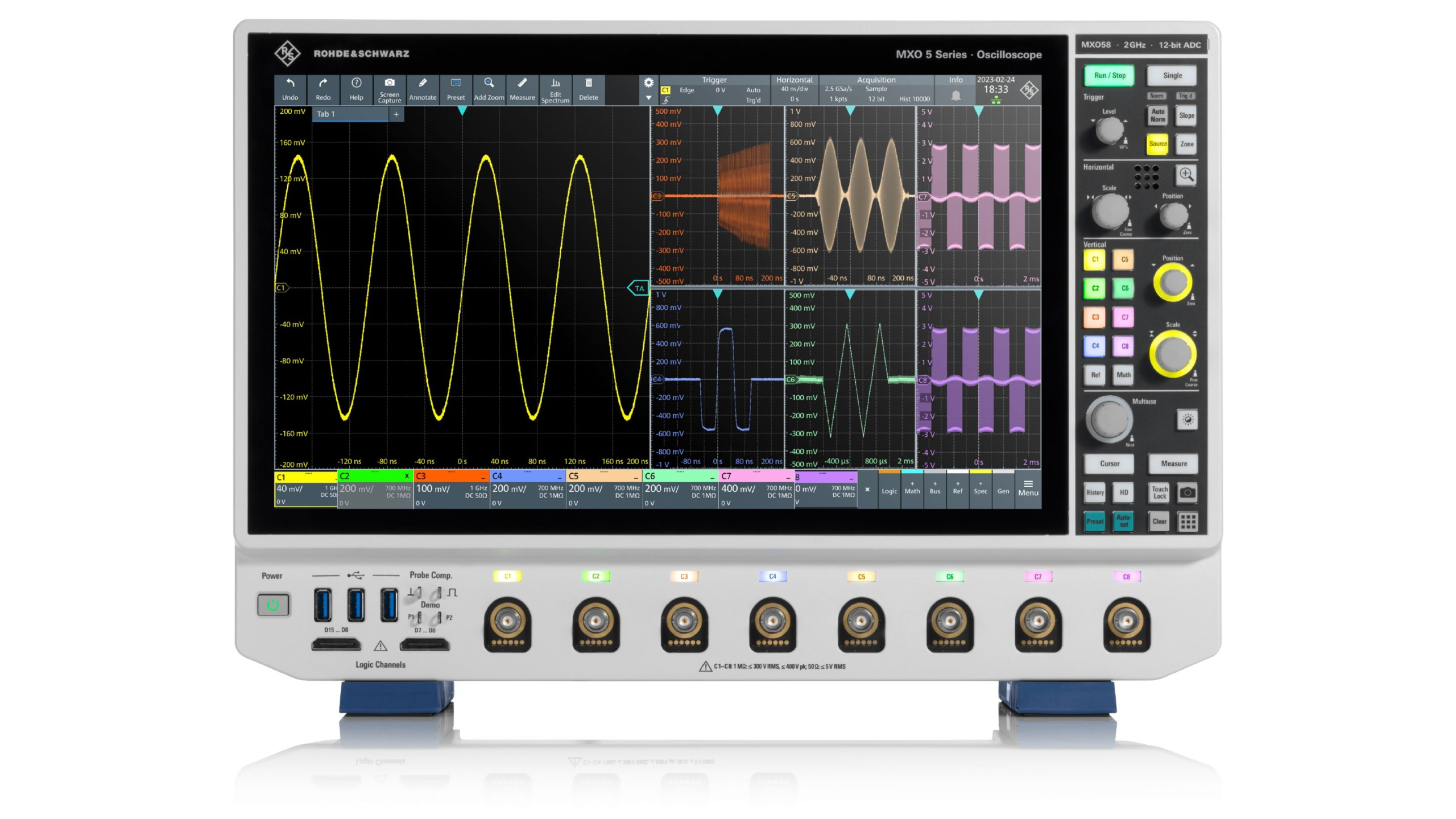
Rohde & Schwarz has introduced MXO AI Connect, software that gives compatible artificial intelligence assistants access to oscilloscope functions through the Model Context Protocol (MCP). The system links natural-language requests to the manufacturer’s instrument documentation and command interfaces, allowing engineers to configure measurements, retrieve results, capture screen images and develop control sequences. It supports the MXO 3, MXO 4, MXO 5 and MXO 5C series, along with R&S ScopeStudio, and is available as a free software download for supported products.
MXO AI Connect runs as a locally installed MCP server on a Windows or macOS computer, or a shared laboratory host. The connected instrument continues to use existing remote-control mechanisms, including Virtual Instrument Software Architecture (VISA) connections and interfaces such as HiSLIP, VXI-11 and TCP/IP. The software exposes tools and searchable instrument-specific guidance to a compatible AI client, rather than requiring engineers to memorise every Standard Commands for Programmable Instruments (SCPI) instruction. The oscilloscope itself requires no additional installed software.
In a conventional automated measurement, the operator establishes acquisition settings, trigger conditions and analysis functions through the front panel or a test script. A remote script must send commands in the correct sequence and interpret instrument responses. The MCP interface adds a layer in which an AI assistant can resolve a requested measurement against documented MXO functions, send the appropriate commands and obtain a result. This still depends on the capabilities of the connected instrument and the validity of the chosen setup.
A CAN bus decoding task illustrates the connection between natural language and measurement controls. An engineer can request a trigger on a particular frame identifier; the assistant searches the relevant MXO help content, applies decoding and trigger settings, and captures the displayed result. The same connection can change channel configurations, add measurement functions and query numerical values. Providing instrument-specific command documentation reduces the need for an AI model to infer the correct SCPI syntax from general training data.
Once a measurement is configured interactively, its command sequence can be developed into reusable Python code. That sequence can set instrument parameters and retrieve readings for subsequent test runs, instead of requiring repeated front-panel configuration. Reproducibility still requires the script to use the intended trigger, timebase, acquisition settings and result checks; a successfully executed command is not, by itself, proof that the measurement meets its acceptance criteria.
Compatible MCP clients can communicate through HTTP or standard input/output transport. The supported environments identified by Rohde & Schwarz include Cursor, Claude Desktop, Claude Code and GitHub Copilot, while the choice of model remains with the user. Measurement values, screenshots and prompts passed to the AI client may be processed by a separate cloud service or by a locally deployed model, according to the chosen configuration. A laboratory with confidential designs must therefore set data-handling and network access rules at the AI-client level as well as on the instrument connection.
Instrument access also needs to be governed at the control interface. MXO AI Connect exposes documented capabilities, but a connected AI client can issue commands that change trigger conditions, acquisition state or displayed measurements. Engineers can inspect the resulting settings and outputs on the oscilloscope, and configure any approval or tool-access controls offered by their client. Those checks help preserve established test conditions when an assistant develops or executes an automation sequence.
Established laboratory systems already connect instruments through VISA libraries, scripts and test frameworks, particularly where the same board or device must be checked repeatedly. MXO AI Connect leaves those communication methods in place while exposing a route to find and apply the right instrument commands. The oscilloscope and its probes still determine measurement bandwidth, signal integrity and calibration; an AI interface does not alter their physical specifications or replace engineering judgement on what constitutes a valid result.
A Windows or macOS computer with a VISA library can host MXO AI Connect and connect to the instrument by LAN or USB. Linux is not currently supported. The local MCP server does not itself need an internet connection, although a cloud-hosted AI service may require one. The free software is available for supported MXO instruments and R&S ScopeStudio, providing a way to evaluate natural-language setup and scripted measurement without replacing existing oscilloscopes.