IN Brief:
- PowerBusbar PF offers four standard lengths from 19 mm to 59 mm for targeted PCB current paths.
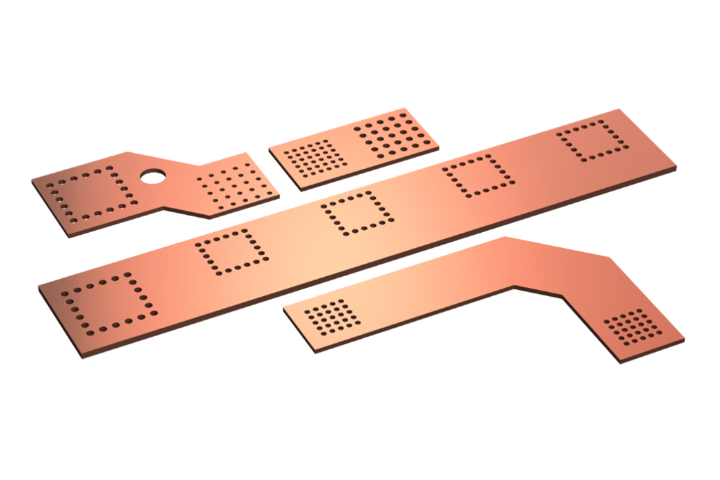
- Copper-alloy conductors are pressed vertically into plated holes and can act as high-current bridges or thermal fins.
- Würth reports a maximum 53.5 K temperature reduction in a specified 185 A, 40°C ambient test.
Würth Elektronik ICS has detailed the dimensions, mounting requirements and thermal performance of its PowerBusbar PF vertical copper conductors for printed circuit boards. The press-fit components reinforce selected high-current paths without requiring heavy copper across an entire board. Four standard lengths are available, and the modular conductors can be used as direct current paths or as raised bridges over other PCB routing. The design addresses power distribution in dense industrial and energy-related electronics where conductor cross-section and heat removal can limit board layout.
Each PowerBusbar PF is formed from a tin-plated copper alloy, with standard dimensions of 19, 29, 39 or 59 mm in length, 18.4 mm in overall height and 1.2 mm in thickness. Würth specifies a height of 13.6 mm above the board and a press-fit pin length of 4.8 mm. Several elements can be combined to form longer or more complex routes, placing conductive material only where the current path requires additional cross-section. The vertical arrangement makes use of enclosure height rather than consuming more surface area on the PCB.
Ordinary PCB traces have resistance determined in part by their copper thickness, width and path length. Increased current produces resistive losses and local heating, while using thicker copper across the complete board can increase fabrication cost and narrow supplier options. The PowerBusbar PF adds a separate conductive path to selected sections. Depending on the complete circuit and thermal design, this may allow the use of a conventional FR4 board where a local heavy-copper solution would otherwise have been considered.
The component also provides a three-dimensional route where planar conductors would need to cross or follow an inconvenient path. Würth describes using a raised bar to bridge selected board regions while carrying high current between press-fit contacts. Such an arrangement can help separate power and lower-current signal routing, although the final layout still requires clearance, mechanical support and verification of the intended return path. Current capability depends on the full assembly, including board construction, the contacts and the thermal environment.
The upright conductor can also dissipate heat from a high-current connection because copper conducts heat and the exposed surface acts as a cooling fin. At an ambient temperature of 40°C and a test current of 185 A, Würth measured a temperature reduction of up to 53.5 K in its specified arrangement. That result is a comparison under the manufacturer’s test conditions, not a general current rating or a guaranteed temperature change on every PCB. Airflow, adjacent components, contact resistance and enclosure geometry will affect the assembled board’s temperature.
Electrical and mechanical contact is established by pressing the pins into correctly prepared plated holes. This avoids the additional thermal cycle associated with soldering the busbar into the board. Würth specifies a press-in force of 60–250 N per pin and a recommended insertion speed of 100–250 mm per minute, using a suitable tool and supporting the PCB during assembly. The force must be applied perpendicular to the board. These details become significant when designing repeatable manufacturing fixtures rather than assembling a single demonstration board.
PCB preparation is similarly specific. Würth requires hole geometry and copper plating to follow its press-fit specifications and identifies a minimum board thickness of 1.5 mm for the product. For an example 2 mm pin, the documentation provides defined drill dimensions, plating limits and annular-ring requirements. A board designed for conventional soldered connectors cannot simply be assumed suitable for press-fit insertion. The supplier reports successful vibration and mechanical shock qualification under the applicable IEC 60068 test methods.
Press-fit insertion must be considered during PCB layout and assembly planning. Prototype boards can be assembled using a suitable press, but volume production requires tooling that supports the PCB and controls pin alignment and insertion load. Board stack-up, plating, the number of pins and enclosure clearance all influence whether the vertical conductor is practical. Thermal validation must also cover neighbouring connectors and devices so that reducing loss in a copper trace does not leave another part of the same current path as the limiting component.
Würth has supplied detailed dimensions, processing limits and thermal results for PowerBusbar PF ahead of electronica in Munich on 10–13 November. The four standard lengths permit conductors to be combined into application-specific routes; their current-carrying capability must be determined from the complete PCB, connector and cooling arrangement. The supplier’s press-fit specifications also define the manufacturing checks required before those routes are used in production equipment.