IN Brief:
- The 1U XR3L4A provides four analogue channels, 16 digital channels, and selectable bandwidths from 200 MHz to 1 GHz.
- Its 14-bit converter and MegaZoom 5 ASIC support a stated 50 µVrms noise floor and 1.3 million waveform updates per second.
- Multiple XR3 instruments can be synchronised to form systems with more than 100 time-correlated channels.
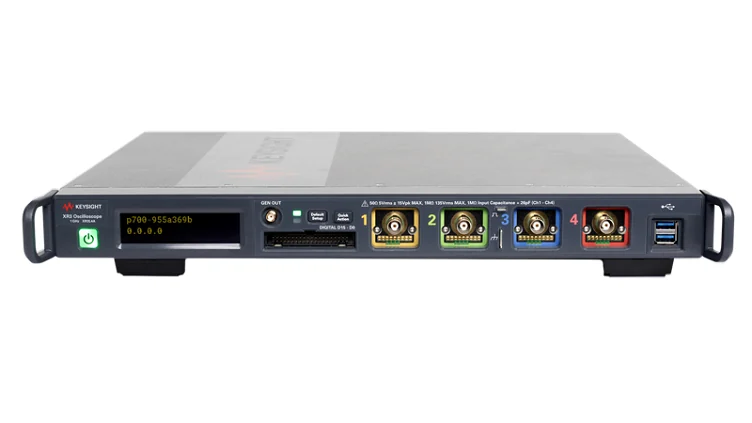
Keysight Technologies has introduced the InfiniiVision XR3 oscilloscope, combining 14-bit signal acquisition, four analogue channels, and hardware synchronisation within a single rack-unit enclosure for automated test systems requiring large numbers of measurement channels.
The XR3L4A provides selectable analogue bandwidths from 200 MHz to 1 GHz, alongside 16 digital channels for mixed-signal measurements. Its 1U mechanical format allows multiple instruments to be installed in equipment racks without the space requirements associated with conventional bench oscilloscopes.
Keysight has designed the instrument around its MegaZoom 5 application-specific integrated circuit and a 14-bit analogue-to-digital converter. The company specifies a noise floor of 50 µVrms, acquisition memory of up to 100 million points per analogue channel, and a waveform update rate reaching 1.3 million waveforms per second.
Automated test installations used in aerospace, defence, manufacturing, and experimental physics may need to measure signals at many positions within the same system. These measurements can include power supply behaviour, control signals, high-speed communications, and electrical responses that must be compared against a common timing reference.
Increasing the channel count introduces challenges beyond the physical installation of additional measurement inputs. Independent oscilloscopes can operate with different clock references, trigger delays, and signal-path characteristics, making it difficult to establish the precise timing relationship between captured events.
The XR3 addresses these requirements through an autosensing 10 MHz reference input and output, which allows the clock references of multiple instruments to be coordinated. Hardware-based synchronisation functions are accompanied by automatic instrument discovery and deskew capabilities.
Deskew is used to compensate for differences in signal propagation and measurement timing. Such differences may arise from cables, probes, instrument inputs, and other parts of the acquisition path, particularly when the signals under test change over very short intervals.
Keysight states that the architecture can support more than 100 time-correlated channels in a multi-instrument configuration. This capacity requires several synchronised units and does not describe the channel count of an individual XR3 oscilloscope.
Each XR3L4A provides four analogue channels, with digital inputs available for additional mixed-signal acquisition. The number of instruments required for a particular installation will depend on the mix of signals, channel availability, acquisition settings, and the system’s synchronisation requirements.
Maintaining a common timing reference is particularly important when engineers need to establish whether one event preceded another. In power electronics, for example, several voltage and current signals may need to be observed around the same switching transition, while distributed test installations may examine responses across separate circuit assemblies.
The XR3’s 14-bit conversion provides a nominal amplitude resolution of 16,384 levels across the selected input range. This is substantially higher than the 256 levels associated with an 8-bit converter, although converter resolution alone does not establish measurement accuracy.
The analogue front end, electrical noise, bandwidth, input range, calibration, and probe configuration influence the smallest signal variation that can be resolved reliably. Keysight’s stated 50 µVrms noise floor must therefore be considered under the measurement conditions to which the specification applies.
The instrument also provides a maximum sampling rate of 3.2 GSa/s. Sampling rate determines how frequently the input waveform is measured, while analogue bandwidth describes the range of signal frequencies the front end is designed to handle.
These characteristics must be considered together. A high sampling rate does not compensate for inadequate analogue bandwidth, and sufficient acquisition memory is required to capture long events without reducing the sampling density below the level required by the test.
With up to 100 Mpts of memory per analogue channel, the XR3 can retain relatively long acquisition records while preserving information about shorter events. The duration available at a selected sample rate depends on the acquisition mode and memory configuration.
Keysight has implemented waveform processing functions in hardware, including filtering, zoom, zone triggering, and colour grading. These operations can run within the instrument’s acquisition architecture without reducing the stated maximum waveform update rate.
High waveform update rates reduce the proportion of time an oscilloscope spends unable to capture incoming signals while processing previous acquisitions. This can improve the likelihood of identifying infrequent anomalies during a test, although detection still depends on the trigger settings and characteristics of the event.
Zone triggering provides a way to define regions of interest within a waveform display and trigger on signals meeting the selected conditions. Hardware implementation allows repeated tests against incoming acquisition data without requiring every decision to be processed through the general-purpose display software.
For automated installations, the instrument provides software functions covering protocol decoding, power supply analysis, and jitter measurements. These can support investigation of timing relationships and electrical behaviour without transferring every acquisition into a separate analysis application.
Keysight’s Infiniium 2026 software can operate on an external controller to provide a unified interface for multiple XR3 instruments. This arrangement enables engineers to manage and visualise several acquisition units from one system rather than relying on the controls of each device individually.
The XR3 can also operate alongside the company’s XR8 oscilloscope, adding high-impedance measurement channels to a larger configuration. The combination allows different signal types and performance requirements to be handled using instruments selected for their respective capabilities.
Jun Chie, Vice President of Product Management at Keysight, said: “Engineers building dense test systems should not have to choose between measurement performance and rack space.”
The XR3 is listed within Keysight’s current oscilloscope portfolio, with bandwidth selections and associated software capabilities available through the company’s product channels. A universal selling price has not been disclosed in the announcement.
Its modular rack architecture provides a route to higher channel density while retaining common timing references, high-resolution acquisition, and analysis functions. The final measurement performance will depend on the selected bandwidths, probe arrangements, clock distribution, and validation of the complete test installation.