IN Brief:
- DP Patterning, Artifex Systems, and ams OSRAM have developed an A-pillar demonstrator incorporating an integrated blind spot warning light.
- The flexible circuit uses DP Patterning's dry mechanical roll-to-roll manufacturing process, avoiding wet chemical etching during patterning.
- Circuit production takes place at the company's new 3,500 m² Norrköping plant, with stated capacity exceeding ten million square metres annually.
DP Patterning has developed a flexible electronic circuit integrated into the moulded A-pillar trim of a vehicle, working with Artifex Systems and ams OSRAM to produce a demonstrator incorporating a blind spot warning light.
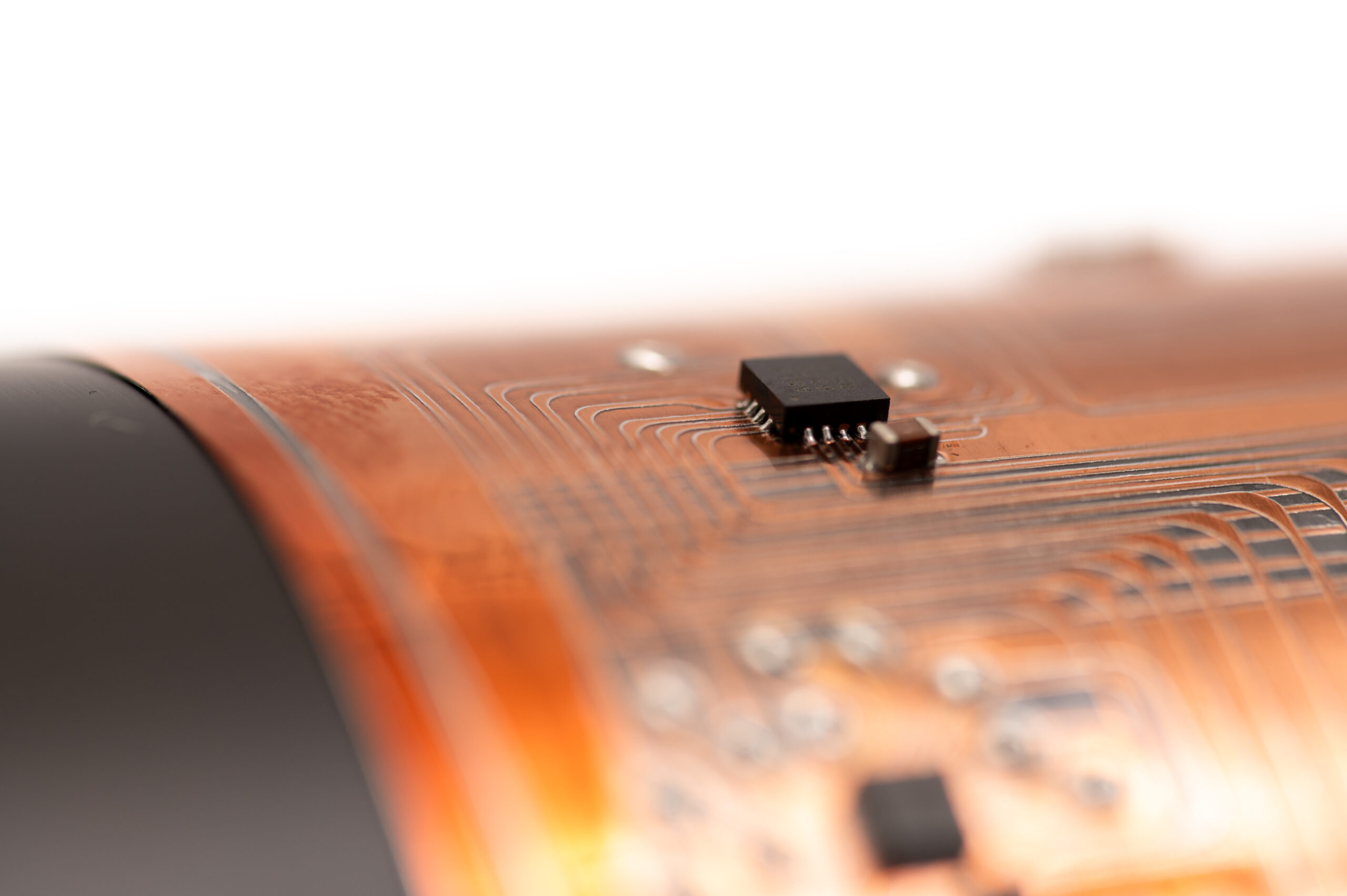
The Swedish company’s copper-clad aluminium circuit is manufactured using its dry mechanical patterning technology at a new production facility in Norrköping. Artifex Systems, part of Tata AutoComp, provides the automotive interior component, while ams OSRAM supplies the LEDs, driver integrated circuits, and lighting design.
The demonstrator will be displayed at electronica in Munich from 10 to 13 November 2026. It extends DP Patterning’s flexible circuit manufacturing process into integrated automotive interior lighting, building on an earlier collaboration with ams OSRAM and existing applications in flexible heaters and antenna structures.
Vehicle manufacturers increasingly incorporate electronic functions into interior components that were previously designed primarily for structural, decorative, or protective purposes. Integrating a lighting circuit into a curved pillar trim introduces requirements involving conductor geometry, mechanical assembly, electrical connections, and the behaviour of the finished component during its service life.
Conventional automotive lighting assemblies can comprise a separate circuit board, wiring, optical components, mounting hardware, and a housing. An embedded arrangement places part of the electronic functionality within the existing interior structure, potentially reducing the number of separate assemblies required.
The practical benefit depends on the completed design. Electrical connections, component mounting, mechanical tolerances, and the ability to replace or service individual parts remain relevant even when the circuit itself is integrated into the moulding.
Artifex initiated the project to examine the incorporation of electronics into the automotive interior components it manufactures. Its existing operations include pillar trims, door panels, and other moulded vehicle components, providing a manufacturing route through which flexible circuits can be evaluated alongside conventional automotive assembly processes.
DP Patterning manufactures the circuit using its patented Dry Phase Patterning process. This mechanically cuts the required conductor pattern into a metal laminate during a continuous roll-to-roll operation, rather than removing unwanted metal through conventional chemical etching.
The company describes the process as operating without etching chemicals or water during the patterning stage. This distinction relates to the circuit patterning method; it should not be interpreted as evidence that every upstream material manufacturing or downstream assembly process is free of chemicals or water consumption.
Aluminium is used as the principal conductor material, providing a lower material-cost alternative to printed silver for suitable applications. Conductor performance nevertheless depends on more than raw material price, particularly where electrical resistance, corrosion protection, connection technology, and the physical dimensions of the circuit influence the design.
The demonstrator uses the company’s copper-clad aluminium approach, with the metal circuit following the geometry required for integration into the vehicle trim. DP Patterning has not disclosed the detailed conductor dimensions, bend radius, or electrical qualification results for the completed assembly.
Roll-to-roll manufacturing allows a continuous web of material to move through the patterning equipment. Such processes can produce large quantities of repeated circuit structures, provided the required conductor geometry and material alignment remain within the specified manufacturing tolerances.
The new demonstrator also establishes a route from circuit manufacture to integration into a moulded component. DP Patterning patterns laminate supplied by a Swedish manufacturer, with Artifex responsible for the automotive interior part and ams OSRAM contributing the semiconductor lighting technologies.
Erik Berggren, Business Development Manager at DP Patterning, said: “The hardest thing for a new manufacturing technology is not making it work. It is getting customers to trust it in production. A light built into a car pillar is a demanding application, and we have built it with almost the whole chain in Sweden.”
The manufacturing arrangement is concentrated in Sweden, apart from the production of the LEDs. The company describes this as an opportunity to demonstrate the feasibility of a regional manufacturing chain for flexible electronics and automotive component integration.
DP Patterning began production at its new 3,500 square metre facility in Norrköping in September 2026. The plant has a stated annual capacity exceeding ten million square metres of flexible circuits, although that figure represents manufacturing capacity rather than confirmed output or orders associated with the automotive demonstrator.
The same general process already serves flexible heater and antenna applications. These require different conductor arrangements and electrical characteristics from integrated lighting, but they provide manufacturing experience relevant to producing patterned metal circuitry in continuous formats.
The lighting design incorporates ams OSRAM’s AS1163 LED driver, together with LEDs supplied by the semiconductor manufacturer. A driver IC controls the operation of connected light sources, providing an interface between the electronic control system and the individual LEDs.
Automotive lighting applications must accommodate variations in vehicle supply conditions, electrical interference, thermal behaviour, and the operating requirements of the LEDs. The precise driver configuration, protection arrangements, and communication architecture used in the demonstrator have not been fully disclosed.
Andrea Maria Saraceno, application engineer at ams OSRAM, said: “Lighting is moving from separate modules into the surfaces of the car, and thin, flexible circuits are a key part of that. This demonstrator shows how our complete lighting solution – including both LEDs and LED drivers – can be integrated into an interior part with a local supply chain, and it continues the work we started with DP Patterning in 2025.”
The partners must also consider mechanical reliability when integrating circuitry into a curved plastic component. Vehicle trim can experience vibration, thermal cycling, and changes in mechanical loading during installation and service, while electrical connections must remain dependable throughout those conditions.
These requirements influence material selection, circuit positioning, connector design, and the mechanical support provided by the surrounding component. Suitable validation is necessary before an integrated assembly can be adopted within a production vehicle programme.
Amir Hodzic, Electronics & Systems Manager at Artifex Systems, said: “Vehicle manufacturers want interiors that do more without adding weight, cost or complexity. Building the electronics directly into the parts we mould is a natural next step for us, and doing it with partners a short drive away makes it a stronger offer to our customers.”
DP Patterning describes the demonstrator as approaching the requirements of series production, but the partners have not identified a nominated vehicle model, production contract, completed qualification programme, or commercial adoption date.
Following its presentation at electronica in Hall A1, Stand 403, the assembly will also be exhibited at the DVN Sweden Workshop in Gothenburg on 18 and 19 November. Further development will determine whether the circuit and moulding approach can satisfy the electrical, mechanical, and manufacturing requirements of a production automotive lighting system.