IN Brief:
- Rohde & Schwarz connected Microchip and NXP ASA-ML evaluation boards during a technical demonstration in Kariya, Japan.
- An RTP high-performance oscilloscope monitored physical-layer waveforms while the link operated, with integration support from Nippon Chemi-Con.
- The company disclosed the October demonstration on 16 November; it did not publish a comprehensive compliance report or error-rate results.
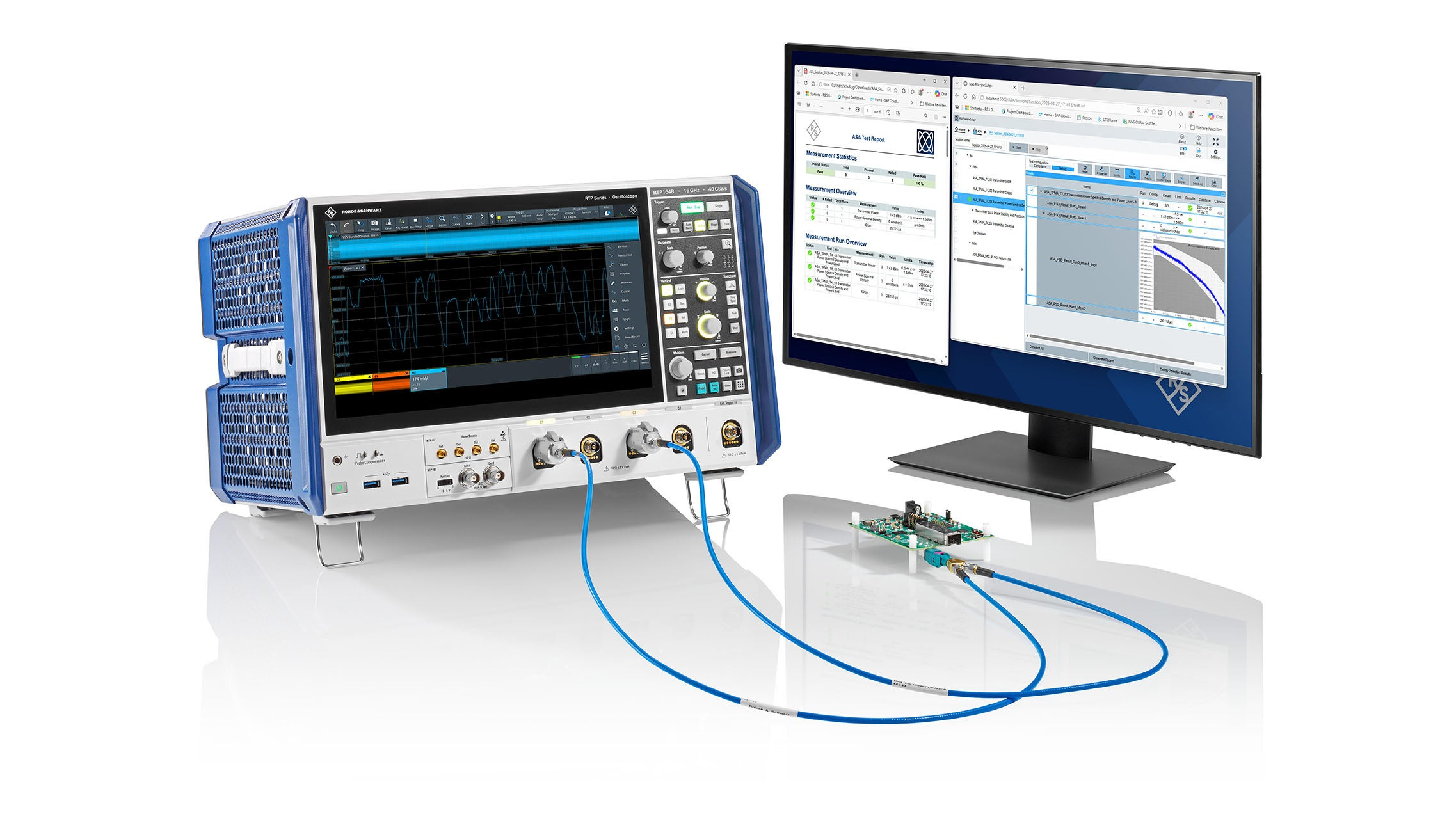
Rohde & Schwarz Japan has tested an operating Automotive SerDes Alliance Motion Link (ASA-ML) connection using evaluation boards from two semiconductor suppliers. The live demonstration at Technical Seminar Kariya 2026, held in October, joined Microchip Technology and NXP Semiconductors hardware while an R&S RTP oscilloscope monitored physical-layer signals. The company disclosed the test on 16 November, distinguishing the recent report from the earlier demonstration.
The mixed-vendor configuration carried data between the evaluation boards, with Nippon Chemi-Con assisting system integration. The published results establish communication in that particular laboratory arrangement, but contain no quantified bit error rate, measured link speed, wider device interoperability matrix, or formal compliance certificate. Successful operation under seminar conditions does not confirm the performance of every ASA-ML implementation.
ASA-ML is an asymmetric high-speed communications specification intended to carry data between vehicle cameras, sensors, displays, and associated electronic control units. A serializer converts information into a stream that can be carried over a high-speed physical connection; a deserializer reconstructs data at the receiving end. The asymmetry accommodates applications in which a large data flow is concentrated in one direction while control or housekeeping traffic has different requirements.
A shared specification does not eliminate differences between individual transceivers. Clock-recovery circuits, analogue input stages, supply architecture, configuration registers, and fault responses may vary by supplier. The receiving device must recover data and timing from the incoming waveform while the system establishes the link and handles control traffic. An interface that works with a matched pair of development boards can encounter different conditions when either device is changed.
Microchip and NXP evaluation hardware provided the two ends of the Kariya connection. Rohde & Schwarz used the RTP oscilloscope to observe operating waveforms, giving the team a view of the electrical behaviour rather than merely confirming that an application had exchanged data. Neither semiconductor part numbers nor board revisions are specified in the public account, so an independent laboratory would need further setup information before attempting an exact reproduction.
A high-speed waveform must be measured without substantially changing the circuit it represents. Probe bandwidth, input capacitance, grounding, and the selected test point can influence the observed signal, especially where connector discontinuities and cable losses already reduce channel margin. Proper physical-layer characterisation therefore has to separate distortion generated by the link from effects introduced by the measurement arrangement.
Jitter is among the parameters that can narrow the time available for a receiver to sample each bit correctly. Reflections, crosstalk, frequency-dependent loss, and interference can also affect the eye opening and recovered timing. An oscilloscope can expose these effects when the relevant measurement modes and acquisition conditions are defined, but the demonstration announcement does not say that a full eye mask, jitter budget, or error rate assessment was performed.
Nippon Chemi-Con contributed expertise to both the serializer and deserializer sides, helped refine the evaluation setup, and supported the verification method. Those system-level tasks extend beyond connecting two chips. Power rails, clocking, cable construction, signal access, and board configuration have to be controlled before the observed waveform can be attributed to the interface itself.
The use of an open common specification gives automotive developers a route to evaluate link devices from multiple suppliers, instead of treating the camera, display, and control unit connection as an inseparable proprietary set. Electrical interoperability is only one element of that choice. Harness design, software configuration, environmental ratings, lifecycle support, and device qualification still have to be checked for each production system.
Vehicle installation adds cable lengths, routing constraints, temperature variation, supply noise, and electromagnetic interference that may not appear in a bench demonstration. Camera and display links also have application-specific latency and reliability limits; safety-related functions bring further validation obligations. The October result does not establish those limits for a vehicle, and the manufacturer has not claimed that the evaluation boards completed automotive production qualification.
Repeatable cross-vendor testing would need documented fixtures, cable assemblies, oscilloscope connection points, pass criteria, and a defined set of operating conditions. It would also need multiple hardware combinations rather than one working pair. Rohde & Schwarz has shown how its test equipment can capture the physical signal while a mixed-vendor link is active, but has not published that broader qualification programme.
Microchip and NXP evaluation boards communicated during the Kariya demonstration, and physical-layer waveforms were examined with Rohde & Schwarz instrumentation. The disclosed result supports further development of mixed-vendor ASA-ML links; claims of certified interoperability, specified error rate performance, or operational suitability across vehicle conditions await additional tests and published results.