IN Brief:
- Keysight and Cohere Technologies are collaborating on integrated sensing and communications testing for emerging 6G systems.
- The laboratory platform uses PROPSIM RF channel emulation, site-specific modelling, and Cohere's Zak-OTFS waveforms.
- Capabilities include hundreds of sensing targets, multiple antenna and radar configurations, and up to 400MHz instantaneous bandwidth.
Keysight Technologies and Cohere Technologies are collaborating on laboratory testing for integrated sensing and communications, combining radio-frequency channel emulation with a waveform architecture designed to support data transmission and environmental sensing. The work will allow developers to evaluate multiple uncrewed aerial vehicles under reproducible radio conditions as research into 6G network capabilities continues.
The collaboration brings Cohere’s Zak-Orthogonal Time Frequency Space, or Zak-OTFS, waveform technology into Keysight’s expanded integrated sensing and communications testing environment. The system uses real-time RF emulation, site-specific propagation models, and automated test procedures to reproduce complex communications and sensing scenarios.
Integrated sensing and communications, usually abbreviated to ISAC, is being developed as a potential capability of future wireless networks. Alongside transferring information between connected devices, radio equipment could use transmitted signals and their reflections to identify objects and estimate characteristics such as their location or movement.
Combining these functions introduces different requirements from conventional communications testing. A network must carry data reliably while also extracting information about the surrounding environment, using radio resources and signal processing techniques suited to both operations.
Multiple moving aircraft provide a demanding test scenario. Each vehicle may follow a different trajectory, creating changing propagation paths, reflections, and Doppler frequency shifts as its position and velocity vary relative to transmitting and receiving equipment.
Closely spaced targets can make the sensing problem more difficult. The system must distinguish reflections associated with different objects while continuing to maintain the radio characteristics needed for communication.
Field trials can evaluate these conditions, but reproducing the same environment repeatedly is difficult. Weather, movement, interference, and the positions of surrounding objects may change between tests, complicating direct comparisons of competing signal processing approaches.
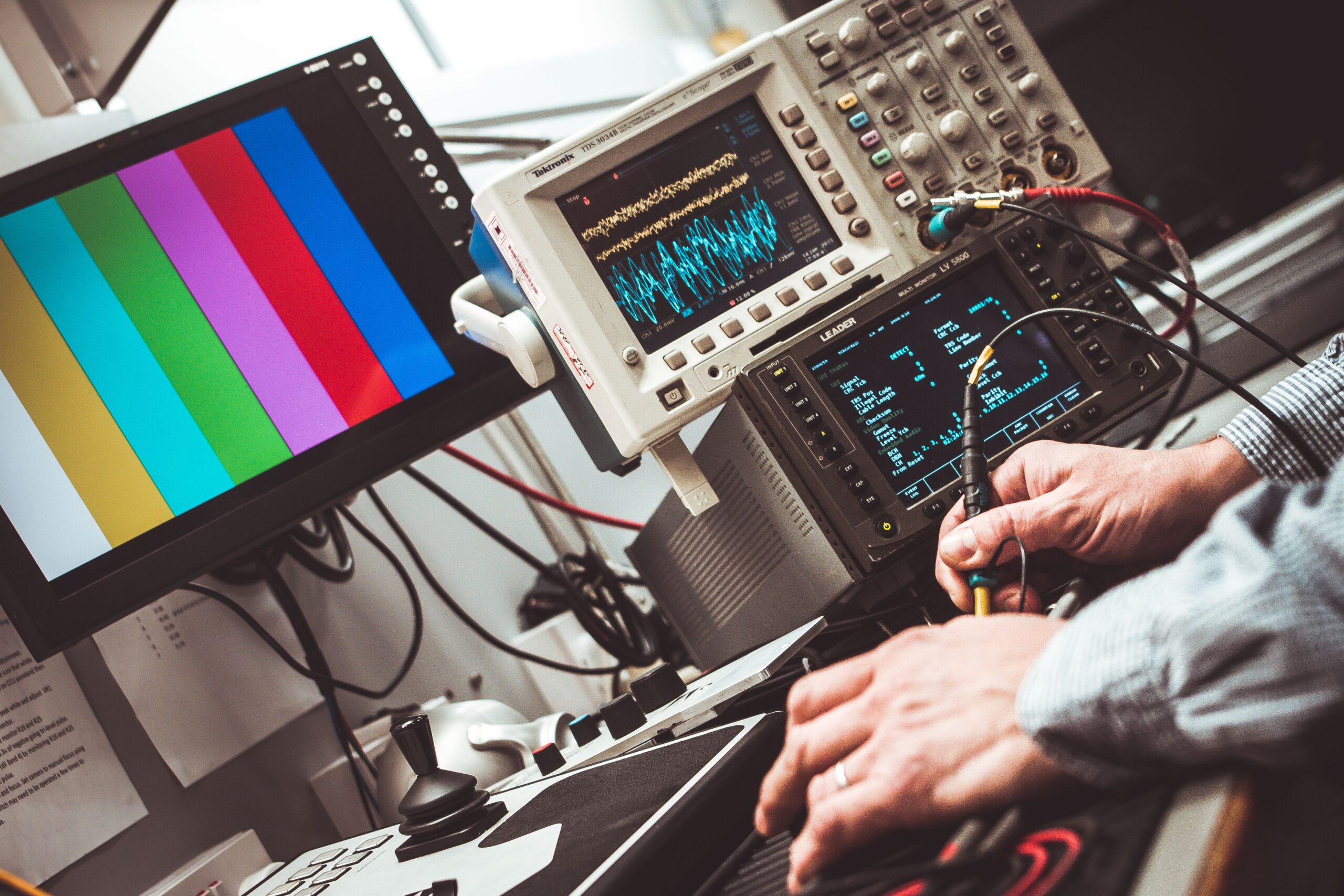
Keysight’s PROPSIM equipment enables real-time emulation of radio propagation conditions within the laboratory. Combined with site-specific modelling, it allows developers to create controlled experiments involving moving targets and different radio channel characteristics.
The expanded platform supports hundreds of simultaneous sensing targets, according to Keysight. This allows engineers to construct scenarios containing multiple reflecting objects without requiring the corresponding number of physical aircraft or other targets to be present.
The system also accommodates large multiple-input multiple-output antenna configurations. MIMO systems use several antennas and signal paths to transmit and receive information, making the spatial characteristics of the radio channel an important part of performance evaluation.
Larger antenna arrays can support advanced beamforming and other spatial processing techniques, but they also introduce more complex interactions between antenna elements and propagation paths. Testing those interactions requires an environment capable of representing multiple simultaneous signal channels.
Keysight’s platform supports monostatic, bistatic, and multistatic sensing configurations. Monostatic arrangements place the transmitter and receiver at the same location, while bistatic and multistatic systems use separated positions to observe targets from different geometries.
These configurations produce different measurement characteristics and may affect the ability to identify or track objects in a given environment. Evaluating several arrangements allows developers to investigate how future networks could use distributed radio equipment for sensing.
The platform incorporates radar cross-section models to represent the reflective properties of targets. It also supports site-specific ray-traced environments, allowing interactions between radio signals, objects, and surrounding structures to be represented in an RF digital twin.
The accuracy of these simulations depends on the underlying models and available environmental information. Laboratory repeatability is useful for comparing engineering changes, but it does not independently establish performance under every real-world condition.
Cohere’s Zak-OTFS technology provides the waveform component of the collaboration. The technique represents wireless information in the delay-Doppler domain, allowing signal processing to account for propagation delays and frequency shifts associated with movement.
Those characteristics are relevant to sensing because reflected signals contain information related to an object’s relative distance and velocity. The same radio resources may consequently support both communications and measurement functions, depending on the waveform and system architecture.
Cohere is developing multi-waveform technology intended to operate alongside established 5G signalling methods. Its Zak-OTFS work forms part of research supported by the US Department of Defense FutureG Office, including investigation of sensing applications involving uncrewed aircraft.
Keysight identifies support for existing 5G frequency ranges and emerging FR3 research frequencies up to 18GHz, with instantaneous bandwidth of up to 400MHz. These are stated test-platform capabilities rather than specifications of a deployed 6G network.
The environment also provides application programming interfaces that allow tests to be integrated into automated procedures and software-controlled workflows. Such functions can support repeated experiments when developers change waveform parameters, antenna configurations, or sensing algorithms.
The collaboration is intended to help equipment manufacturers, chipset developers, and research organisations validate proposed technologies before field deployment. It does not establish approval of Zak-OTFS as a final 6G standard or demonstrate a commercially deployed sensing-enabled cellular network.
Further laboratory testing will examine communications and sensing performance under increasingly complex conditions. Subsequent field trials and standards development will determine which techniques progress into future network equipment and commercial deployments.