IN Brief:
- Omnibus generates system-on-chip interconnect structures from machine-readable YAML specifications.
- The software supports address mapping, protocol conversion, clock domain crossing, and crossbar configuration.
- Graphviz and Topwrap integration provide visualisation, hardware generation, and additional verification capabilities.
Antmicro has introduced Omnibus, an open-source tool that automatically generates system-on-chip interconnect structures from configuration files, reducing the manual engineering required to connect processors, memory, and peripheral devices.
The software uses YAML specifications to define the interconnect architecture, identify the communication requirements of its component interfaces, and generate the structures needed to connect them. It also integrates with Antmicro’s Topwrap design aggregation environment.
Omnibus was detailed on 19 November as part of the company’s wider development of open-source silicon design tools. Its functions include protocol conversion, clock domain crossing, address mapping, and the construction of interconnects using configurable crossbars.
A system-on-chip typically combines several functional blocks, each with its own communication interfaces and operating requirements. Processor cores, direct memory access engines, memories, accelerators, and peripheral controllers exchange data through an interconnect that determines how transactions move between them.
Those connections can involve different bus protocols. AXI, AXI Lite, AHB, APB, Avalon, TileLink, and Wishbone are among the interfaces encountered in semiconductor designs, with each imposing particular requirements on transaction handling.
Even blocks using the same protocol may operate at different data widths or clock frequencies. Additional logic is needed to adapt those interfaces while preserving transaction ordering, routing, and other requirements established by the architecture.
An interconnect commonly incorporates address decoders, multiplexers, demultiplexers, buffers, and conversion components. Engineers first establish how those elements should be arranged, then connect the required hardware blocks through register-transfer level descriptions.
Changes to a memory map or the addition of another peripheral can force revisions across several parts of that structure. A new address allocation may require changes to decoding logic, while an interface with different parameters can require another conversion stage.
Manual modifications create opportunities for inconsistencies between the intended architecture and its implementation. Incorrect address decoding, unsupported interface combinations, and mistakes in the connection hierarchy may not become apparent until verification.
Omnibus moves the architectural description into a machine-readable configuration. Engineers identify the ports, address ranges, crossbars, and connections, allowing the generator to construct intermediate components when the configuration requires them.
The tool can insert protocol and interface converters automatically, including components needed when connected ports use incompatible parameters. It also converts a system-wide address map into the local address maps required by individual crossbars.
Crossbars provide routing between multiple initiators and destinations. Their organisation influences which components can communicate and how the system handles simultaneous transactions, making their configuration an important architectural decision.
Omnibus permits engineers to specify the routing architecture explicitly rather than leaving every decision to the generator. The resulting design remains governed by the configuration and component resources selected for the project.
The current implementation uses hardware components from the PULP platform, although Antmicro says the generator’s architecture is not inherently restricted to that library.
Two principal backends are supported. Graphviz generates visual representations of the interconnect for inspection and debugging, while the Topwrap PULP Platform backend produces Topwrap project specifications and SystemVerilog wrappers.
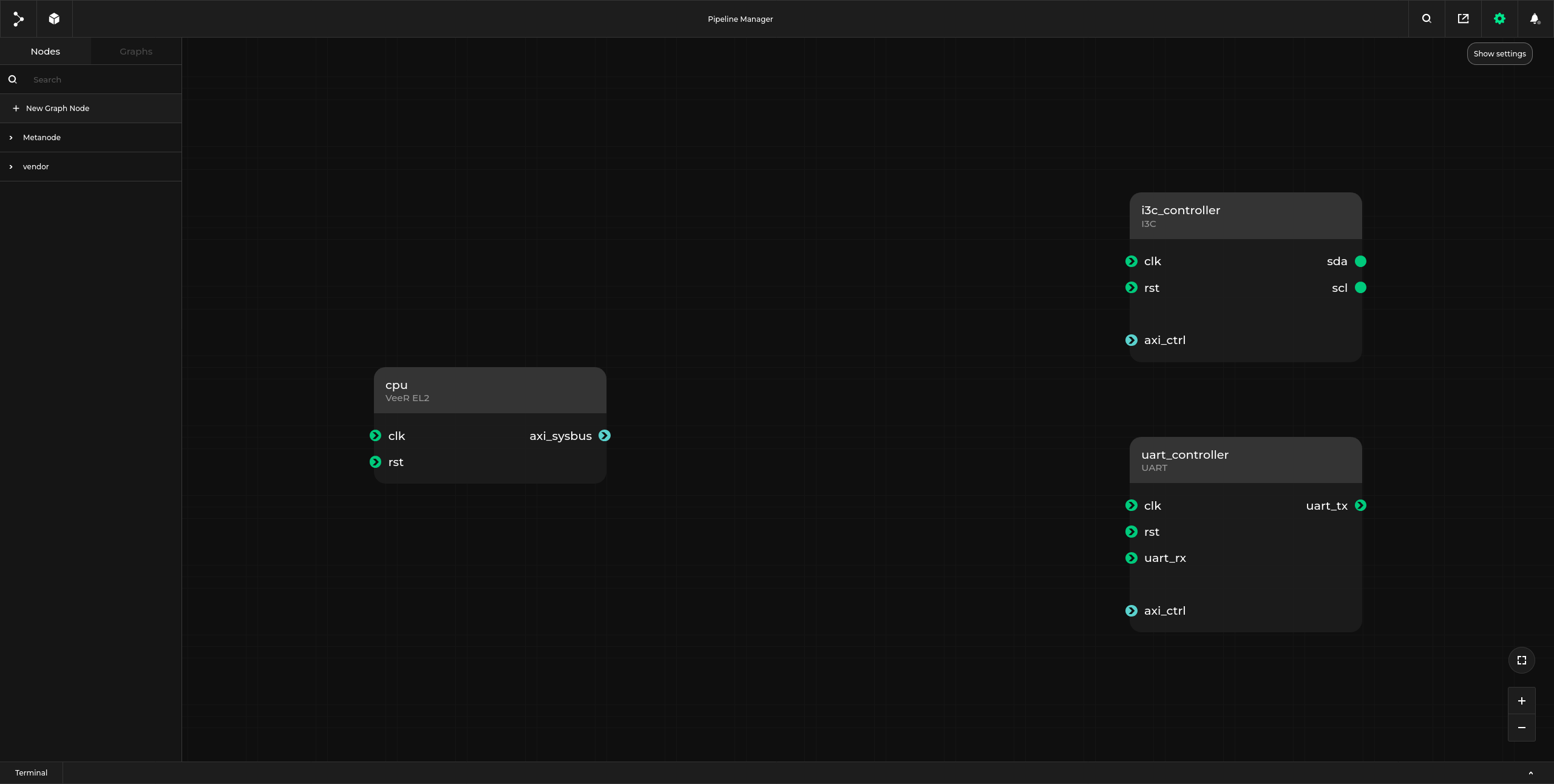
Topwrap can then display the generated architecture and produce Verilog files. Omnibus also supports direct Verilog generation, allowing its outputs to be used in subsequent system integration work.
Antmicro demonstrates the workflow with a 64-bit interconnect operating at a specified 10MHz clock frequency. The example has one input and two output ports, with the address space divided between the outputs.
Most of the example uses AXI4, but one output is configured for AXI4-Lite. Omnibus recognises the interface difference and inserts the required converter rather than relying on the engineer to instantiate it manually.
The example illustrates the relationship between a relatively concise configuration file and the hardware structure generated from it. It does not establish a performance improvement for an application-specific chip or a reduction in manufactured silicon area.
Antmicro has also developed a verification suite using Pytest, cocotb, and Verilator. The tests examine valid and invalid YAML inputs, generated architecture properties, and backend output files.
Verilator performs SystemVerilog syntax checks and generates simulations, while cocotb and cocotbext-axi test transactions through the resulting interconnect. These include read and write operations, address boundary cases, and attempts to access unmapped regions.
An AHB-to-AXI bridge is additionally tested through a UVM environment using third-party verification intellectual property.
These checks establish whether the generator and its outputs behave as expected under the tested conditions. Individual semiconductor projects will still require their own integration and functional verification, particularly when additional components or timing constraints are introduced.
Omnibus is available as part of Antmicro’s open-source tooling, with the published workflow covering configuration, generation, visualisation, and testing. The company has not reported independently measured reductions in engineering time, chip power consumption, or silicon area.