
IN Brief:
- DeviceEdge AIE-KT and AIE-PT systems will support NVIDIA Jetson T3000 and T2000.
- T3000 delivers up to 865 FP4 TFLOPS at 70W, while T2000 reaches 400 FP4 TFLOPS.
- The additional modules create lower-power design points for robots moving from prototype into volume deployment.
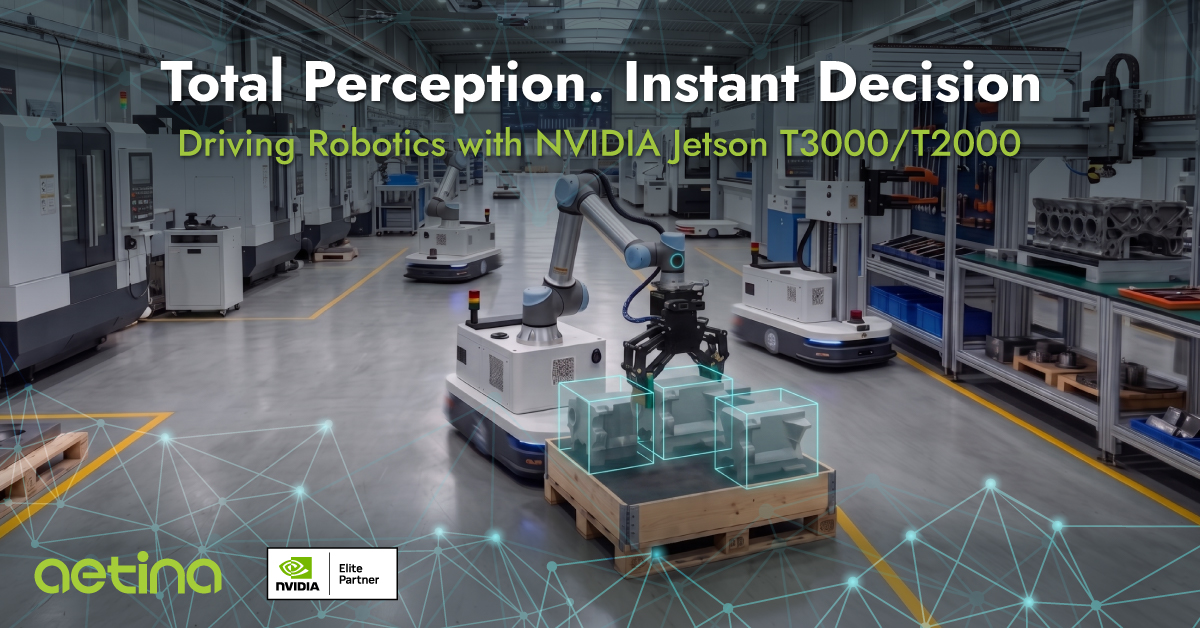
Aetina is extending its DeviceEdge industrial-computing range to support NVIDIA’s Jetson T3000 and T2000 system-on-modules, adding lower-power design points for robotics, machine vision, and physical-AI equipment.
The modules will be offered through an expanded AIE-KT series using active fan cooling and a new AIE-PT series built around fanless thermal designs. Detailed I/O configurations, availability, and developer support will be released as the systems move towards commercial launch.
Jetson T3000 combines a Blackwell GPU containing 1,536 CUDA cores with an eight-core Arm Neoverse processor and 32GB of LPDDR5X memory. Memory bandwidth reaches 273GB/s, while AI performance is rated at up to 865 FP4 TFLOPS within a 70W power envelope.
Jetson T2000 provides 1,024 CUDA cores and 16GB of LPDDR5X memory with bandwidth of 137GB/s. Maximum AI performance reaches 400 FP4 TFLOPS, creating a smaller platform for visual agents, autonomous mobile robots, manipulators, and other systems that do not require the capacity of the flagship Thor modules.
Aetina already supports Jetson AGX Thor systems reaching up to 2,070 FP4 TFLOPS within a 130W envelope. Those platforms address advanced humanoid robotics and demanding multimodal models, although their power, memory, cooling, and cost exceed the requirements of many production machines.
T3000 and T2000 fill the space between high-end physical-AI development systems and smaller edge processors. Developers can retain the Jetson software environment while selecting a module more closely matched to camera count, model size, inference rate, memory requirement, and power budget.
The modules are expected to become available during the first quarter of 2027. Software support will include NVIDIA Nemotron, Cosmos 3, GR00T, and Jetson agent skills alongside the wider Jetson development stack.
Cosmos 3 is an open omnimodal world model intended to process several visual viewpoints and support world-action model development, while GR00T provides a foundation for humanoid and general-purpose robot reasoning. Running such models locally reduces dependence on continuous cloud connectivity and keeps sensor data close to the machine.
Thermal construction will define how closely each system sustains its peak performance. The fan-cooled AIE-KT provides additional thermal headroom for continuous workloads, whereas the AIE-PT removes a moving component and can be sealed more effectively against dust, moisture, or industrial contamination.
Installation conditions will determine the preferred architecture. A warehouse robot in a clean and serviceable environment may accept active cooling, while equipment inside a sealed cabinet, agricultural platform, medical cart, food-production area, or remote infrastructure site may favour passive heat conduction and lower maintenance.
Fanless operation still requires heat to move through interface materials, spreaders, enclosure walls, and mounting surfaces into the surrounding environment. Sustained performance can be affected by ambient temperature, orientation, solar load, restricted airflow, and simultaneous CPU, GPU, networking, and storage activity.
Physical-AI investment is moving from demonstrations towards production capacity. STMicroelectronics’ investment in Oversonic Robotics is supporting the manufacture and commercial deployment of humanoid systems that combine local processing with sensing, motor control, communications, and safety electronics.
Camera connectivity creates another design constraint. A robot processing several high-resolution streams must preserve synchronisation and data integrity without excessive CPU intervention. Ethernet, GMSL, MIPI, USB, and other interfaces introduce different cable lengths, latency, bandwidth, power, and electromagnetic-compatibility requirements.
Memory capacity may restrict deployment before peak compute does. Multimodal models, mapping data, video buffers, operating software, and application processes compete for the same LPDDR5X resource, so workloads developed on the flagship platform will need to be profiled and reduced before transfer to T2000 or T3000.
Production systems also require long-term module supply, controlled firmware, secure updates, durable storage, and recoverable peripheral configurations. Robots operating across several sites need a common software baseline and a defined response when an update, model, camera, or network service behaves unexpectedly.
Aetina’s fan-cooled and fanless families recognise that processor performance is only one part of physical-AI deployment. The T3000 and T2000 systems will be judged by their ability to sustain local intelligence inside equipment that remains thermally stable, maintainable, and compatible with the environmental and safety requirements of the surrounding machine.

