IN Brief:
- Asahi Kasei Microdevices has developed the CZ3K current sensor series for EV onboard chargers, DC/DC converters, and eFuse circuits.
- The devices support high-current measurement up to ±300A, 0.27mΩ primary conductor resistance, and 100ns response.
- Current sensing is becoming more demanding as compact SiC and GaN-based power systems move toward higher switching frequencies and power density.
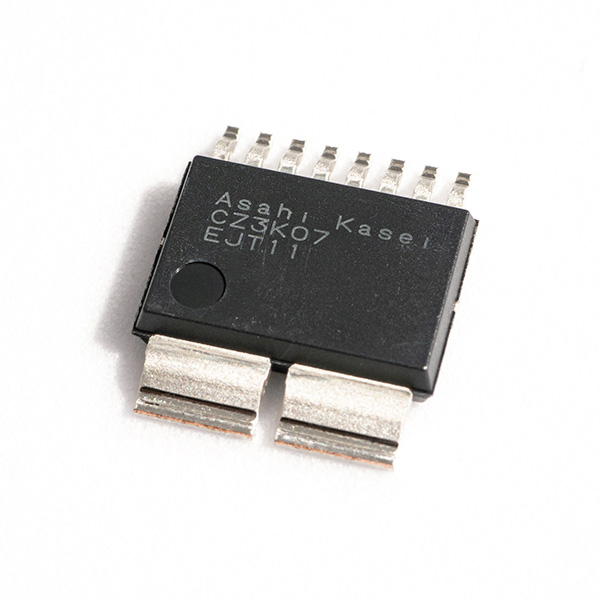
Asahi Kasei Microdevices has developed the CZ3K current sensor series for electric vehicle power systems, targeting onboard chargers, DC/DC converters, and electronic fuse circuits.
The new series supports high-current measurement up to ±300A and uses a low-resistance conductor structure to reduce heat generation during continuous operation. The ±300A version has primary conductor resistance of 0.27mΩ, while the series also includes a ±168A device for lower-current system requirements.
The CZ3K range builds on AKM’s CZ39 current sensor architecture, adding wider current measurement while retaining fast response and noise immunity. The devices provide a 100ns response time, supporting fast protection against overcurrent and short-circuit events in high-power conversion stages.
AKM has designed the series for EV systems using next-generation power devices such as SiC and GaN. Higher switching frequencies can reduce passive component size and support denser power designs, but they also increase the importance of accurate current measurement in electrically noisy conditions. Current sensors have to provide protection, control feedback, and thermal confidence without adding excessive conduction losses.
The CZ3K07 supports ±300A measurement, while the CZ3K05 supports ±168A. Both devices are intended for bipolar and unipolar current measurement. The product range is aimed at high-power bidirectional onboard chargers, DC/DC converters, and eFuse circuits, where cutoff timing and configurable current thresholds are increasingly important to system safety and protection behaviour.
Current sensing now sits close to the core of EV power architecture. Onboard chargers are moving toward bidirectional operation, allowing vehicles to exchange power with homes, buildings, or the grid. DC/DC converters are carrying heavier loads as low-voltage vehicle systems expand. Electronic fuses are replacing mechanical protection in areas where fast, resettable, and software-coordinated protection is needed.
Power-stage advances are also changing the surrounding component requirements. Infineon’s expansion of its 2300V CoolSiC module range showed how higher-voltage silicon carbide devices are moving into larger conversion systems. As those devices increase power density and switching performance, the analogue sensing layer has to preserve measurement quality without becoming a thermal or layout bottleneck.
Low conductor resistance is especially valuable in high-current EV applications. Even small resistive losses become meaningful when hundreds of amps flow through the sensing path, and excess heat can constrain board layout, package placement, and enclosure design. Fast response is similarly important because a short-circuit event can develop quickly in a low-inductance, high-power converter.
The CZ3K series gives EV power designers a current-sensing option aligned with the direction of wide-bandgap conversion. As OBCs, DC/DC converters, and protection circuits become more compact and more electronically controlled, current sensors have to support both the efficiency target and the safety case. The sensing component is no longer a passive measurement point; it is part of the converter’s protection and control architecture.