IN Brief:
- Infineon has added 2300 V CoolSiC MOSFET variants to its XHP 2 power module portfolio.
- The modules support DC-link voltages up to 1500 V for high-voltage converters.
- Renewable energy, battery storage, and wind systems are the primary application targets.
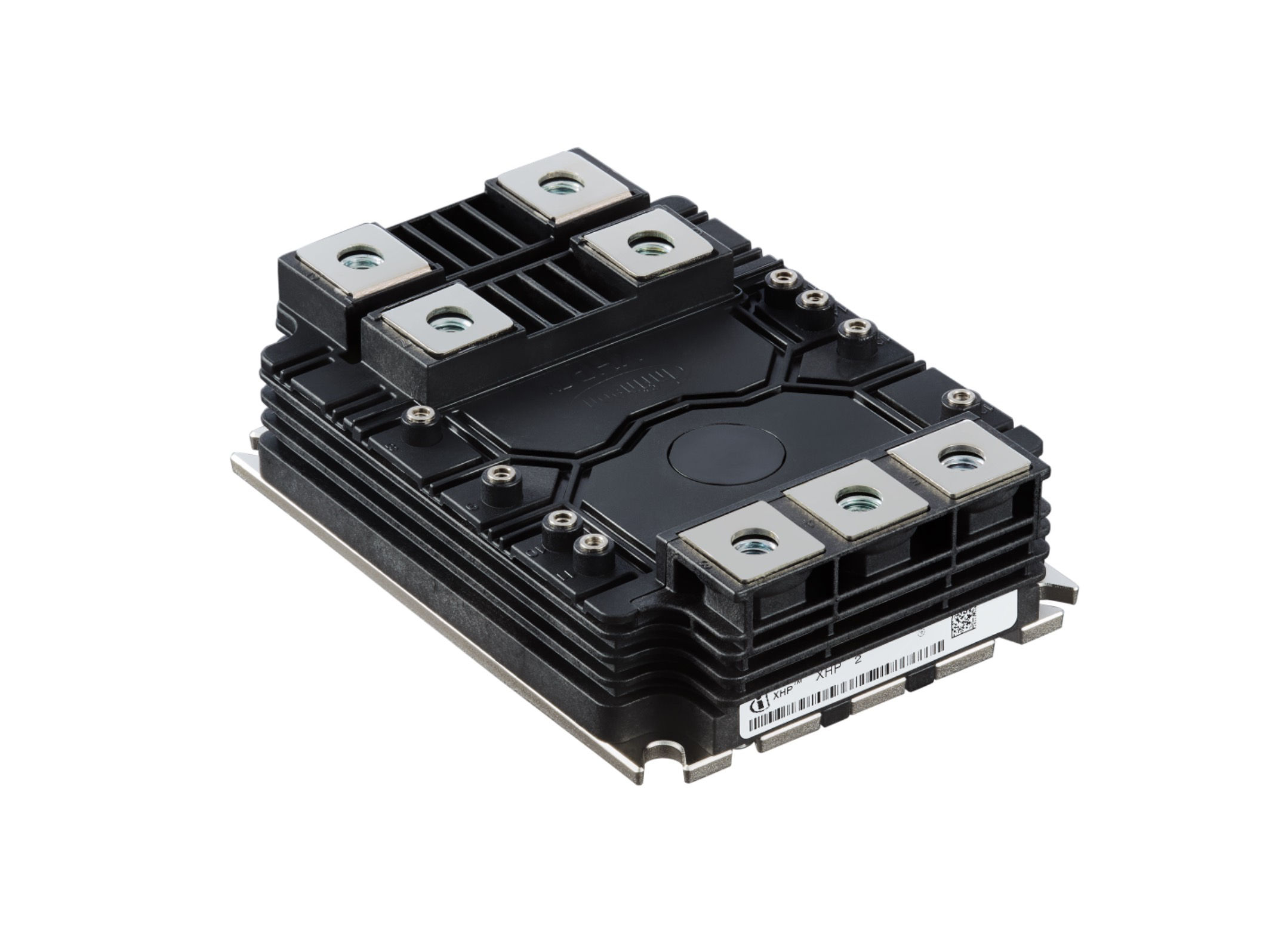
Infineon Technologies has expanded its XHP 2 power module portfolio with 2300 V CoolSiC MOSFET variants for high-voltage energy systems using DC-link voltages up to 1500 V.
The new modules extend the company’s silicon carbide power range for renewable energy and storage applications, where higher system voltages are being used to improve conversion efficiency, reduce current, and increase power density. The portfolio includes variants with on-resistance values from 1 mΩ to 2 mΩ, alongside 4 kV and 6 kV isolation voltage options.
Built around the XHP 2 package, the devices give converter manufacturers a standardised module format for large power systems while retaining the switching efficiency associated with SiC technology. The package is designed for symmetrical switching behaviour, which supports more predictable performance when multiple modules are paralleled in higher-power stages.
Each variant integrates Infineon’s .XT interconnection technology to improve thermal cycling robustness and support longer operating life. The modules are also available with pre-applied thermal interface material, reducing assembly variation and helping manufacturers achieve more consistent thermal performance during production.
Wind power, photovoltaic, and battery energy storage systems are the main targets for the new devices. These applications are moving toward higher-voltage converter architectures as developers look to reduce losses, simplify cabling, and support larger power blocks within tighter cabinet footprints. In a wind power demonstration system, Infineon reports a power density of 300 kW/L, while battery storage testing showed semiconductor losses below 0.7% of output power.
Across renewable energy infrastructure, converter design is being pulled in two directions at once. System operators want higher efficiency and greater output, while equipment manufacturers must also control cabinet size, cooling burden, and maintenance demands. Higher-voltage SiC modules help address those constraints by allowing current to be reduced at the system level while improving switching performance inside the converter.
The 2300 V class also sits in a useful position for systems built around 1500 V DC links. Designers need adequate voltage margin, reliable isolation, and predictable thermal behaviour without completely reworking the mechanical stack for every new project. A standardised module platform gives manufacturers a way to reuse layout, cooling, and qualification work across wind, solar, and storage designs.
As renewable and storage projects scale, power electronics is becoming a larger part of system performance and project economics. The converter is now judged on efficiency, service life, grid-support capability, and installation density, not simply on headline power rating. Infineon’s expanded XHP 2 range gives manufacturers another route to push SiC into those larger industrial power platforms.