IN Brief:
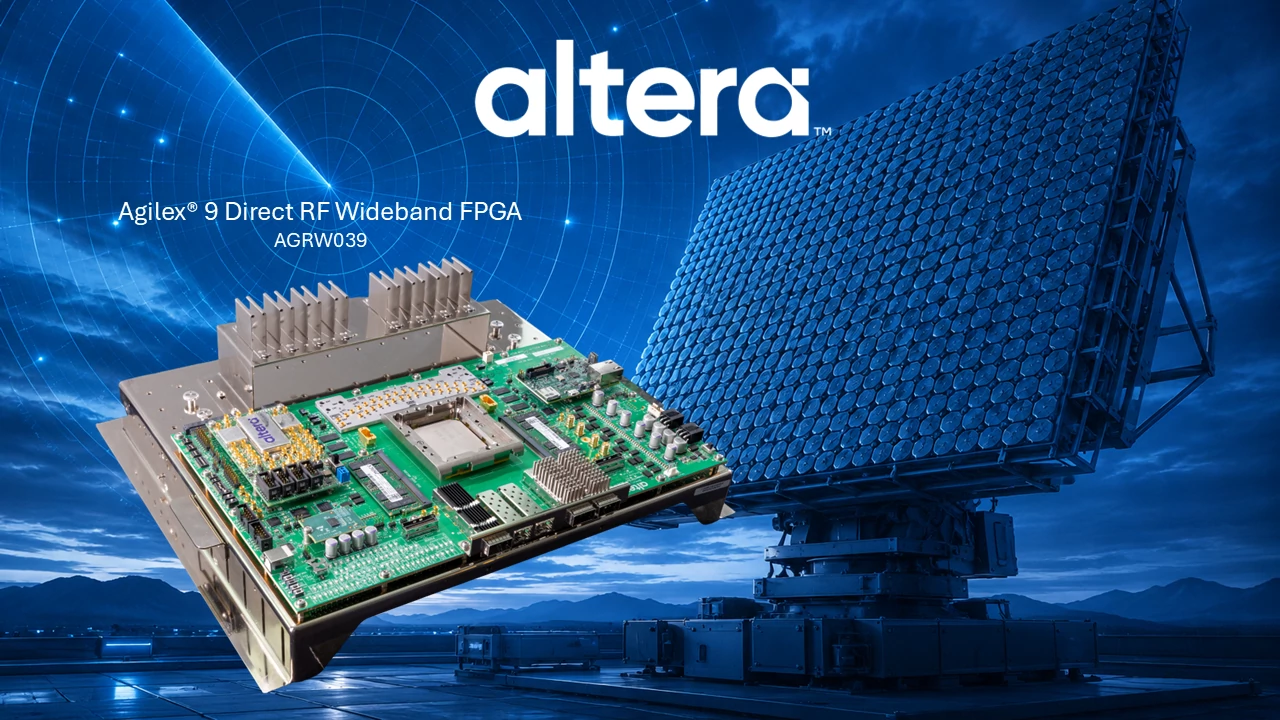
- Altera has introduced engineering samples of its Agilex 9 Direct RF-Series SoC FPGA.
- The platform integrates high-speed converters, programmable logic, processing, memory support, and direct RF capability.
- Wideband RF systems are moving towards tighter converter, compute, and FPGA integration.
Altera has introduced engineering samples of its Agilex 9 Direct RF-Series SoC FPGA, targeting aerospace, defence, and advanced communications systems that require wideband RF processing.
Announced at IMS2026, the device extends Altera’s Direct RF portfolio with a higher level of RF and compute integration. The company says the new generation delivers a 40% increase in compute capability per square millimetre compared with its previous Direct RF platform.
Agilex 9 Direct RF-Series SoC FPGAs combine high-speed data converters, programmable logic, processing elements, and memory support in a single package. The architecture is designed to move signal capture, generation, and processing closer together, reducing the number of devices required in wideband RF systems.
The new device supports integrated 64Gsps wideband RF capability, higher logic and DSP density, and DDR5 and LPDDR5 memory technologies. Altera says the platform provides 45% greater logic and DSP density than the previous generation.
Applications include radar, advanced communications, beamforming, data cube processing, and other RF-intensive systems that need real-time response under size, weight, power, and latency constraints. Production silicon and development kits are scheduled for availability in the third quarter of 2026, while engineering samples of the AGRW039 device are available now.
Wideband RF architecture is being compressed as systems handle more bandwidth, more modes, and more adaptive signal behaviour. Conventional designs often rely on multiple analogue conversion, intermediate-frequency, digital processing, and memory stages before signals reach useful analysis or response. Each stage adds latency, board area, power consumption, thermal load, and integration work.
Direct RF architectures reduce some of that burden by sampling closer to the antenna and pushing more signal-chain work into tightly integrated digital hardware. The engineering challenge then shifts towards converter performance, data movement, DSP density, memory bandwidth, synchronisation, and deterministic real-time behaviour inside a smaller hardware envelope.
Beam-steered and multifunction RF systems are already placing more pressure on validation and processing flows. Work on accelerated ESA testing by Rohde & Schwarz and Greenerwave shows how antenna platforms are becoming harder to characterise as steerable arrays move towards wider deployment. Agilex 9 Direct RF addresses the processing architecture behind similar systems, where higher bandwidth and adaptive operation have to fit within platform limits.
Defence and aerospace applications are an obvious fit, but the same pressures are spreading through 5G Advanced, 6G research, satellite communications, test platforms, software-defined radio, and instrumentation. Hardware has to support changing waveforms, multiple operating modes, reconfiguration, and heavier edge processing without expanding the RF chain.
FPGA-based RF systems remain attractive because they can evolve after deployment, yet programmability now has to sit closer to fixed-function performance. By integrating converters, compute resources, memory support, and programmable logic more tightly, Altera is pushing Direct RF further into applications where adaptability, bandwidth, and latency have to be engineered together.