IN Brief:
- The test measured a 50cm Ku-band electronically steerable antenna using a near-field setup.
- The radiation pattern was recorded in 32 minutes, with close agreement against simulation and compact range data.
- Faster ESA characterisation supports SATCOM, broadband, IoT, and defence antenna development.
Rohde & Schwarz and Greenerwave have demonstrated a near-field method for characterising electronically steerable antennas, recording the radiation pattern of a 50cm Ku-band SATCOM array in 32 minutes.
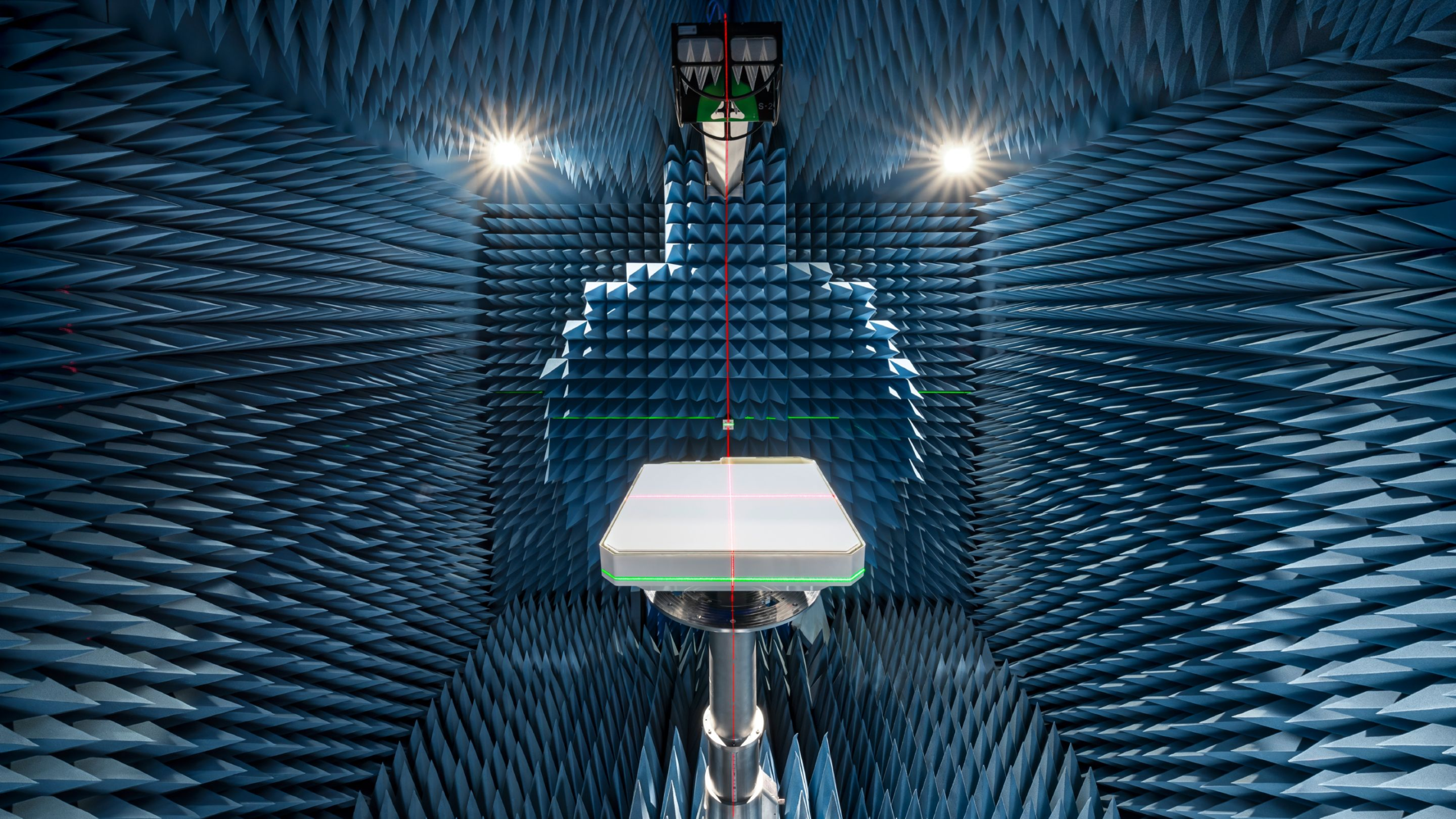
The measurement campaign used the R&S TS8991 over-the-air and antenna measurement system, a conical cut positioner, and the R&S ZNA vector network analyser. Greenerwave supplied a passive single-aperture electronically steerable antenna based on reconfigurable intelligent surface technology. The antenna under test had a 50cm by 50cm aperture and was developed for low power consumption and simplified integration.
The test recorded ten Ku-band frequencies across an extended upper hemisphere down to a polar angle of 120 degrees, using a one-degree step size. Data was processed through R&S AMS32 antenna measurement software, with near-field-to-far-field transformation used to derive the final antenna characterisation.
The measured results showed peak gain or directivity variations of no more than 1dB compared with the numerical twin model and Greenerwave’s compact antenna test range data. Typical variation was 0.3dB, supporting the use of near-field measurement for large SATCOM antenna validation where chamber size and test duration can become development bottlenecks.
Electronically steerable arrays are becoming central to satellite communications terminals across LEO, MEO, and GEO networks. Their performance depends on accurate characterisation of radiation pattern, beam control, gain, directivity, and behaviour across operating frequencies. As apertures increase and antenna suppliers move from prototypes towards deployable terminals, test throughput becomes a practical constraint.
Traditional far-field measurement can require large chambers, especially at Ku and Ka band where the antenna aperture may reach half a metre or more. Compact antenna test ranges reduce some infrastructure demands, but they still require substantial space and careful positioning. A near-field approach can reduce the required footprint and accelerate the measurement process while retaining correlation with established modelling and test methods.
RF validation is becoming more complex as antenna systems move beyond fixed beams and simple operating states. Beam-steered terminals depend on multiple phase and amplitude settings, software control, reconfigurable surfaces, and adaptive behaviour. Testing has to account for far more operating conditions than a conventional antenna with a static radiation pattern. Faster measurement workflows allow engineers to close the loop between simulation and physical validation without slowing development cycles.
The ability to export measurement data into tools such as CST Microwave Studio or MATLAB also supports the way modern antenna engineering is carried out. Design teams increasingly work across numerical modelling, chamber measurement, and system-level simulation, with each stage feeding the next. Reliable correlation between measured and simulated performance reduces late-stage redesign risk, particularly for antennas intended for aircraft, ships, land vehicles, and fixed SATCOM terminals.
Electronically steerable antenna adoption is expanding across broadband connectivity, defence communications, satellite IoT, and mobile platforms. Each application brings different mechanical, power, thermal, and integration requirements, but all depend on repeatable RF performance. Faster characterisation gives antenna developers a stronger route from numerical design to production validation as electronically steerable systems move into wider deployment.