
IN Brief:
- Samtec’s mPOWER system is now available with through-hole board termination options.
- The connector family supports up to 18A per blade and claims 40% space savings over traditional power connectors.
- The through-hole variants target rugged applications exposed to vibration, shock, and mechanical stress.
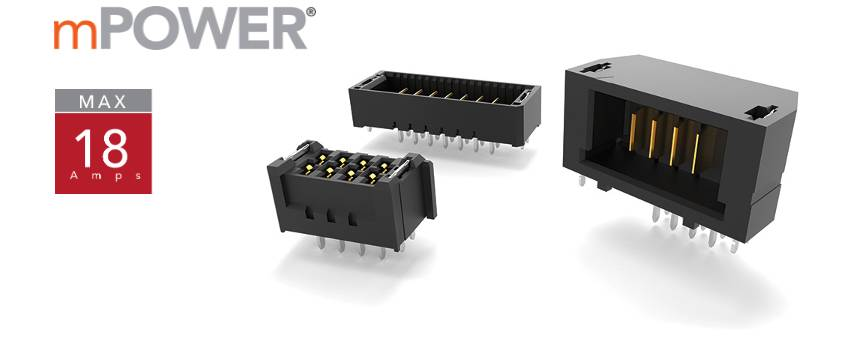
Samtec has expanded its mPOWER ultra-micro power interconnect system with through-hole board termination options for rugged, high-current applications.
The mPOWER family uses micro 2.00mm power blade interconnects and supports board-to-board, cable-to-board, and cable-to-cable designs. The system supports up to 18A per power blade in a compact form factor, giving design teams a high-current option for PCB assemblies where space and mechanical durability are both constrained.
The new through-hole board termination options apply to UMPT, UMPT-RA, and UMPS series products. Vertical and right-angle configurations are available, with two to 10 power positions and stack heights from 5mm to 16mm, 18mm, and 20mm. The range also includes tin or gold-plated power blade options, with 30µin gold plating available for specific requirements.
Samtec’s surface-mount mPOWER options are already used where compact power delivery and board density are priorities. Through-hole termination adds mechanical reinforcement for systems exposed to vibration, shock, and mechanical stress. That broadens the connector family’s use in military, aerospace, industrial, and transport equipment where retention and long-term electrical continuity are central design requirements.
The company positions mPOWER as approximately 40% smaller than traditional power connectors, while maintaining current capability through individual power blades. The design can be used in board stacking, perpendicular mating, wire-to-board, and wire-to-wire arrangements, giving engineers several routes for routing power into dense assemblies.
Power electronics design continues to push towards higher density. Equipment is becoming smaller, more modular, and more tightly packaged, while electrical loads are rising across embedded compute, industrial controls, robotics, instrumentation, and ruggedised systems. The interconnect has to carry higher current without becoming the limiting factor in board layout, thermal design, or service reliability.
Power connectors often define a large part of the system reliability envelope. A high-current interconnect has to manage contact resistance, temperature rise, creepage, clearance, retention, mating tolerance, and process compatibility. In vehicles, aircraft, factory automation systems, mobile machinery, and defence equipment, mechanical strength becomes as important as nominal current rating.
Through-hole termination remains useful in those environments because it increases shear and pull-force resistance compared with many compact surface-mount arrangements. The approach requires PCB area and manufacturing consideration, but it can provide a stronger mechanical connection where intermittent contact, fatigue, or field failure would carry a higher cost.
The additions also align with the move towards distributed power architectures. More systems now place conversion and distribution close to processors, actuators, sensors, and electromechanical loads. That drives demand for compact interconnects capable of carrying meaningful current into crowded board layouts without forcing a larger enclosure or a major mechanical redesign.
Offering through-hole variants alongside surface-mount options gives designers a way to use the same connector family across products with different mechanical requirements. That can simplify qualification, sourcing, and layout reuse, especially where commercial, industrial, and ruggedised versions share a common electronics platform.
The connector sits at the edge of the board, but it is no longer an afterthought in high-density power design. As current rises and equipment shrinks, the interconnect has to satisfy electrical, mechanical, thermal, and manufacturing requirements in a single component decision.

