IN Brief:
- Agilex 7 M-Series devices gain DDR5-6400 and LPDDR5-6400 support through Quartus Prime Pro 26.1.1.
- Supported configurations can deliver up to 204.8GB/s of aggregate memory bandwidth.
- Documented LPDDR5X compatibility gives selected Agilex 3 and Agilex 5 designs additional memory-sourcing options.
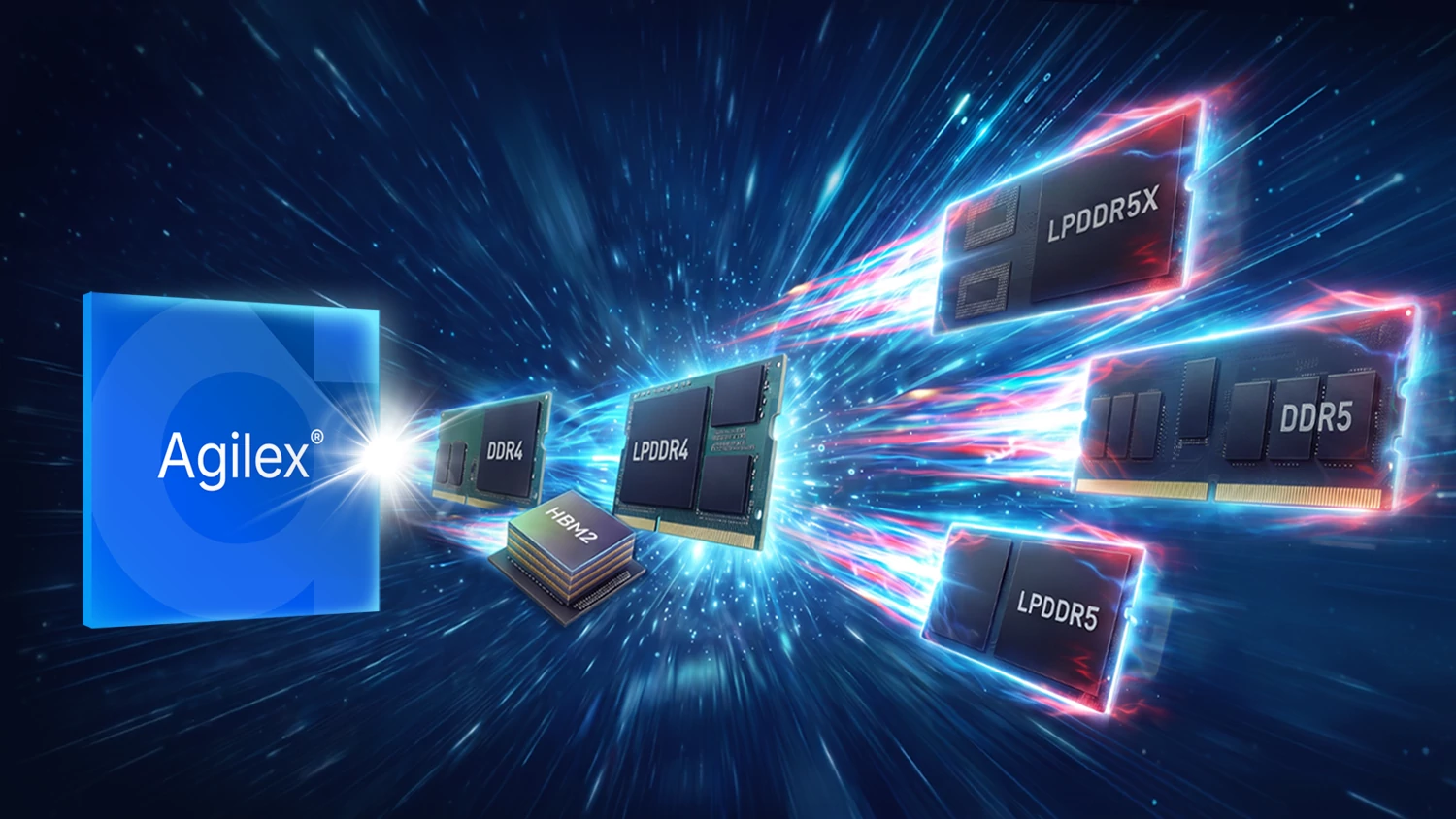
Altera has expanded high-speed memory support across its Agilex FPGA portfolio with Quartus Prime Pro Edition 26.1.1, adding DDR5-6400 and LPDDR5-6400 support to Agilex 7 M-Series devices and widening lower-power memory options elsewhere in the family.
The update matters because external memory bandwidth can become the limiting factor in FPGA systems long before the programmable logic itself is exhausted. AI accelerators, network-processing pipelines, and embedded systems can all require sustained access to large datasets, so faster memory support has to be considered as part of the wider architecture rather than as an isolated interface specification.
On Agilex 7 M-Series devices, the new release enables DDR5 and LPDDR5 operation at up to 6400MT/s. Altera states that supported configurations can deliver as much as 204.8GB/s of aggregate memory bandwidth, providing additional headroom where several channels are used to feed parallel processing or high-rate data movement.
Quartus 26.1.1 also adds LPDDR5 support to Agilex 3 devices, while Agilex 5 already supports DDR5 and LPDDR5. For supported Agilex 3 and Agilex 5 devices, Altera has documented compatibility with LPDDR5X components operating in LPDDR5-compatible mode, giving designers another sourcing option without implying that every LPDDR5X feature is available.
That distinction is useful in long-lived embedded and industrial designs. A memory device can become difficult to source years before the FPGA platform itself reaches end of life, forcing engineering teams to qualify alternatives against an otherwise stable board. Broader documented compatibility can reduce the amount of redesign required when suppliers change product availability or customers demand a longer production lifetime.
The choice between DDR5 and LPDDR5 is also more complex than a comparison of headline transfer rates. DDR5 can suit systems where capacity and sustained bandwidth dominate, while LPDDR devices offer a different balance around power consumption and board area. FPGA-based edge systems may therefore prefer a lower-power memory architecture even where the maximum available bandwidth is lower than a larger server-class implementation.
At 6400MT/s, the board design becomes part of the memory problem. Signal integrity, power integrity, routing topology, termination, package breakout, and timing margin all influence whether the interface can operate reliably. A software update can expose a faster supported mode, but it cannot turn an existing PCB into a 6400MT/s design if the physical implementation was never built for that speed.
This is where an FPGA vendor’s memory support extends beyond controller IP. The PHY, calibration, timing analysis, reference guidance, device models, and Quartus implementation flow all have to work together if the stated data rate is to be useful in production rather than only in a demonstration environment.
The update also gives existing Agilex users a degree of investment protection. Because the memory enhancements arrive through software, IP, and documentation rather than a new FPGA generation, some designs can adopt additional memory options while retaining their chosen logic device and development environment. The practical extent of that benefit will still depend on the board and memory hardware already in place.
For AI and networking applications, memory traffic can be especially difficult because several data paths may compete for the same external bandwidth. Accelerator inputs, packet buffers, processor exchanges, intermediate results, and storage traffic can all contend for memory access. Increasing the available bandwidth raises the ceiling, but system architects still need to manage arbitration, buffering, latency, and locality if application performance is to improve.
The new Quartus release is available now. The engineering value is less about attaching another speed grade to the Agilex name than about widening the range of memory architectures that can be qualified around existing FPGA families. In systems where the programmable logic has headroom but the memory interface is becoming restrictive, that can extend the useful life of a platform without forcing an immediate migration to new hardware.