
IN Brief:
- Altus Group has partnered with Optimum to supply Smart Klaus in the UK and Ireland.
- The camera-based system supports manual assembly, THT, final inspection, and goods processes.
- The platform links operator guidance with optical checks, traceability, and MES/ERP integration.
Altus Group has partnered with Optimum datamanagement solutions to introduce the Smart Klaus digital worker-assistance system to electronics manufacturers in the UK and Ireland.
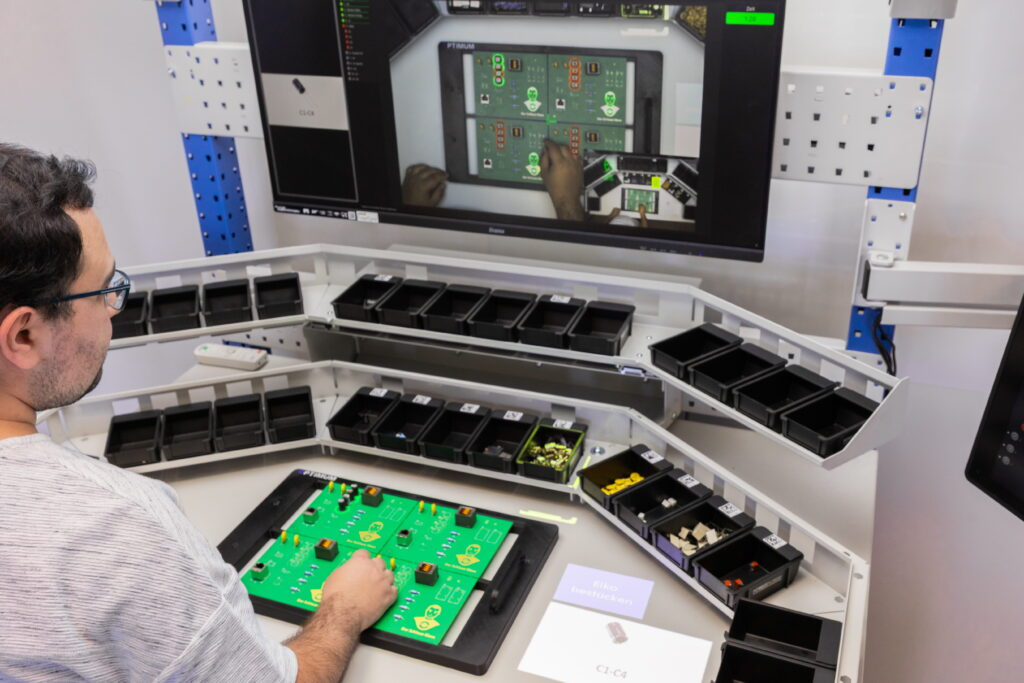
Smart Klaus is a camera-based production assistance platform for manual assembly, through-hole assembly, final inspection, outgoing goods inspection, and related production tasks. It combines step-by-step operator guidance with optical verification, helping production teams control build sequence, component placement, inspection results, and traceability at the workstation.
The platform can be configured with Pick-by-Light systems, projectors, external digital measuring tools, and interfaces to ERP and MES systems. Work instructions, process checks, and production data can therefore be brought into the same station, reducing dependence on paper documentation, informal operator knowledge, and disconnected inspection steps.
Manual assembly remains one of the harder areas of electronics production to digitise. SMT lines have absorbed significant investment in placement, inspection, reflow, traceability, and process control, but through-hole assembly, cable fitting, connector work, box build, rework, and final assembly often remain labour-intensive. These operations carry quality risk because outcomes depend on training, attention, component selection, work sequencing, and documentation discipline.
Worker-assistance systems create a practical route between paper-led manual work and full automation. A camera-based station can verify placement, sequence, orientation, and completion while presenting instructions in a controlled format. It can also capture evidence of production steps, which is increasingly valuable where customers require proof of build process, inspection status, or operator action.
Weak adoption of productivity technologies remains a persistent problem in UK engineering, a challenge reflected in Royal Academy of Engineering research on technology uptake across engineering businesses. Electronics production shows the same pattern: useful systems exist, but factories still have to integrate them around mixed product flows, established benches, operator routines, customer requirements, and legacy production data.
High-mix, low-volume manufacturing adds further pressure. Product changeovers, shorter build runs, labour constraints, and rising documentation requirements all make informal manual processes more difficult to stabilise. Digital guidance can help new operators reach consistent output more quickly, while experienced operators gain a controlled process environment that reduces avoidable errors.
Traceability is also gaining commercial value as electronics move deeper into medical, industrial, automotive, aerospace, and defence applications. Build records, inspection images, tool data, component handling evidence, and process compliance increasingly form part of customer assurance. In that environment, the production station becomes a data source as well as a place where work is performed.
Smart Klaus does not remove the need for skilled operators. It changes how that skill is supported, verified, and recorded. Where full automation is too rigid or uneconomic, assisted manual assembly gives manufacturers a way to improve consistency without stripping flexibility from production.

