IN Brief:
- Kodiak has integrated AMD EPYC processors into its seventh-generation autonomous truck computing platform.
- The CPUs provide 80 PCIe lanes, 3.15 GHz base frequency, and boost frequency up to 4.4 GHz.
- EPYC handles sensor aggregation, preprocessing, localisation, path planning, and other timing-sensitive processing inside the Kodiak Driver.
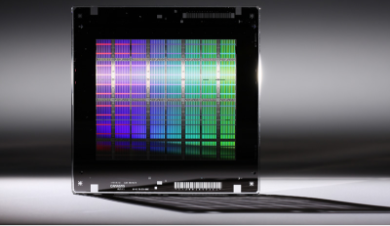
AMD EPYC processors are powering Kodiak AI’s seventh-generation autonomous truck platform, providing CPU capacity for sensor aggregation, localisation, path planning, logistics, and other timing-sensitive workloads inside the Kodiak Driver. The deployment places server-derived processors inside an embedded vehicle architecture handling large, continuously changing sensor datasets.
The EPYC processors used by Kodiak provide 80 PCI Express lanes and operate at a 3.15 GHz base frequency with maximum boost frequency of 4.4 GHz. AMD says that maximum clock speed is 25% higher than the processor used in Kodiak’s previous hardware generation.
Data from cameras, lidar, and radar in Kodiak’s SensorPods is aggregated through the EPYC processor for preprocessing and path planning. The CPU also handles localisation and general-purpose processing associated with determining vehicle navigation.
Autonomous-driving systems are often characterised by the performance of their AI accelerators, but a vehicle contains workloads that do not map neatly onto massively parallel hardware. System coordination, route planning, localisation, communications, sensor management, and sections of preprocessing can depend on serial execution or low and predictable response latency.
High CPU frequency therefore remains useful alongside accelerators, while the available PCIe connectivity determines how many high-bandwidth devices can be attached without excessive switching or interface consolidation. An autonomous truck has to connect processors to sensors, network controllers, storage, accelerators, diagnostic systems, and other peripherals within a finite board and enclosure architecture.
Eighty PCIe lanes provide substantial connectivity directly from the CPU, although Kodiak has not disclosed the complete internal topology of its seventh-generation compute system. The interface count gives the platform more flexibility to accommodate high-bandwidth devices without forcing all traffic through a narrow set of shared links.
The hardware operates under substantially different conditions from a conventional server. Vehicle electronics are exposed to vibration, changing ambient temperatures, restricted enclosure volume, road contamination, and limited electrical and thermal budgets. Higher processor performance therefore has to be supported by power conversion, cooling, connectors, memory, and storage capable of surviving sustained commercial operation.
Kodiak introduced its seventh-generation platform earlier in August. The company says Gen7 provides almost 50% more compute capability than its previous generation and uses more compact and serviceable hardware. It also reports that stress testing indicates the SensorPods and compute enclosures should deliver almost 50% longer operating lifetimes than previous versions.
Those durability claims are important because autonomous trucks are intended to operate for long commercial duty cycles rather than short development runs. Processing performance that requires frequent hardware replacement or excessive maintenance would undermine the economics of the vehicle regardless of benchmark results.
Using commercially available EPYC processors allows Kodiak to build around an existing processor ecosystem rather than maintaining its own general-purpose CPU design. That can shorten hardware development and provide access to established software tooling, but vehicle integration still requires thermal qualification, mechanical design, power management, fault handling, and validation of the complete electronics system.
The deployment is also occurring in a growing commercial fleet. Kodiak reported 35 customer-owned driverless trucks in operation at the end of its second quarter and more than 40,000 cumulative hours of paid driverless operation. The company is working towards driverless long-haul highway operations in the southern United States by the end of 2026.
As fleet numbers increase, processor choice affects manufacturing and maintenance as well as real-time compute. CPU availability, board design, enclosure cooling, vehicle wiring, spare parts, software qualification, and replacement procedures all become part of turning an autonomous-driving prototype into repeatable production hardware.
The EPYC integration therefore illustrates a broader characteristic of embedded AI systems: accelerators may provide the headline inference throughput, but the surrounding CPU and I/O architecture still has to ingest sensor data, coordinate the machine, and keep dozens of time-sensitive functions operating together. In Kodiak’s Gen7 platform, server-class EPYC silicon has taken on that central role inside a vehicle expected to operate continuously on public roads.