IN Brief:
- LUMI-AI will use AMD Instinct MI430X GPUs and sixth-generation EPYC processors with 256 CPU cores.
- The €387.8 million system is expected to provide ten times LUMI's AI capacity and nearly twice its HPC capability.
- Bull's liquid-cooled XH3500 platform combines AMD compute with IBM storage, Nokia networking, and BXI interconnect technology.
AMD will supply the processors at the heart of Europe’s €387.8 million LUMI-AI supercomputer, with next-generation Instinct MI430X GPUs and sixth-generation EPYC 256-core CPUs selected for the system due to enter service in Finland during 2027.
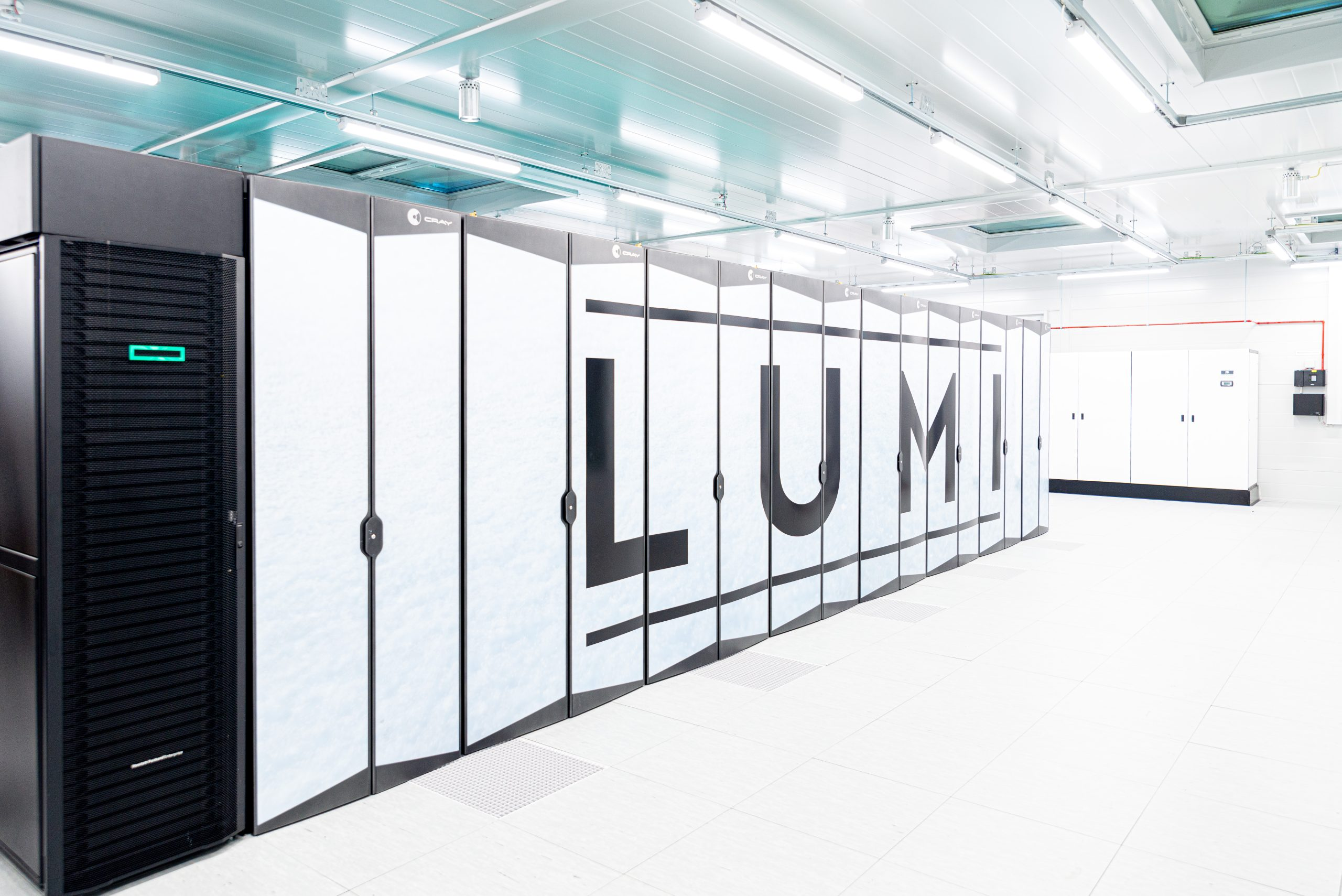
The EuroHPC Joint Undertaking has signed the procurement contract with Bull, which will deliver LUMI-AI to CSC – IT Center for Science in Kajaani. The new machine will form the computing backbone of the six-country LUMI AI Factory and is expected to provide around ten times the artificial-intelligence capacity and almost twice the conventional high-performance-computing capability of the existing LUMI system.
The contract covers acquisition, delivery, installation, and maintenance, with EuroHPC JU funding half of the €387.8 million cost through the Digital Europe Programme. The remaining half will be funded by the LUMI AI Factory consortium comprising Finland, Czechia, Denmark, Estonia, Norway, and Poland.
Deployment is scheduled for the second half of 2027 at CSC’s new data centre in the Renforsin Ranta business park. LUMI-AI will support AI training and inference alongside conventional scientific simulations, with access intended for researchers, start-ups, SMEs, and industrial users rather than operating solely as an academic computing resource.
The processor selection extends AMD’s role in the existing LUMI infrastructure. The current machine uses AMD Instinct MI250X accelerators across its main GPU partition, alongside AMD EPYC host processors, creating a degree of architectural continuity as CSC moves to a substantially more AI-oriented system.
LUMI-AI will shift that compute platform to the forthcoming Instinct MI430X accelerator and sixth-generation EPYC processors with 256 cores. Detailed node counts, accelerator quantities, memory capacities, and aggregate system performance have not yet been published, so the tenfold AI-capacity claim describes the planned system-level improvement rather than a disclosed comparison between individual processors.
The distinction is important in large AI systems because accelerator performance alone does not determine usable throughput. Training and inference across thousands of processors depend on the ability to keep data moving between accelerators, CPUs, storage, and neighbouring nodes without allowing communication overhead to leave expensive compute silicon idle.
Bull will build the machine around its BullSequana XH3500 architecture, a liquid-cooled platform designed to combine large-scale AI and traditional HPC workloads. Its own BXI interconnect will provide part of the high-bandwidth, low-latency fabric, while Nokia is contributing data-centre networking expertise and IBM will provide storage based on IBM Storage Scale.
The resulting architecture reflects the increasing convergence between supercomputing and AI infrastructure. Conventional HPC machines have historically been optimised around tightly coupled numerical simulations, while large AI workloads place heavy demands on accelerator-to-accelerator communication, high-throughput storage, distributed model training, and rapid movement of very large datasets.
Those workloads also vary considerably between users. LUMI-AI is being designed as a multi-tenant system, with API-based access intended to support more contemporary development environments alongside established batch-based supercomputing workflows. The approach should allow organisations to use the infrastructure without reproducing a traditional HPC software environment for every AI project.
For the processor and systems designers, that flexibility creates additional pressure on memory movement and interconnect performance. Large models can be distributed across many accelerators, requiring parameters and intermediate results to move continuously between devices, while scientific AI applications may also combine model execution with simulation data produced elsewhere in the same machine.
The CPU remains important despite the emphasis on GPUs. Host processors handle operating-system tasks, data preparation, orchestration, I/O, and parts of workloads that either cannot or should not be placed on the accelerator. Moving to 256-core EPYC processors gives each node substantial general-purpose compute capacity alongside the MI430X devices without relying on separate CPU-heavy infrastructure for every supporting task.
Storage has a similarly central role. Training datasets, checkpoints, simulation outputs, and intermediate results can reach sizes that make conventional enterprise storage architectures impractical. IBM Storage Scale is intended to provide the parallel data layer behind the compute system, while the networking architecture must connect storage and compute without allowing I/O bottlenecks to offset the available accelerator performance.
LUMI-AI will also integrate with the LUMI-IQ quantum-computing platform, allowing conventional HPC and AI resources to sit alongside quantum hardware within the wider Kajaani environment. The immediate engineering significance is less about replacing classical computation than making several computing architectures accessible through a common research infrastructure.
Power and cooling are equally material to the design. Bull will use direct liquid cooling based on warm water, avoiding reliance on air cooling around the highest-density compute equipment. The system is intended to run entirely on renewable electricity, while recovered heat will be fed into Kajaani’s district-heating network.
That arrangement follows the operating model already associated with the LUMI site, where energy efficiency and heat reuse are part of the infrastructure design rather than retrospective measures applied after installation. Higher accelerator densities make that approach increasingly necessary because removing several kilowatts from individual compute nodes becomes difficult with conventional air cooling alone.
The €387.8 million contract also demonstrates how processor selection is becoming tied to broader European infrastructure policy. EuroHPC has been expanding AI Factory capacity across the continent as demand for public and shared AI computing resources outstrips supply, creating a market for systems that combine high-end accelerators with European integration, operation, networking, and data-management capabilities.
Bull’s role is therefore considerably broader than assembling AMD processors into racks. The contractor is responsible for delivering an integrated machine in which accelerator hardware, host CPUs, storage, networking, cooling, software, and facility infrastructure have to operate as a single production platform.
For AMD, LUMI-AI provides another large European reference system for Instinct and EPYC at a point when competition for AI infrastructure is increasingly being decided at complete-system level. The MI430X will ultimately be judged not simply by its peak processor specifications, but by how effectively thousands of devices can be supplied with data, cooled, interconnected, programmed, and kept productive across a multi-user machine.
The next substantive milestones will be the disclosure of LUMI-AI’s detailed configuration and the start of installation in Kajaani. Until then, the published figures establish the scale of the procurement and its processor architecture: a €387.8 million Bull system built around AMD’s next Instinct and EPYC generations, targeting a tenfold increase in AI capacity when users begin accessing it during 2027.