
IN Brief:
- AMD has expanded Ryzen AI Embedded P100 with higher-core variants aimed at mixed industrial AI workloads.
- New parts bring up to 12 Zen 5 cores, RDNA 3.5 graphics, XDNA 2 NPU, ROCm support, and up to 80 system TOPS.
- The portfolio is being positioned for consolidated industrial PCs, robotics, and medical imaging platforms shipping through 2026.
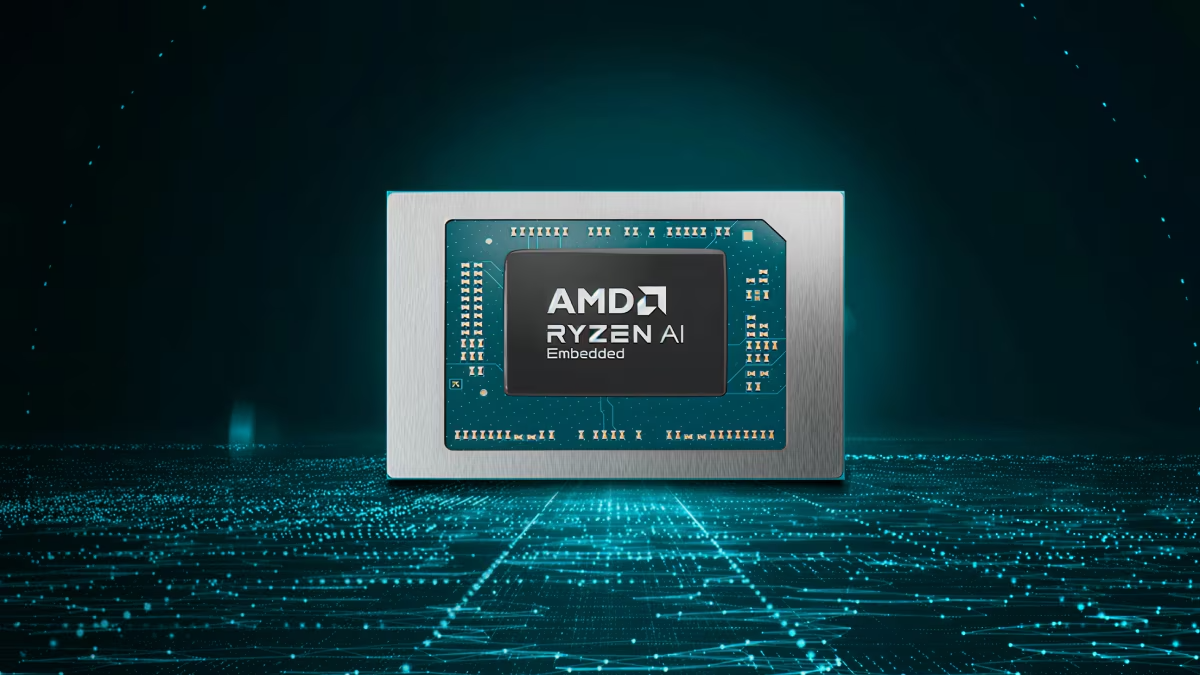
AMD has expanded Ryzen AI Embedded for heavier edge workloads. The latest additions to the Ryzen AI Embedded P100 Series push the portfolio up to 12 Zen 5 CPU cores and 80 system TOPS in the same compact footprint, giving system designers a broader spread of compute without forcing a move to a larger, multi-chip edge platform.
The emphasis is on consolidation. Industrial PCs, autonomous robots, and medical imaging systems increasingly want real-time control, graphics, machine vision, and local AI inference on one long-life embedded platform, but those requirements do not sit comfortably together. CPU headroom, deterministic response, GPU throughput, low-power inference, and lifecycle support all end up competing for board area, thermal budget, and software attention. AMD’s pitch is that the tighter CPU-GPU-NPU integration inside the P100 family makes that trade-off easier to manage.
At the top end, the new devices bring eight to 12 Zen 5 cores, RDNA 3.5 graphics, and an XDNA 2 NPU, while ROCm support extends a more familiar open software stack into embedded deployment. AMD is also leaning into use cases where different compute blocks can be partitioned with some clarity: multicamera machine vision and HMI in industrial PCs, perception and route planning in mobile robots, and 3D imaging plus edge AI analysis in medical equipment. The company is backing that with a virtualised reference stack built on Xen, designed to isolate Linux, Windows, Ubuntu, and RTOS domains for mixed-criticality applications.
Performance uplift is substantial on paper. AMD is quoting up to 39% higher multithreaded performance and up to 2.1x higher total system TOPS versus the previous Ryzen Embedded 8000 generation, alongside support for nearly twice as many virtual machines and larger models than lower-end P100 configurations. The usual caveat applies — edge performance is decided in thermal envelopes, not in slide decks — but the portfolio direction is clear enough.
What gives the launch more weight is the surrounding ecosystem work. Advantech, congatec, and Kontron are already lining up production hardware around the platform, and AMD is giving those partners a story that is wider than raw TOPS: open software, workload partitioning, deterministic behaviour, and lifecycle suitability for always-on deployments. The lower-core parts are expected to enter production in the second quarter of 2026, with eight- to 12-core variants following in July, which gives the industrial edge market a fairly direct timeline from sampling to system availability.

