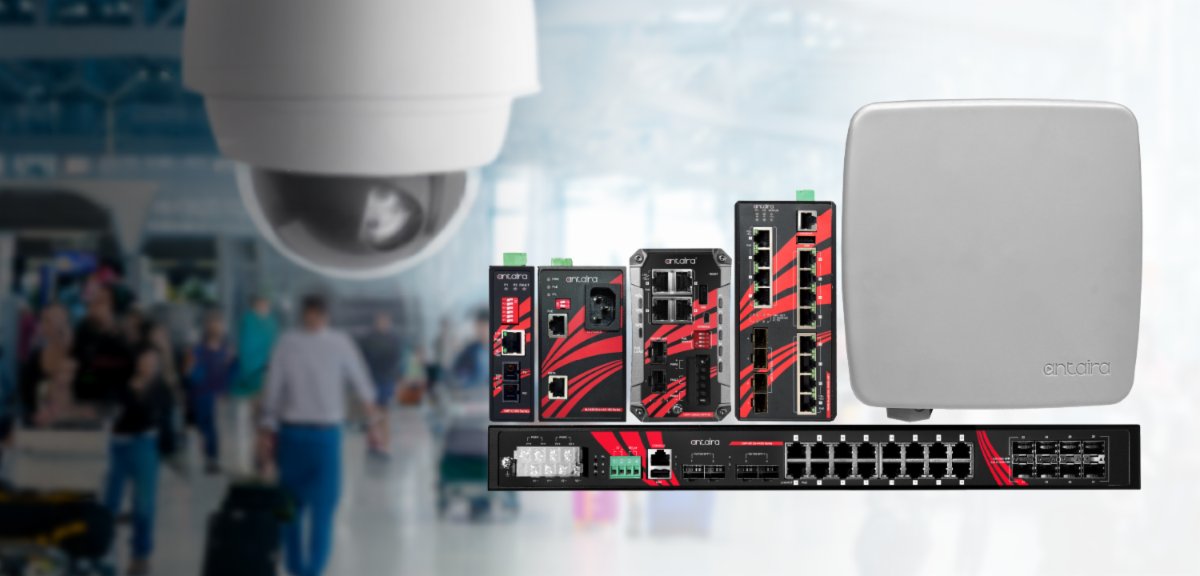
IN Brief:
- Antaira’s Layer 3 portfolio combines high-power PoE ports with OSPF, RIP, and VRRP routing functions.
- A new AC-powered switch provides two 95W IEEE 802.3bt outputs without requiring a separate industrial DC supply.
- IP67 wireless bridge hardware and central management software extend the portfolio into backhaul, commissioning, and network supervision.
Antaira Technologies is expanding its industrial Ethernet portfolio around higher-power IEEE 802.3bt PoE, Layer 3 routing, outdoor wireless backhaul, and centralised network management, targeting networks with cameras, wireless radios, sensors, and other edge devices that combine increasing bandwidth with heavier power requirements.
The company is presenting the portfolio at GSX 2026, but the engineering content extends beyond an exhibition preview. The announcement includes new AC-powered switching hardware, forthcoming high-power access switches, Layer 3 distribution platforms, outdoor wireless equipment, and management software intended to cover more of the path between powered edge devices and the wider network.
At the distribution layer, Antaira’s LMP-1604G-4XS-bt-T provides 12 Gigabit copper interfaces alongside four 1G/2.5G/10G SFP+ slots. Its current US product material describes support for several high-power PoE modes and advertises up to 100W-class delivery, while the formal port feature list specifies IEEE 802.3bt outputs at 90W per port and a 360W overall PoE budget.
That distinction matters in a high-power installation because per-port protocol capability and the total switch power budget are separate limits. A switch can support a high PoE class on individual ports without providing enough input and thermal capacity to run every port at its maximum simultaneously.
The LMP-1604 platform also includes OSPFv2 and OSPFv3, RIPv2 and RIPng, and VRRPv2 and VRRPv3. Those functions allow it to participate in routed networks rather than behaving solely as a Layer 2 access switch, while four SFP+ interfaces provide higher-bandwidth fibre links towards aggregation equipment.
Antaira’s larger LMP-3228G-4X24S-bt-T combines four 100W PoE++ copper ports with four 1G/2.5G/10G SFP+ slots and 24 Gigabit SFP interfaces. That configuration suits distribution locations where relatively few local devices need high-power copper connectivity but the bulk of the network is carried over fibre.
Dynamic routing and gateway redundancy become more useful as camera, wireless, and industrial networks are divided into multiple segments. OSPF can exchange routes between network devices automatically, while VRRP provides a mechanism for gateway failover. In an industrial switch, those functions have to coexist with extended-temperature operation, redundant power inputs, electromagnetic protection, and installation constraints absent from conventional office hardware.
Power delivery is becoming the other limiting factor. Earlier PoE generations were sufficient for basic cameras, telephones, and access points, but IEEE 802.3bt allows substantially more power to be delivered across the cable, supporting PTZ cameras, higher-performance radios, lighting, and other edge equipment that would otherwise need a separate local supply.
Antaira General Manager Joe Cook said: “Security networks continue to incorporate more cameras, wireless devices, and other connected equipment with higher power and bandwidth requirements.” He said the company is using the GSX demonstrations to show how those requirements can be addressed from the network edge through switching, wireless connectivity, and centralised management.
The new LNP-0401G-SFP-bt-AC-95-T addresses smaller installations where mains power is available but an industrial DC supply is not. The unmanaged switch incorporates its own AC/DC supply and provides two IEEE 802.3bt ports rated at up to 95W each, together with another Gigabit copper port and a 100/1000 SFP interface.
Antaira specifies operation from -40°C to 75°C, an IP30 aluminium enclosure, and DIN-rail or wall mounting. Combining the AC supply and PoE switching function can simplify a remote installation, although designers still have to account for the total 180W PoE budget, mains protection, cable length, connector heating, and environmental sealing around the complete enclosure.
Wireless backhaul is provided through the AIROLINX-GOMAX-KIT-IP67-T. Each kit ships as a matched point-to-point pair with integrated 19dBi panel antennas, a 5GHz dual-chain Wi-Fi 6 radio rated to wireless speeds of up to 2400Mbps, and IP67 housings for permanent outdoor use.
The associated Airolinx Go Studio software handles device discovery, first-run security, channel optimisation, antenna alignment, and link testing. A separate base unit extends the product family into point-to-multipoint networks. The commissioning functions are more useful than the raw radio-rate figure alone because outdoor wireless throughput depends heavily on alignment, interference, line of sight, regulatory limits, and link distance.
Antaira’s A.NMS software adds centralised device discovery, topology views, firmware and configuration management, alarms, SNMP and syslog monitoring, user privileges, and troubleshooting tools. That reduces dependence on managing every switch through a separate local interface once the deployment grows beyond a small collection of edge devices.
Although the announcement is aimed heavily at the security market, the engineering characteristics overlap with factory automation, utilities, transport infrastructure, and remote industrial installations. High-power PoE changes supply sizing and thermal design, while Layer 3 functions and fibre uplinks address the network architecture required once the number of powered endpoints starts to increase.
The portfolio therefore has a broader industrial electronics angle than the GSX framing suggests. The relevant development is the combination of powered Ethernet, routing, fibre, outdoor wireless, and management in equipment designed for wide-temperature environments, rather than the fact that those products are being demonstrated on a Las Vegas exhibition stand.