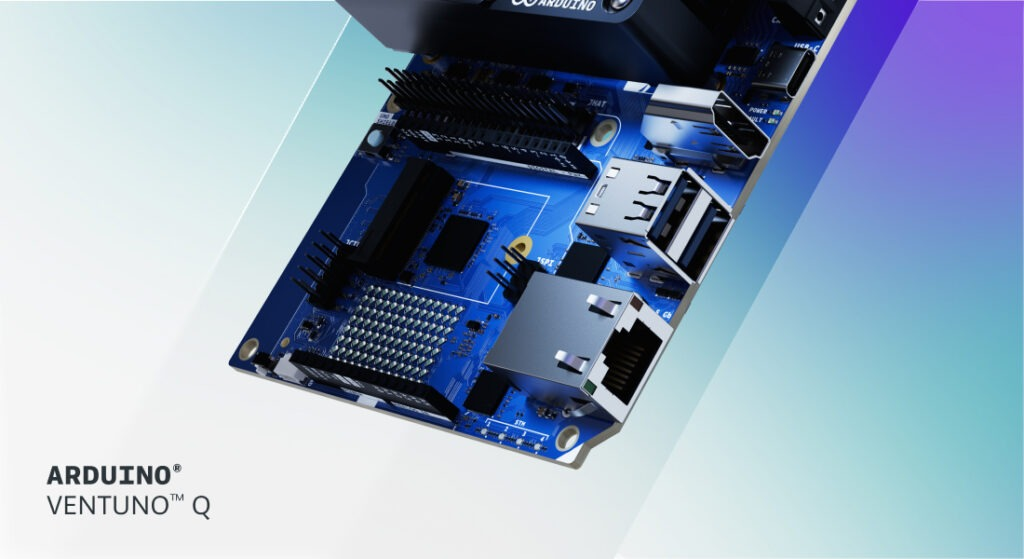
IN Brief:
- VENTUNO Q combines a Qualcomm Dragonwing IQ8 processor delivering up to 40 dense TOPS with an STM32H5 real-time microcontroller.
- The board carries 16GB LPDDR5, 64GB eMMC, NVMe expansion, three MIPI CSI interfaces, CAN-FD, 2.5Gb Ethernet, Wi-Fi 6, and Bluetooth 5.3.
- SECO and Toradex are supporting production-oriented modules using the same processor architecture, providing a route beyond prototyping.
Arduino has opened pre-orders for VENTUNO Q, an edge-AI development board built around a Qualcomm Dragonwing IQ8 processor and an STM32H5 real-time microcontroller. The platform combines high-throughput local inference with deterministic control on one board, allowing robotics and industrial systems to process sensor data while retaining direct control of motors, field interfaces, and time-critical functions.
The Qualcomm processor delivers up to 40 dense TOPS of AI performance, while the STM32H5 handles real-time tasks separately. Arduino pairs the processing architecture with 16GB of LPDDR5 memory and 64GB of eMMC storage, with an M.2 interface available for NVMe Gen4 expansion. Ubuntu runs on the application processor, while the microcontroller side uses the Arduino Core on Zephyr RTOS.
Separating the two processing environments is useful in machines that need substantial local compute without exposing control loops to the scheduling behaviour of a general-purpose operating system. Vision inference, path planning, or other Linux workloads can run on the application processor while motor control, interlocks, and deterministic sensor functions remain on the MCU. CAN-FD connectivity, including a dedicated physical interface on a screw terminal, gives the platform a more explicit industrial role than many general-purpose AI development boards.
The interface set supports sensor-rich systems. VENTUNO Q includes three MIPI CSI camera connectors, USB camera support, 2.5Gb Ethernet, tri-band Wi-Fi 6, and Bluetooth 5.3, alongside I2C/I3C, SPI, PWM, and UART. Display output is available through HDMI, DisplayPort over USB-C Alt Mode, and MIPI DSI, while ROS 2 compatibility provides a familiar framework for robotics development.
Arduino is also linking its traditional prototyping environment with a more conventional embedded Linux toolchain. App Lab can run NPU-optimised models from Qualcomm AI Hub, while developers can work with VS Code, PyCharm, Jupyter, Docker, and native Linux tools. GGUF-format models from Hugging Face can be brought into App Lab, and Edge Impulse Studio is integrated for teams that need to train or adapt models for specific sensor workloads.
Hardware compatibility is deliberately broad. Existing Arduino UNO shields and carriers are supported, along with Modulino nodes through the onboard Qwiic connector and Raspberry Pi HATs. That can reduce board-level work during early development, particularly where an engineering team already has proven sensors or interface hardware available in one of those formats.
The more difficult transition comes after the prototype. Development boards are designed for accessibility and flexibility, while production hardware has to satisfy thermal, mechanical, environmental, lifecycle, and qualification requirements that rarely fit an evaluation platform unchanged. Arduino is addressing that gap through its Works with Arduino programme, with SECO and Toradex among the first partners preparing production-oriented system-on-modules around the same Dragonwing IQ8 architecture.
Retaining the processor architecture across prototype and production hardware could reduce software migration work, although it does not remove the need for carrier-board development, validation, or application-specific qualification. The practical benefit will depend on how closely the partner modules reproduce the software environment, interfaces, accelerator support, and peripheral behaviour used during development on VENTUNO Q.
Edge-AI hardware is increasingly constrained by more than nominal accelerator throughput. Model compatibility, memory bandwidth, camera input, latency, thermal design, and sustained performance can have a greater effect on deployed systems than a headline TOPS figure. A processor capable of high peak inference throughput is of limited value if the target model contains unsupported operators, sensor data cannot reach the accelerator efficiently, or thermal limits force sustained performance below its nominal rating.
VENTUNO Q therefore arrives as a combined compute and control platform rather than simply another AI accelerator board. Pre-orders opened on 25 August, with distribution also planned through DigiKey, Farnell, Mouser, and RS. Its more demanding test will come when developers transfer working prototypes to production modules and begin measuring latency, thermal behaviour, deterministic control, and accelerator utilisation under continuous industrial workloads.