IN Brief:
- Europa provides 629 TOPS from eight second-generation AI processing cores with a 45W accelerator-card TDP.
- The architecture adds 16 RISC-V vector cores, 128MB L2 SRAM, 200GB/s DRAM bandwidth, and onboard video processing.
- PCIe accelerator products are shipping with validated Dell XE5 and Supermicro 111AD server configurations.
Axelera AI has launched its second-generation Europa AI Processing Unit for enterprise and physical-AI inference, with silicon shipping in accelerator products and validated server systems from Dell Technologies and Supermicro. The Eindhoven company is extending the architecture behind its edge products into servers intended to run persistent inference workloads within customer-controlled infrastructure.
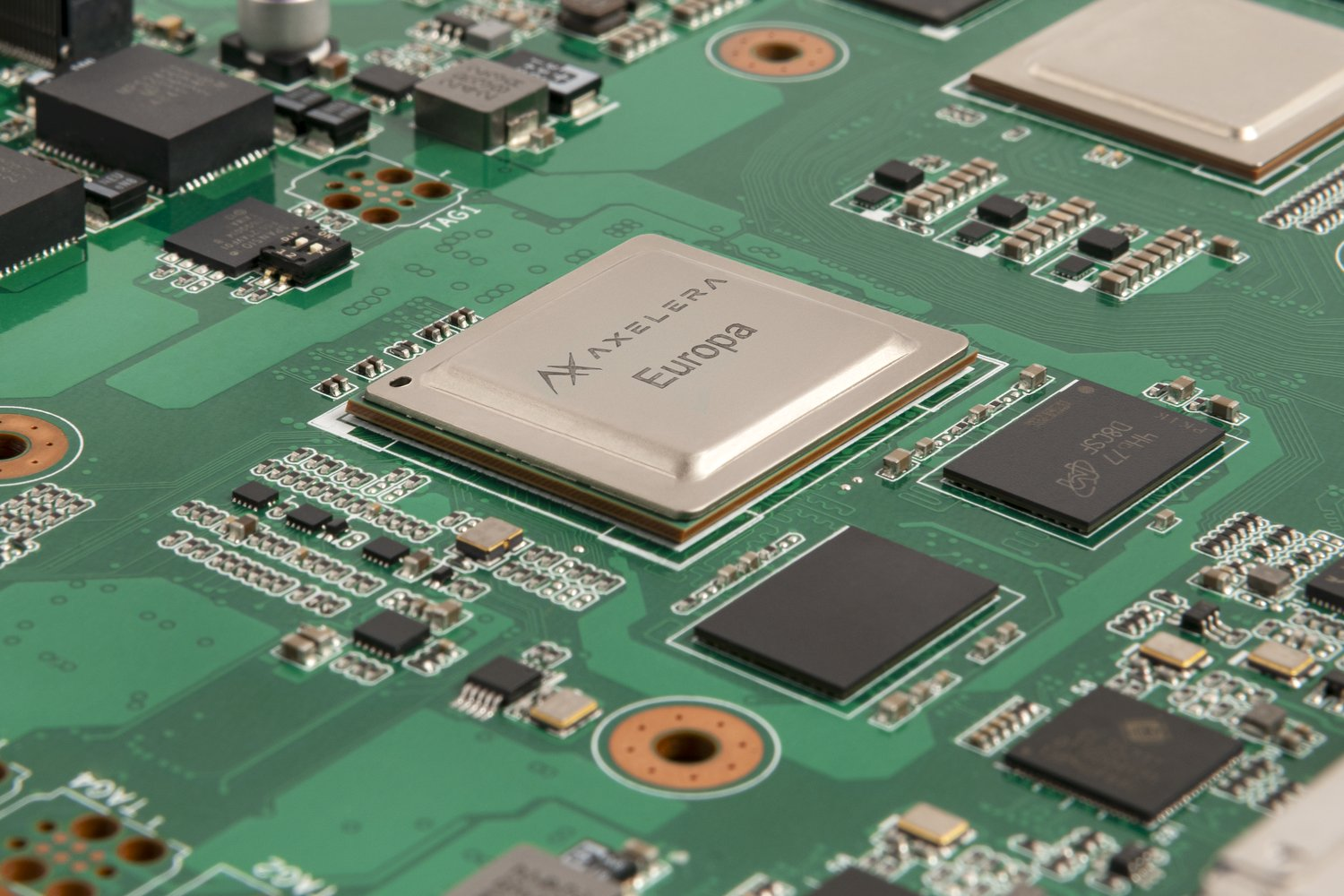
Europa provides 629 TOPS of inference performance from eight second-generation AI processing cores and carries a 45W TDP per accelerator card. Sixteen RISC-V vector processing cores handle pre- and post-processing on the device, while 128MB of L2 SRAM, 200GB/s of DRAM bandwidth, and an onboard video decoder are intended to reduce the amount of data movement through the host processor. The silicon is manufactured on Samsung’s 5nm process.
Axelera is offering Europa in three deployment forms. Customers can use the chip in their own board designs, install the single-AIPU Edge 232p half-height, half-length PCIe card, or use the full-height, full-length Server 250p. The PCIe approach allows the accelerator to enter conventional server platforms without requiring a proprietary rack architecture.
The Edge 232p is available in validated Dell XE5 and Supermicro 111AD systems. Axelera says Europa is shipping now and is also being adopted through a wider group of OEM, software, and infrastructure partners. The company reports deployments across more than 600 customers and a sales pipeline exceeding $1.5 billion, although those figures describe its broader business rather than booked Europa revenue.
Moving from edge hardware into servers changes the balance of the design. Edge inference is usually constrained by local power, thermals, latency, and physical space, whereas server deployments place greater emphasis on memory capacity, multi-user throughput, host integration, software portability, and fleet management. Europa is positioned between embedded inference devices and larger accelerator platforms used for training and very high-throughput inference.
The additional RISC-V vector cores and onboard video processing are intended to keep common data preparation and output-processing tasks away from the host CPU. Axelera also uses the same Voyager software toolchain across its Metis and Europa hardware, allowing applications to move between product classes without changing the entire deployment environment.
Samsung’s 5nm process also gives Axelera more transistor and power-management headroom than older edge-oriented nodes, but a server product still has to translate that silicon capability into predictable thermals at board level. A 45W accelerator can be attractive where several cards need to fit into a standard server, although cooling, PCIe slot power, airflow, and host allocation still determine how densely systems can be configured. The validated Dell and Supermicro platforms provide an early reference point for those integration constraints.
Software support will be central to the device’s commercial performance. Model coverage, compiler behaviour, quantisation, memory allocation, pre- and post-processing, and integration with existing server-management software determine how much of an accelerator’s theoretical throughput is available to a real application. Europa supports INT4, INT8, and INT16 workloads and targets agentic systems, vision-language models, generative AI, machine vision, and computer vision.
The launch also places Axelera within European infrastructure programmes seeking more locally controlled AI capacity. Dell Technologies is working with systems integrator E4 and Axelera on AI infrastructure for European AI Factory projects in Italy and Luxembourg. Standard PCIe card formats give those projects a familiar route for assembly, service, and expansion while allowing the accelerator technology to change independently of the surrounding server platform.
Axelera claims significant performance-per-watt and performance-per-dollar advantages over competing GPU-based systems, but those comparisons depend on workload, model, batch size, software version, and configuration. Production deployments will provide more useful evidence through sustained throughput, memory utilisation, host overhead, software stability, and behaviour within real power and cooling limits.
Europa gives Axelera a commercial bridge from its edge-AI portfolio into enterprise inference without abandoning the low-power design emphasis of its first generation. Shipping silicon, standard PCIe products, and validated Dell and Supermicro systems take the programme beyond an architecture announcement; the next measure will be how consistently the 629-TOPS device performs when integrated into production inference infrastructure.