
IN Brief:
- Bharat Electronics Limited and Bellatrix Aerospace will jointly design, develop, and manufacture satellite systems and payloads for Very Low Earth Orbit missions.
- VLEO can deliver sharper imaging, lower latency, and better atmospheric science, but the regime demands propulsion and platform designs that can handle persistent drag.
- The tie-up extends BEL’s space electronics work and gives Bellatrix a route to combine its propulsion stack with larger-scale manufacturing and mission-grade electronics.
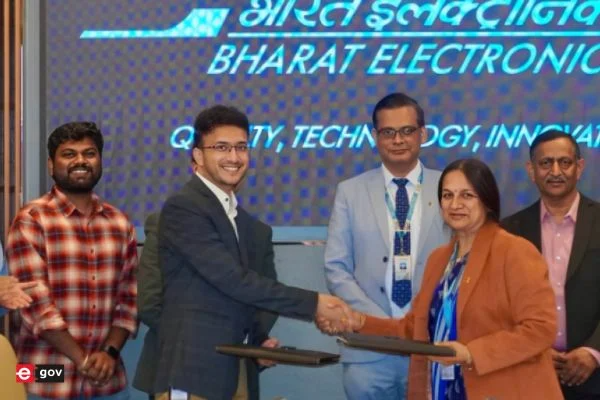
Bharat Electronics Limited and Bellatrix Aerospace have signed an MoU to jointly design, develop, and manufacture satellite systems and payloads aimed at Very Low Earth Orbit missions, bringing a defence-electronics heavyweight together with a propulsion specialist at a point where space hardware design is becoming more tightly coupled to orbital mechanics.
VLEO is typically defined as the band between roughly 100km and 450km above Earth. Its appeal is clear enough: satellites operating closer to the planet can deliver higher-resolution imagery, faster communications, and better atmospheric science, while avoiding some of the congestion that is building up elsewhere in low Earth orbit. The engineering trade-off is much less forgiving, because atmospheric drag rises sharply, pushing propulsion, power efficiency, thermal control, and platform mass from secondary design concerns into the centre of the mission.
That is what makes this pairing look more substantial than a routine cooperation agreement. BEL brings long-standing experience in mission electronics, RF and microwave subsystems, satcom terminals, and satellite integration. On its official space electronics programme, the company says it has completed assembly, integration, and testing of three RISAT satellites under ISRO supervision, is exploring satellite and payload development, and is also examining a LEO constellation programme. Bellatrix, founded in 2015, has built its profile around in-space mobility and propulsion, with products spanning green propulsion, electric propulsion, orbital transfer, and small-satellite subsystems.
Rohan M Ganapathy, CEO and CTO of Bellatrix Aerospace, said: “Very Low Earth Orbit opens up a new frontier for high-performance satellite missions, but it demands technologies purpose-built for that environment. This collaboration brings together complementary capabilities to accelerate the development of satellites designed specifically for sustained operations in VLEO.”
The immediate step is an MoU, not a flight programme, but the industrial direction is clear. VLEO is increasingly a systems-integration problem as much as an orbital one: propulsion cannot be separated from avionics, payload efficiency cannot be separated from orbit maintenance, and manufacturing discipline matters because the economics only become attractive when platforms can move beyond one-off demonstration hardware. That is a natural fit for BEL’s production depth and qualification culture, while Bellatrix supplies the propulsion and subsystem technology needed to keep a spacecraft viable in a far harsher operating band.
For BEL, the partnership broadens a space portfolio that was already moving beyond ground systems. For Bellatrix, it adds access to scale, qualification discipline, and an electronics pedigree that matters once missions shift from concept studies to deployable hardware. VLEO promises lower latency and sharper sensing, but it also punishes weak propulsion efficiency and poor platform integration very quickly. This agreement is aimed squarely at solving that problem.

